The Palace of the Dragon King of the Eastern Sea
Various legendary horizons; Munmu's story c. 681 CE · The eastern coast of Korea, and the underwater palace of Donghaeyong
Contents
A Korean warrior follows a sea turtle to the underwater palace of Donghaeyong, the Dragon King of the Eastern Sea. He heals the dragon king, or rescues his daughter, or receives a gift — a dragon pearl, a flute that calms armies, a sword that cannot be resisted. He returns to the human world changed.
- When
- Various legendary horizons; Munmu's story c. 681 CE
- Where
- The eastern coast of Korea, and the underwater palace of Donghaeyong
The eastern sea, off the Korean peninsula, is deep.
The continental shelf drops away early. Within a few miles of the coast the sea floor falls into the abyssal plain that runs all the way to Japan, and the water turns from green to blue to black. Korean fishermen for two thousand years have known that the eastern sea is not a place of casual sailing — the depths, the currents, the storms that come in from the north in autumn, all argue against treating it as a friendly water. The eastern sea is, in the old understanding, the territory of the Dragon King.
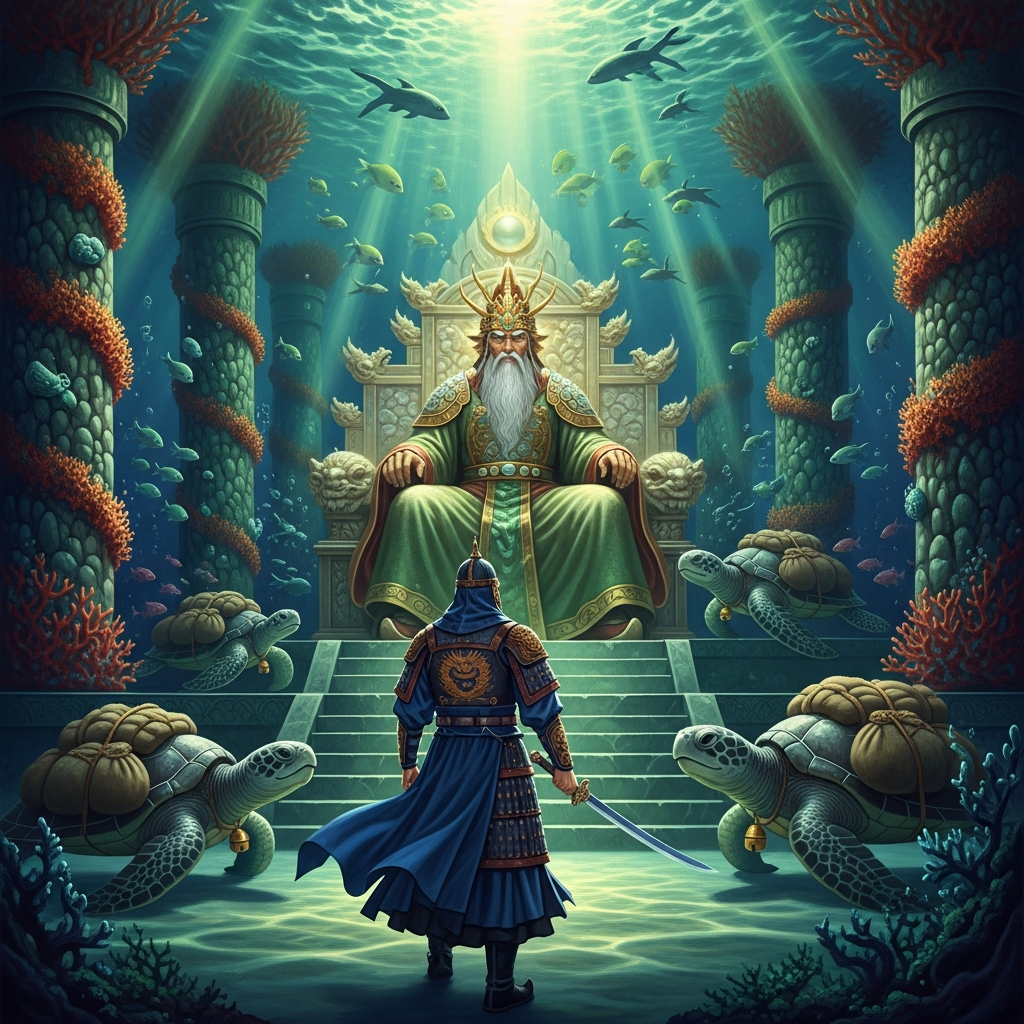
Donghaeyong — the Dragon King of the Eastern Sea — is one of the most precise figures in Korean mythology. He is older than the Silla kingdom that documented him. He rules the eastern sea from a palace at the bottom of it, a vast underwater hall built of coral and pearl and crystal, lit by lamps that do not need air, populated by a court of sea-creatures who have taken human form for the duration of their service. The Dragon King is occasionally on land, but usually at home, ruling the tides, the migrations, the storm patterns, and the diplomacy with the human kingdoms that share the coast.
He is approached, in the stories, by warriors and kings and occasionally by ordinary fishermen. The approach is always the same: a sea creature appears at a critical moment, asks a kindness, and the kindness opens the path to the palace. Sometimes the creature is a turtle whose shell has been damaged by hunters. Sometimes it is a fish caught in a net who reveals itself as the dragon king’s son. Sometimes it is the dragon king’s daughter herself, in human form, requesting passage or food or shelter from a fisherman who does not yet know whom he is helping. The kindness is performed. The creature reveals itself. The palace door opens.
The most famous of these stories is the founding of the Suro kingdom, in the southern part of the peninsula, in the first century CE.
Suro was the first king of Geumgwan Gaya — one of the small confederated kingdoms that preceded the unification of Korea — and his coming was prefigured by signs from the Dragon King. The story, recorded in the Samguk Yusa, has the elders of the future kingdom assembled on the shore at the Dragon King’s instruction. A great voice is heard from the sea. A golden box descends from the sky on a purple cord, suspended above the water just offshore. The box is opened. Inside are six golden eggs. From the eggs hatch six boys, who become the founding kings of the six confederated states. Suro is the first to emerge.
Suro’s queen, Heo Hwang-ok, comes by sea from a country far to the south — by some traditions India, by some traditions an island kingdom of the southern ocean — and she comes in a boat blessed by the Dragon King, who escorts her vessel past the storms and the reefs and brings her safely to Suro’s shore. The marriage of Suro and Heo Hwang-ok founds a dynasty. The Dragon King is the matchmaker. The eastern sea has organized the politics of the southern coast.
This is the diplomatic register of the Donghaeyong tradition. The Dragon King is not a distant force; he is an active participant in the founding of Korean kingdoms, and his patronage is part of the legitimating frame for any ruling line that has access to the coast.
The most beautiful of the stories is the gift of the Manpasikjeok.
In 681 CE, King Munmu of Silla died. Munmu was the king who had unified the Korean peninsula by defeating the rival kingdoms of Baekje and Goguryeo and pushing back the Tang Chinese forces who had come south to absorb the unified country into their own empire. He was, by every measure, the founder of the unified Korea that the modern peninsula remembers. He was also, at the end of his life, deeply concerned about the future of the kingdom — about the Japanese pirates who raided the eastern coast, about the Tang Chinese who might come back, about the internal factions that might tear the new unification apart.
Munmu instructed his son, the prince who would become King Sinmun, that his body was to be cremated and his ashes scattered in the eastern sea. I will become a dragon, Munmu said, and protect the country from the eastern coast. This was not metaphor. This was a specific request rooted in the Donghaeyong tradition: a great king could, with sufficient virtue and the appropriate burial, become a dragon of the eastern sea, joining Donghaeyong’s court and continuing his protective work from the underwater palace. Munmu died. His son followed his instructions. The ashes were scattered at the offshore rock now called Daewangam, the Great King’s Rock, two hundred meters from the shore at the mouth of the Daejong River. A small temple, Gameunsa, was built on the shore facing the rock. The temple’s design included an underwater chamber connected by channel to the sea — so that the dragon king Munmu could enter the temple from below, in dragon form, when he wished to consult with his son.
A year later, in 682, Sinmun received the gift.
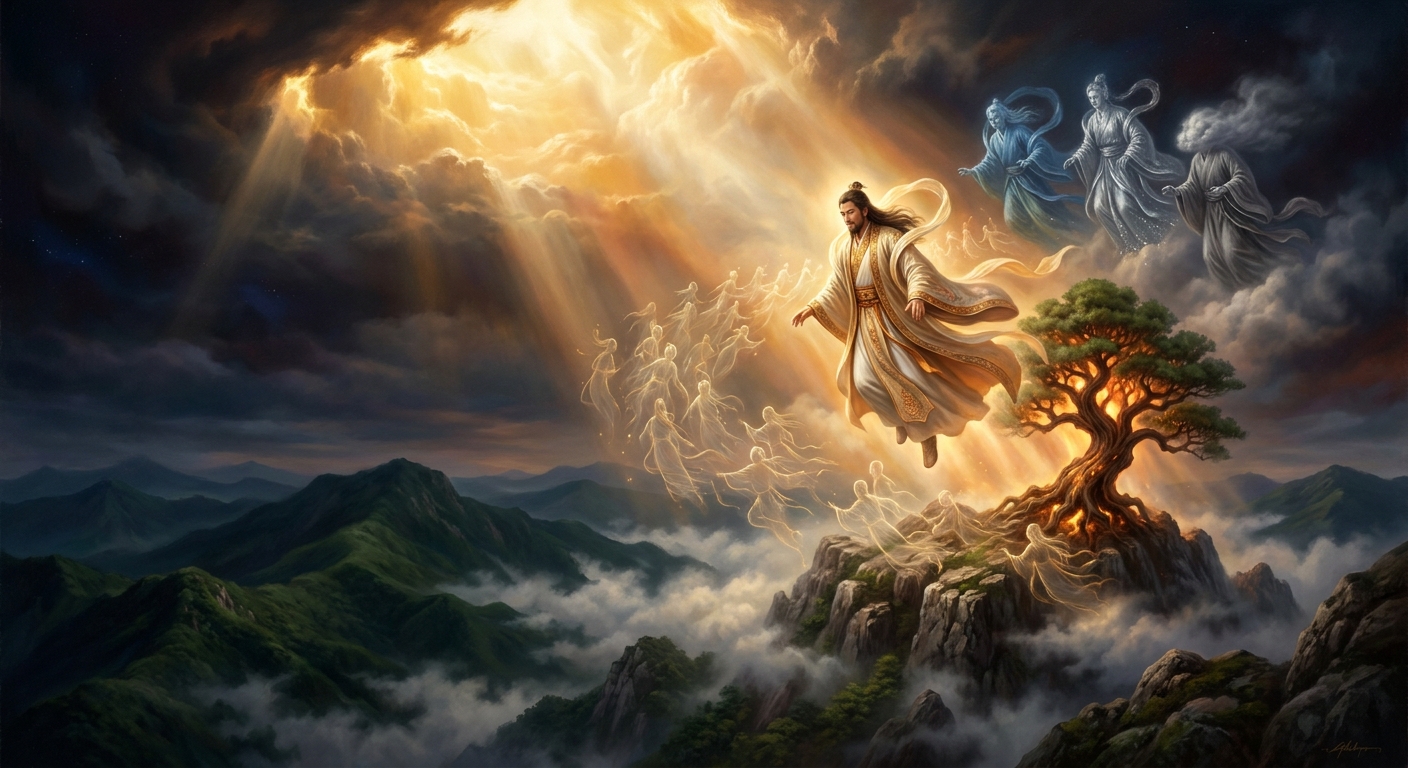
A small island appeared off the coast — a floating island, the texts say, that drifted toward the shore and stopped within wading distance of Gameunsa temple. On the island grew a single bamboo tree. The tree was unusual: in the daytime it split into two trunks, and at night the two trunks rejoined into one. Sinmun, who had been instructed by his court astrologer that this was a sign, walked out to the island. He met the dragon king there — Munmu’s father, or Munmu himself in his new form, or both at once, the texts are not strict — and was given a gift.
The gift was a flute. The flute was made from the bamboo of the floating island. It was called Manpasikjeok, the flute that calms ten thousand waves. The dragon king explained: when this flute is played, every problem that afflicts the kingdom subsides. Enemies retreat. Drought ends. Epidemic disease ceases. Earthquakes stop. The peninsula’s hostile geographies and politics, played upon by the flute, fall into temporary order. The flute is the Dragon King’s contribution to the new kingdom. It is the gift of the eastern sea to the unified Korea.
Sinmun took the flute. He returned to the shore. He played it. The chronicle reports that for many years afterward, when the flute was played at moments of national crisis, the crisis subsided. The flute was kept in the royal treasury of Silla. It was played sparingly. It was guarded carefully. It was lost, eventually, in one of the dynastic transitions, but the memory of it has remained — the Manpasikjeok is one of the central items in the Korean mythological inventory, and Gameunsa temple still stands (in ruins, but visited) on the eastern coast, with Daewangam visible offshore.
The pattern of the Donghaeyong stories is consistent across the centuries.
A human protagonist — usually male, usually a warrior or a king or someone with the moral capacity to recognize a sea creature when one appears — is approached by a creature in distress. A turtle on a beach with a damaged shell. A fish in a net that speaks. A young woman in plain clothes who asks for shelter. The protagonist responds with kindness. The creature reveals itself. The protagonist is invited to the palace.
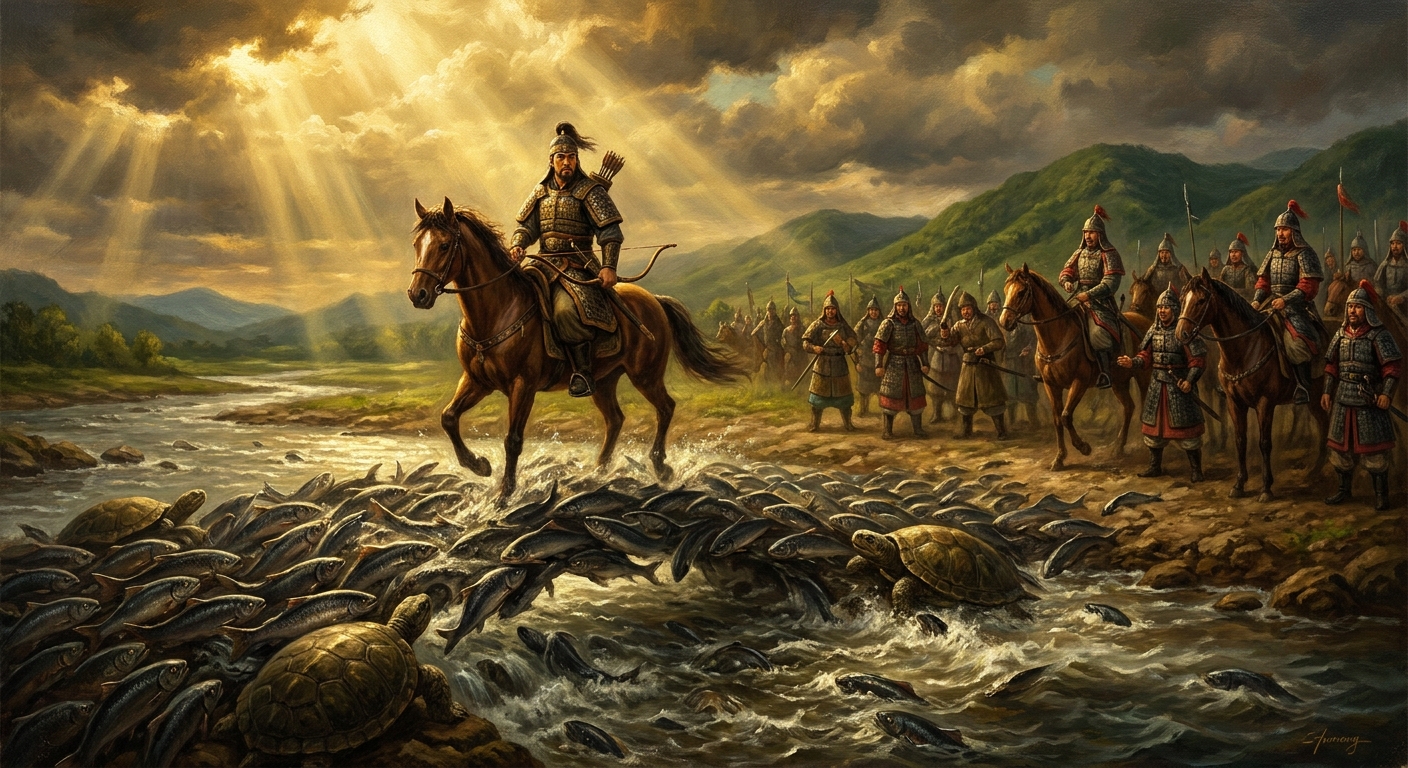
The descent to the palace varies. In some stories, the turtle carries the protagonist on its back; the protagonist clings to the shell as the turtle dives, and somehow the protagonist can breathe underwater for the duration of the journey — the dragon king’s protection extends to his guests. In other stories, the path opens through a hole in a rock at low tide; the protagonist walks down a stone staircase that descends through the sea floor, with the water somehow held back by an invisible barrier that lets the path stay dry. In a third version, the protagonist falls asleep on a beach and wakes inside the palace, the journey having occurred during sleep.
The palace is described with consistent imagery. It is vast. It is bright — lit by some inner light, not by lamps. Its halls are paved with mother-of-pearl. Its pillars are of red coral. Its ceilings are vaulted. Its courtiers are sea creatures in formal dress: the prime minister is an old turtle in court robes, the chief of guards is a swordfish, the musicians are jellyfish, the chefs are shrimp and crabs. Everyone speaks the polite court Korean of the period of the story. The dragon king himself is enormous in his true form but receives visitors in human form, as a tall robed figure with a long white beard and quietly authoritative voice.
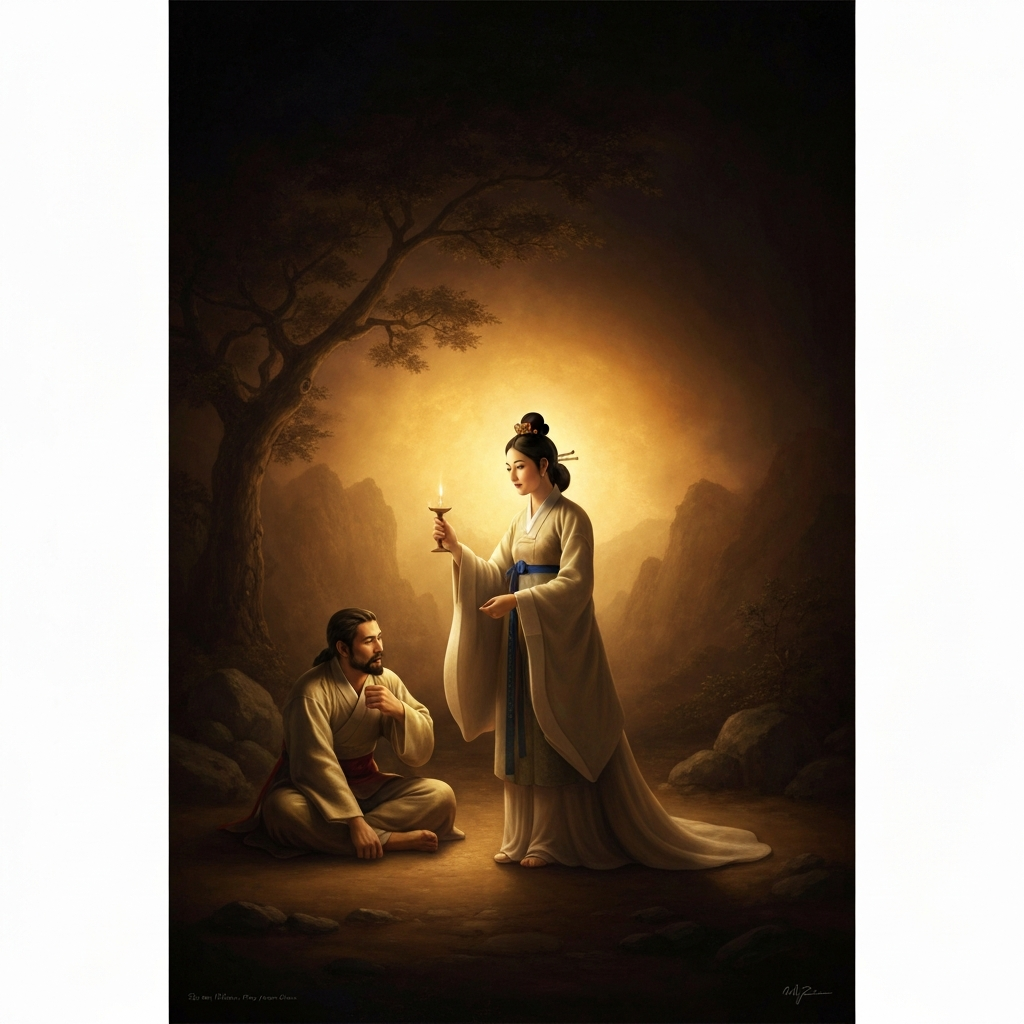
The protagonist is hosted. There is a feast — fish, of course, but prepared in extraordinary ways the surface world does not know, and seaweeds, and the strange fruits of the underwater gardens. There is music. There is conversation. The dragon king, eventually, comes to the matter at hand: a service is needed. His daughter is ill. His son has been kidnapped by a rival sea creature. His palace is plagued by a sea-monster that even his guards cannot defeat. The protagonist agrees to help.
The help is rendered. The daughter is healed (often by a herb the protagonist brought from land, since some healing requires earth-elements). The son is rescued. The monster is fought and defeated. The dragon king is grateful. The reward is offered.
The reward varies by story but is always specific. A dragon pearl — a small luminous orb that grants its bearer the ability to breathe underwater, or to control weather, or to see truly. A flute, like Manpasikjeok. A sword that cannot be resisted in battle, often called a yongcheom or dragon sword. A robe that protects against drowning. A song that, sung at the right moment, parts the waters. The protagonist accepts the reward, often with the warning that it is to be used only at moments of true necessity. The protagonist returns to the surface — by turtle, by stairway, by the same means as the descent — and resumes life on land.
Life on land is changed. The protagonist has been somewhere most humans never go. The protagonist now carries an object or a memory that connects them permanently to the eastern sea. The protagonist’s later career is shaped by the encounter — they win battles they should not have won, they save kingdoms that should have fallen, they become the figure in their lineage’s story whose virtue brought a gift from the deep.
The Donghaeyong tradition is not extinct.
It survives in modern Korean popular religion, especially on the east coast, where shamanic practitioners (mudang) still perform rituals invoking the Dragon King. The festivals at Gangneung, at Ulleungdo, at Yeongdeok, include offerings to Donghaeyong — fishermen launch small boats with food and rice wine and silk, asking for safety in the season’s catches. The temple at Gameunsa, though it is now a UNESCO World Heritage site rather than an active temple, still receives visitors who come to pray at the Daewangam rock offshore. The two pagodas of Gameunsa still stand, the tallest stone pagodas in Korea, marking the place where the dragon king Munmu was supposed to have entered the temple from below.
The tradition has also entered modern Korean popular culture — historical dramas about Silla and Goguryeo regularly feature the Dragon King and his palace, the Manpasikjeok flute appears as a magical artifact in fantasy novels and television, the underwater palace is a setting in animation and video games. The Donghaeyong is one of the still-living mythological frames of the Korean cultural imagination, and the eastern sea, when one stands on the cliffs at Gangneung at sunrise and watches the water turn from black to gray to gold, is still the sea of the dragon king.
The Donghaeyong tradition is one of the most generous theologies of the sea in any world tradition. The eastern sea is not a place of monsters who hate humans. It is a kingdom in active diplomatic relationship with the human kingdoms of the coast. The dragon king is a peer ruler, with his own court and protocols and concerns, and he is willing to help when help is asked properly and when his own family receives kindness from human visitors.
The protagonist of every Donghaeyong story does the same thing: he treats a sea creature with respect. The creature turns out to be of higher rank than the protagonist could have known. The protagonist is rewarded for kindness performed without knowledge of who was watching. The moral of the tradition is the same as the moral of the Sumerian Lugbalbanda story, the same as the Japanese Urashima Tarō, the same as a hundred other variants of the same archetype: the small kindness, performed when no one important is looking, is in fact the act that the cosmos has been watching.
Korea is a peninsula. Three sides of the country are sea. The Donghaeyong tradition gave the peninsula a way to think about the water that did not reduce it to threat. The water was a kingdom. Its ruler had concerns. The ruler could be approached. The ruler had gifts to give, when the conditions were met. King Munmu, dying, asked to be buried in this kingdom, asked to join its court, asked to continue protecting his people from the underwater palace — and his son, on the shore at Gameunsa, received from him the flute that calms ten thousand waves. The flute is lost. The temple is in ruins. The rock offshore is still there, and the eastern sea behind it is still, in the old Korean understanding, the territory of the dragon king.
Echoes Across Traditions
Entities
- Donghaeyong (Dragon King of the Eastern Sea)
- Suro
- Munmu
- Manpasikjeok (the divine flute)
Sources
- Iryeon, *Samguk Yusa* (Memorabilia of the Three Kingdoms), 13th c.
- Kim Bu-sik, *Samguk Sagi* (History of the Three Kingdoms), 1145 CE
- James Huntley Grayson, *Korea: A Religious History* (2002)
- Folk traditions of the Korean east coast, especially Gameunsa temple area