Banda Singh Bahadur: The Ascetic Who Became an Army
1708–1716 CE; Punjab and the Deccan, Mughal Empire · Nanded (Deccan) — meeting Guru Gobind Singh; Punjab — the campaign; Gurudaspur, then Delhi — execution
Contents
Banda Bahadur was a Hindu ascetic living in a forest when Guru Gobind Singh found him, converted him to Sikhism, and gave him five arrows and a drum. He was told to avenge the martyred sons of the Guru and to fight Mughal tyranny in Punjab. Within two years, Banda had raised a peasant army, defeated the governor who had executed the Guru's sons, and established the first Sikh polity in history. He was captured, tortured for months, and executed in 1716 refusing to convert. He went laughing.
- When
- 1708–1716 CE; Punjab and the Deccan, Mughal Empire
- Where
- Nanded (Deccan) — meeting Guru Gobind Singh; Punjab — the campaign; Gurudaspur, then Delhi — execution
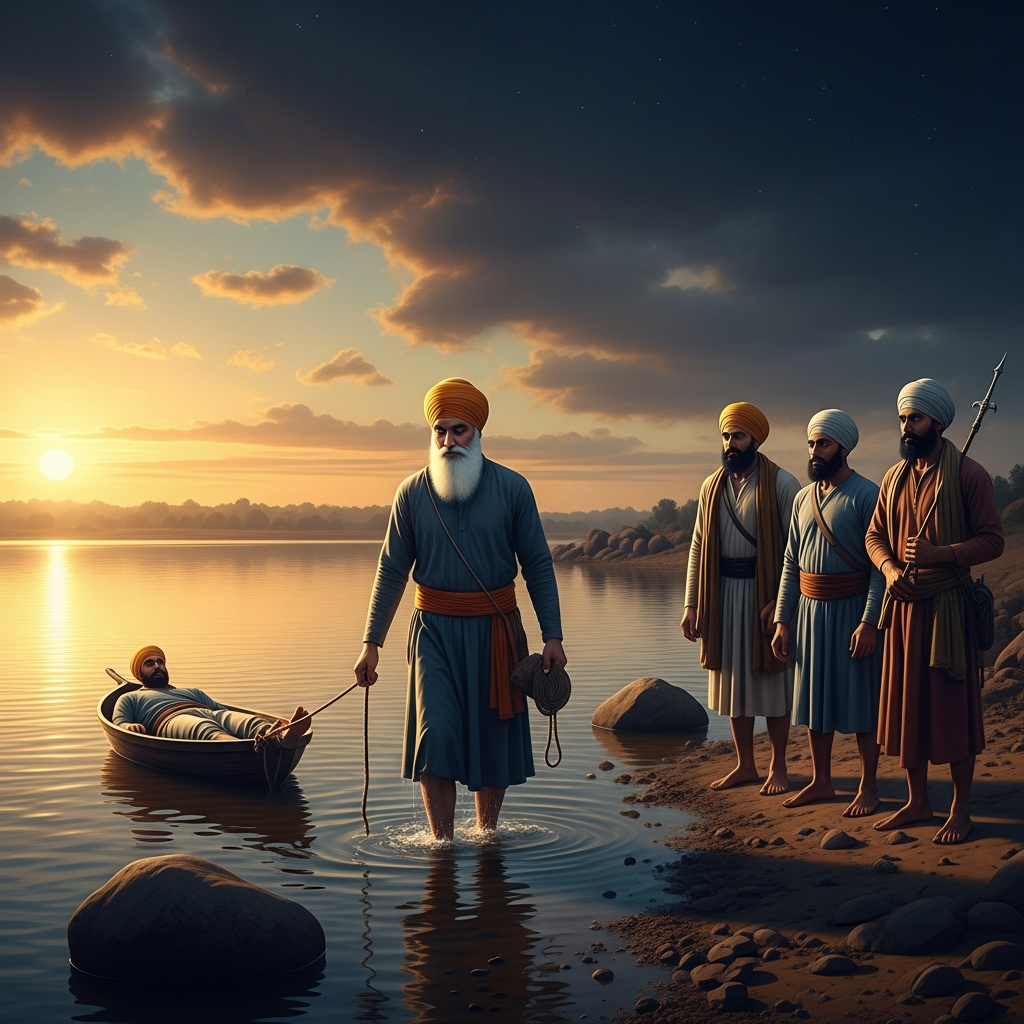
Madho Das was meditating when the Guru arrived.
He was a Hindu Vaishnava ascetic, a bairagi — a renunciant — who had established a hermitage in the forests near Nanded in the Deccan, far from the Punjab where the worst things in his lifetime were happening. He had some reputation as a practitioner, some local followers, a hut, and a determination to stay out of the world’s complications. He was around forty years old and had spent twenty of those years in the kind of ascetic practice that builds specific spiritual capacities and specific spiritual detachment.
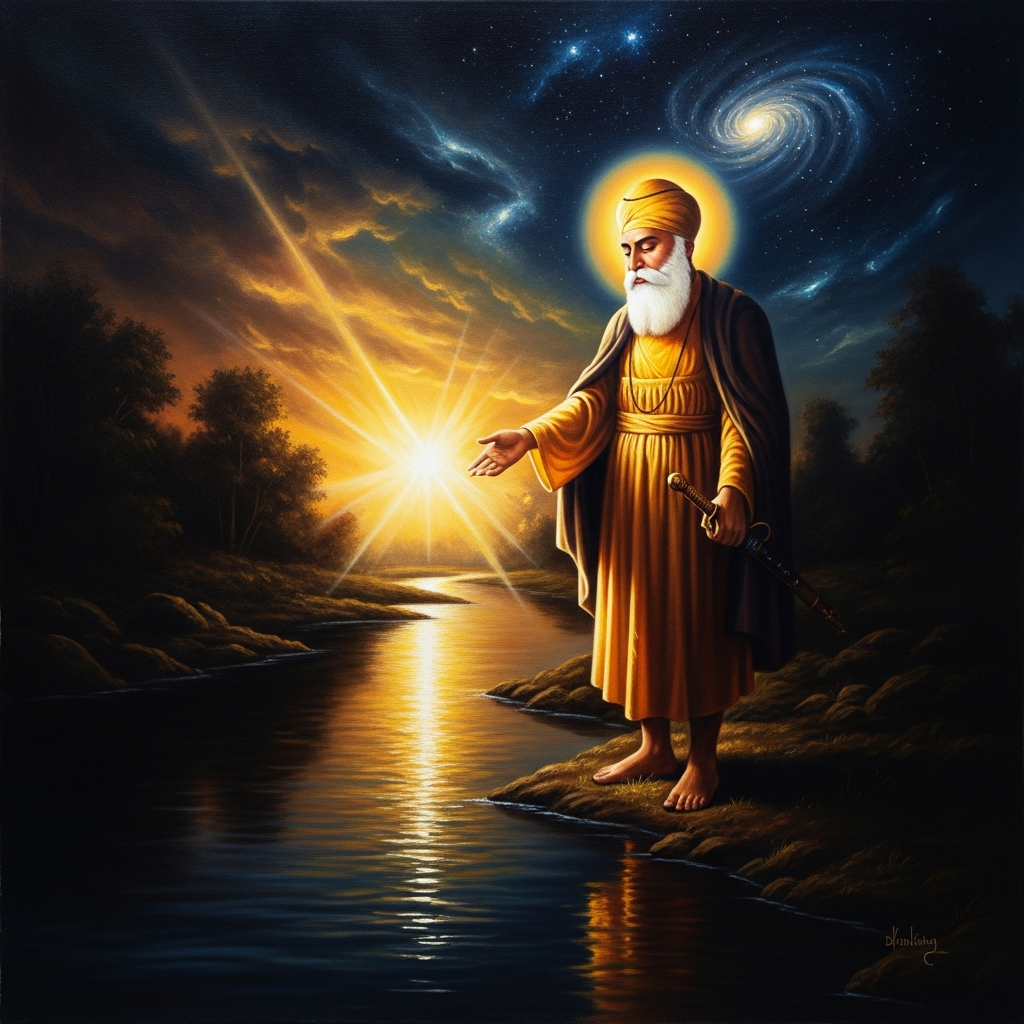
Guru Gobind Singh walked into his hermitage in September 1708.
The Guru was also about forty. He had lost his four sons — two in battle at Chamkaur, two bricked alive into a wall at Sirhind on the orders of Wazir Khan, the Nawab of Sirhind, for refusing to convert to Islam. He had lost his mother to grief. He had spent years in the Deccan forests fighting a running war against the combined forces of the Mughal governors and the hill chiefs of the Punjab. He was walking south to meet the Mughal Emperor Bahadur Shah I, with whom he had negotiated a tentative understanding, when he encountered Madho Das.
The encounter between the two men is one of the most compressed in Sikh narrative.
Madho Das had heard of Guru Gobind Singh — the Tenth Guru, the founder of the Khalsa, the warrior-saint whose battles against the Mughals were known throughout the subcontinent. When the Guru walked into the hermitage, Madho Das used the powers his practice had given him to place obstacles in the way. The accounts are varied in their specifics — the ground shakes, the fire goes out, the cooking pots refuse to stay upright — and uniform in their conclusion: the obstacles do not work. The Guru sits down in the hermitage without difficulty and waits.
Madho Das returns and finds a man sitting in his seat.
He asks, with the directness of an ascetic who has not bothered with social form for twenty years: who are you?
The Guru says: I am he whom you know.
The tradition records what happens next without explaining it, which is the tradition’s way of saying it cannot be explained. Madho Das falls at the Guru’s feet and says: Tere ko banda hoon — I am your bondsman. Your servant. Your instrument.
He has just given the Guru his name.
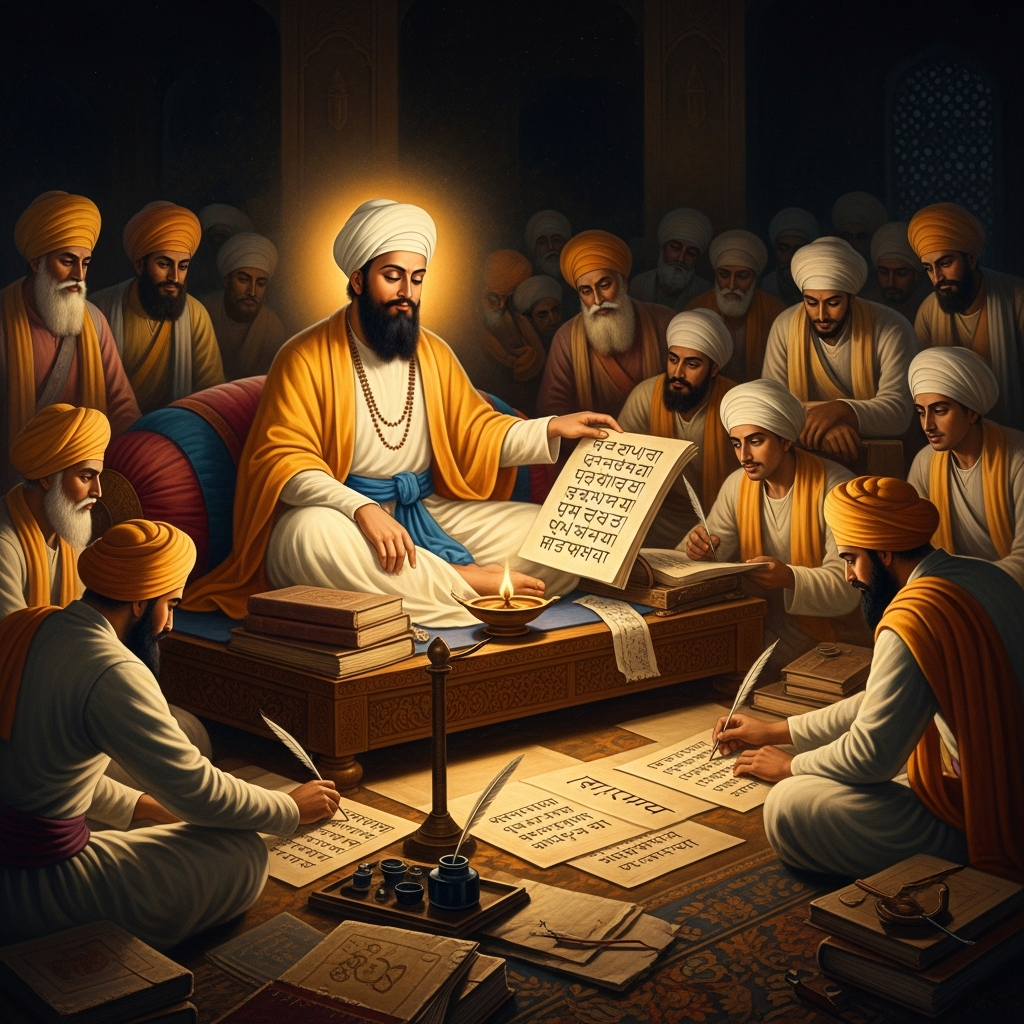
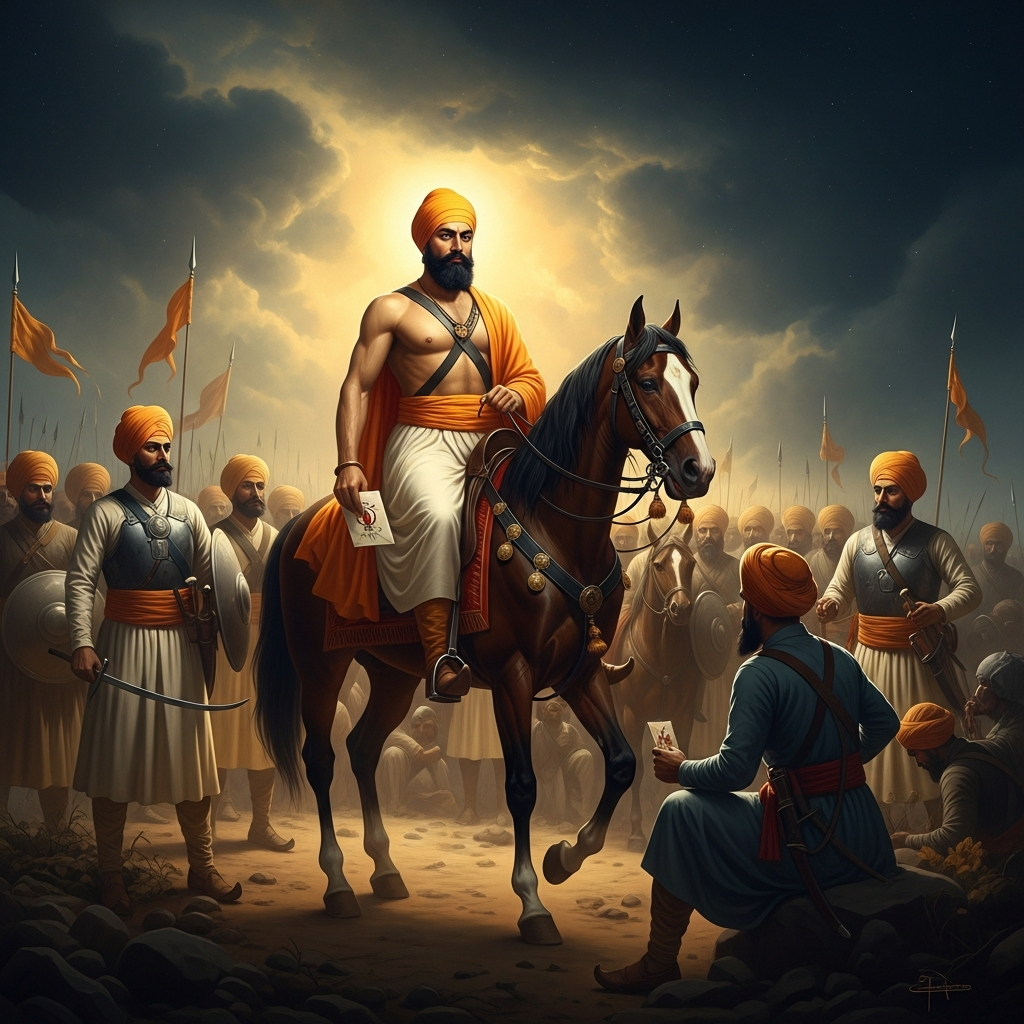
Guru Gobind Singh performed the amrit ceremony — the Khalsa initiation — on Madho Das in the hermitage at Nanded. He renamed him Banda Singh Bahadur: Banda (the bondsman, from the word he had used to surrender), Singh (lion, the Khalsa surname), Bahadur (brave). He gave him five arrows from his own quiver. He gave him a nagara — a war drum. He gave him a hukumnama, a letter of authority to the Sikhs of Punjab, instructing them to join Banda’s forces.
He told him to go north and fight.
The specific mission: avenge the sons bricked into the wall at Sirhind. Punish Wazir Khan. Defend the Khalsa. Establish Sikh authority in Punjab.
Banda set out north within weeks. Guru Gobind Singh went south to continue negotiations with Bahadur Shah. He was stabbed by a Pathan assassin two months later and died, in October 1708, at Nanded, naming the Guru Granth Sahib as his eternal successor. He did not live to see what Banda would accomplish with his five arrows and his drum.
By 1710, Banda Singh had raised an army.
Not an army of trained soldiers. An army of farmers: Jat cultivators from the Punjab countryside who had spent decades under the combination of Mughal tax collectors, Brahminical caste restrictions, and local chiefs who took whatever remained. They came with agricultural tools and hunting weapons and the kinds of muscles you build by working fields, and they came because the hukumnama had arrived from the Guru — now dead, but whose authority survived — and because Banda Singh moved through the Punjab villages with the Guru’s arrows and the Guru’s letter and the absolute certainty of a man who has been specifically told what to do.
The Battle of Chappar Chiri in May 1710 was the decisive engagement. Banda’s army of farmers, outnumbered on terrain that the Mughal governor’s cavalry was designed to dominate, won. Wazir Khan — the man who had ordered the Guru’s sons bricked into the wall — was killed in the battle. The same day, Banda’s forces took Sirhind, the seat of the man who had commanded the execution.
The city was razed. The tradition does not apologize for this. The tradition understands why.
Banda established a polity.
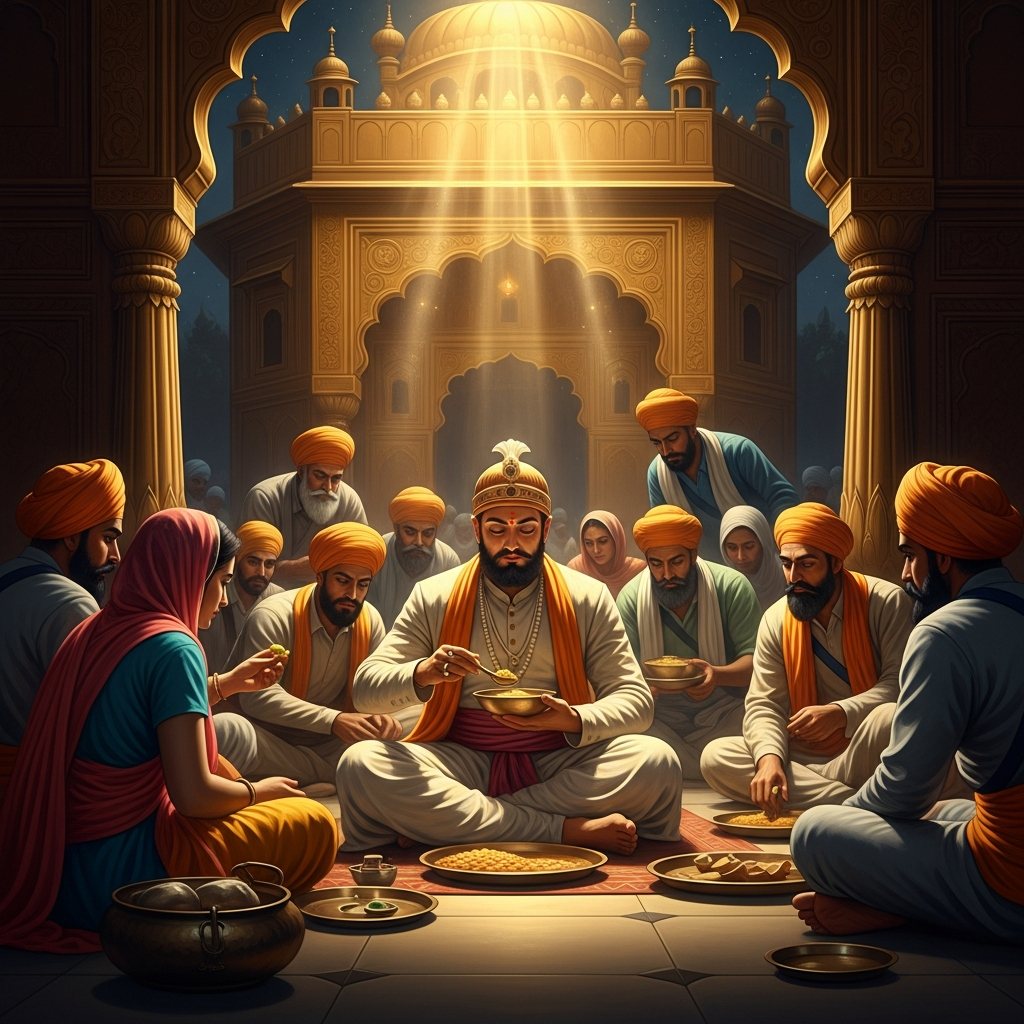
In the territory he controlled, he issued coins in the names of Guru Nanak and Guru Gobind Singh — the first Sikh coinage in history. He established land redistribution: the feudal zamindari system, by which lords held vast hereditary estates worked by tenant farmers who gave up most of their harvest, was abolished in the areas under his administration. The land was given to the farmers. This was not merely political generosity. It was the Khalsa’s theological egalitarianism expressed in agricultural policy: the people who work the ground have the claim on what the ground produces.
For two years, between 1709 and 1711, Banda controlled a substantial portion of Punjab. The Mughal court in Delhi responded with increasing urgency. Bahadur Shah I died in 1712; his successors were occupied with dynastic conflict until Farrukhsiyar consolidated power in 1713 and turned his full administrative attention to the Punjab problem.
The forces against Banda were eventually too large, too sustained, too systematically supplied to be countered by a peasant army operating without secure supply lines.
He was captured at Gurdas Nangal in 1715 after a months-long siege during which, the accounts agree, he refused to surrender until the garrison had eaten everything available including the leather of their shoes.
He was taken to Delhi with seven hundred of his followers.
The Mughal records document the procession: the Sikh prisoners carried in iron cages on the backs of elephants, processing through Delhi to demonstrate the empire’s restoration of order. Banda was brought before the Emperor Farrukhsiyar and given the same offer that Mughal power had been making to Sikh leaders for a generation: convert to Islam and live.
He said no.
The execution lasted several months. The accounts are precise about what was done to him — too precise for a general audience, which is why the tradition generally summarizes it as torture — and uniform in their description of his response. He did not recant. He did not perform the theatrical despair the imperial audience expected. He demonstrated, in the accounts of both Mughal chroniclers and Sikh sources, something that witnesses found genuinely unsettling: equanimity. The same quality that had made Madho Das a functioning ascetic before the Guru gave him different work to do.
On June 9, 1716, at Mehrauli outside Delhi, Banda Singh Bahadur was executed. He was forty-five.
The land redistribution that Banda established in his brief polity — giving agricultural land to the farmers who worked it — is the first example of a land reform program in Sikh governance, and it anticipates by two and a half centuries the land reforms that various South Asian governments would attempt, with mixed success, in the twentieth century.
The Khalsa he served and the polity he briefly held would eventually, under Maharaja Ranjit Singh, become the Sikh Empire of Punjab in 1799 — the most powerful state in the subcontinent outside British control. It lasted until 1849, when the British annexed it after two Anglo-Sikh wars. Ranjit Singh acknowledged Banda as his predecessor.
The five arrows the Guru gave him at Nanded are, in Sikh historical consciousness, still flying. Where they land depends on who has the drum.
Echoes Across Traditions
Entities
- Banda Singh Bahadur (Lachhman Das / Madho Das)
- Guru Gobind Singh
- Wazir Khan (Nawab of Sirhind)
- Farrukhsiyar (Mughal Emperor)
- the Khalsa peasant army

Sources
- Sohan Lal Suri, *Umdat-ut-Twarikh* (c. 1848-1849) — primary Sikh chronicle
- Hari Ram Gupta, *History of the Sikhs, Vol. II: The Banda Bahadur Period* (Munshiram Manoharlal, 1978)
- Ganda Singh, *Life of Banda Singh Bahadur* (Khalsa College, 1935)
- Pashaura Singh & Louis Fenech (eds.), *The Oxford Handbook of Sikh Studies* (Oxford, 2014)
- Khushwant Singh, *A History of the Sikhs, Vol. I: 1469-1839* (Princeton, 1963), ch. 5
- J. S. Grewal, *The Sikhs of the Punjab* (Cambridge New History of India, 1990), ch. 4