The Pool of Nectar
Pool excavated c. 1577 CE under Guru Ram Das; Harmandir Sahib built c. 1589–1604 CE under Guru Arjan; gold plating added by Maharaja Ranjit Singh, 1830 CE · Amritsar, Punjab, India — a marshy plain that Guru Ram Das purchased from the village of Tung
Contents
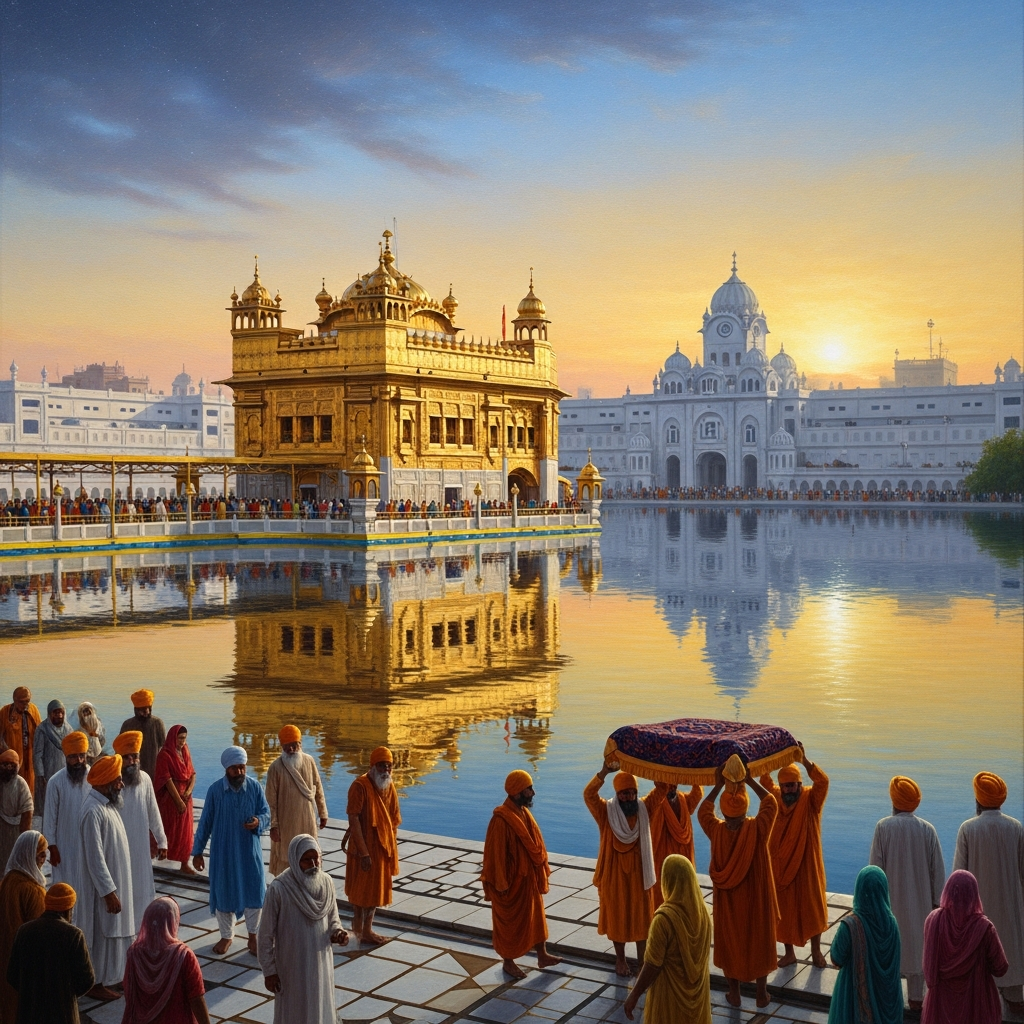
Guru Ram Das, the fourth Sikh Guru, dug a pool in a marshy area and named it Amritsar — Pool of Nectar. His successor Guru Arjan placed the Adi Granth in the center of the pool on a small island and built the Harmandir Sahib — the Temple of God — with doors on all four sides, facing all directions, open to all faiths. The foundation stone was laid by the Muslim Sufi saint Mian Mir. It is the most visited pilgrimage site in the world. It is always open. There is always food.
- When
- Pool excavated c. 1577 CE under Guru Ram Das; Harmandir Sahib built c. 1589–1604 CE under Guru Arjan; gold plating added by Maharaja Ranjit Singh, 1830 CE
- Where
- Amritsar, Punjab, India — a marshy plain that Guru Ram Das purchased from the village of Tung
The site was a marsh.
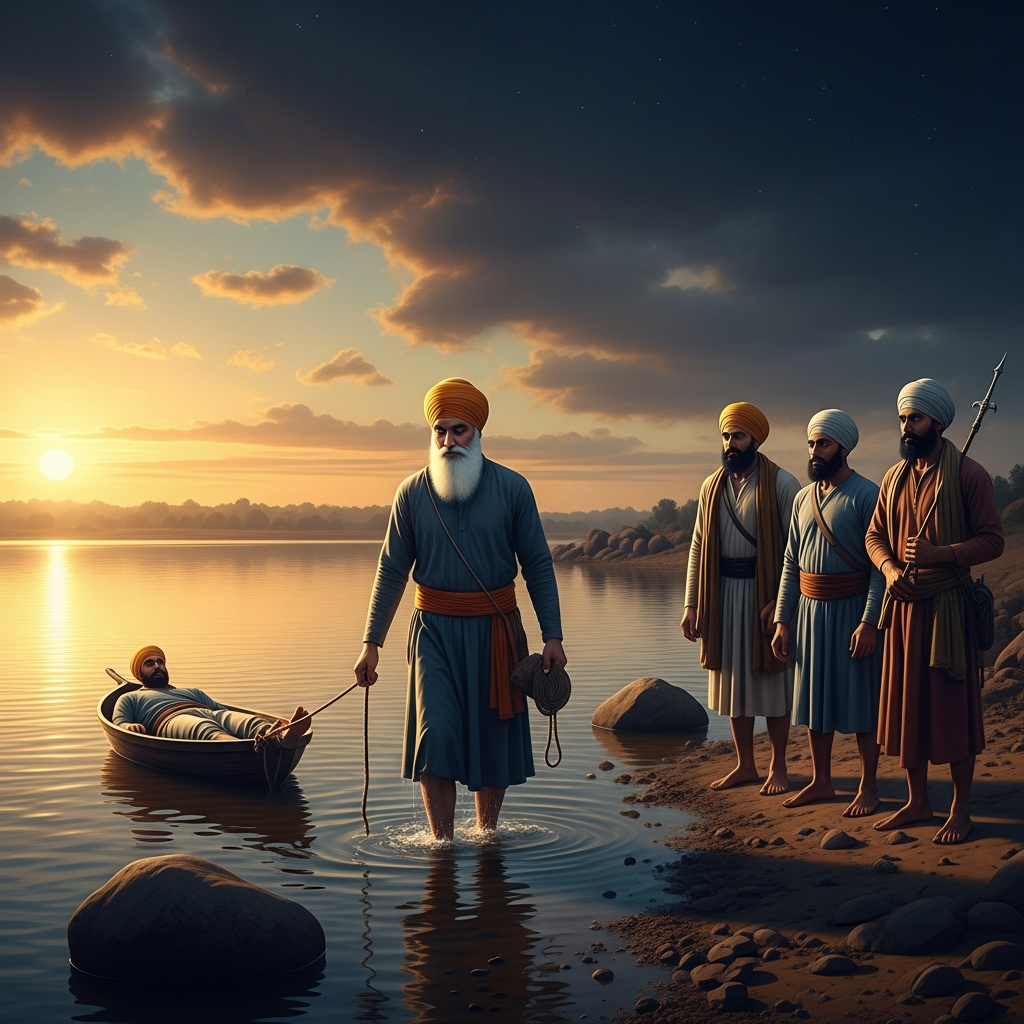
Guru Ram Das — Jetha the orphan, the child from Lahore who had come to Goindval as a water-carrier for the langar, who had caught the eye of Guru Amar Das, who had married Bibi Bhani and served for decades at the Guru’s side — purchased a stretch of marshy ground from the village of Tung, in the Punjab plains, at a price the records describe as five hundred rupees or as a gift, depending on the source. He began to excavate a pool.
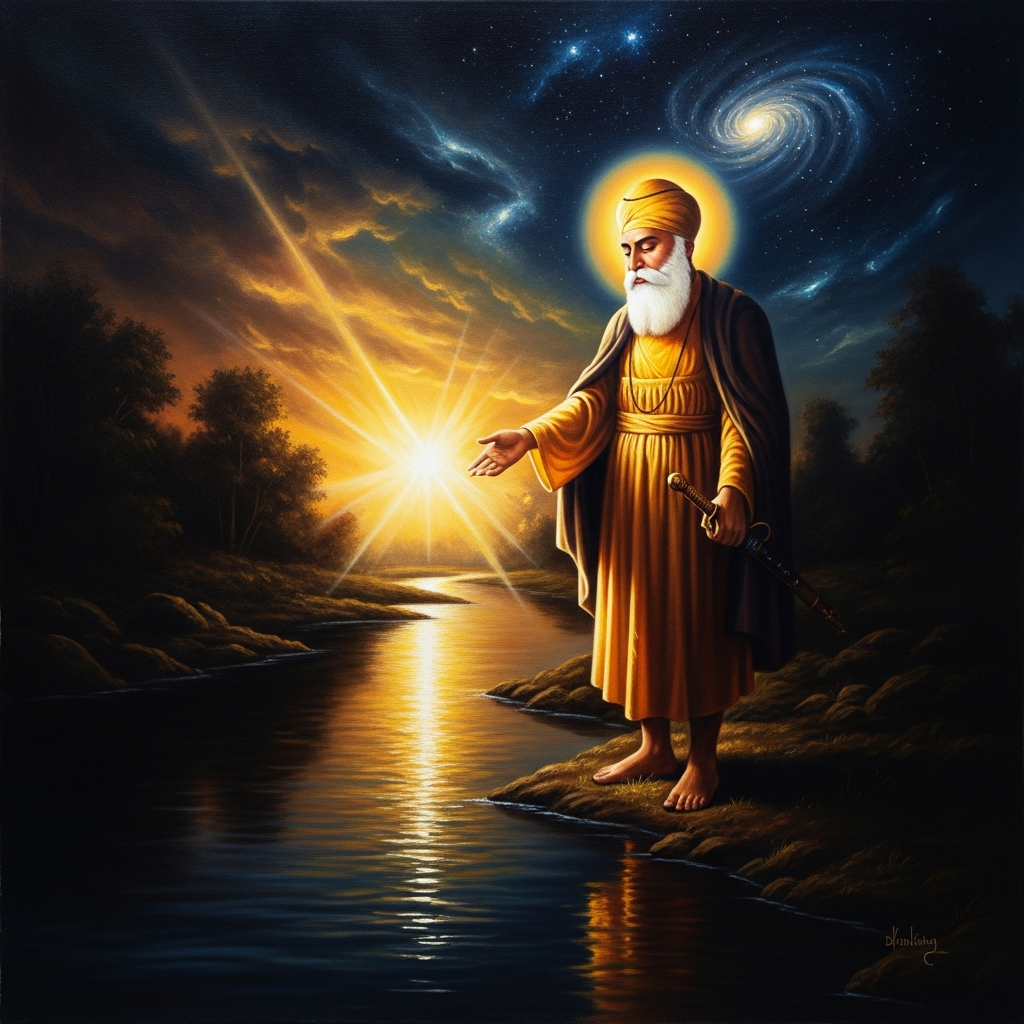
He called the project amrit sarovar. The pool of nectar.
It was 1577. He did not know yet what would be built at its center.
The excavation was seva — selfless service, the Sikh practice of work done without expectation of reward, for the community and for God. Thousands of Sikhs from across the Punjab came to dig. They came in the same spirit that they came to the langar: not because they had to but because the work was itself the worship. The pool took shape over years, an enormous rectangular basin of still water in the flat Punjab plain, fed by underground springs.
Around the pool Ram Das established the city: Ramdaspur, which would later be called Amritsar after the pool at its center. He organized it as a bazaar town, settling traders and craftsmen — Sikh and non-Sikh, Hindu and Muslim, from every caste — and establishing it as a commercial center precisely so that the temple economy would not require donations from pilgrims. The city would sustain itself. The langar would never close.
He died before the temple was built.
His son Arjan inherited the guruship at age eighteen and inherited the pool with it.
The temple Guru Arjan designed is a statement about what kind of door the sacred should have.
Most temples of the period were built to face east — toward the rising sun, which meant one entrance and one authorized direction of approach. The Brahmins who managed temple access maintained their authority partly through the architecture: there was a right way to enter and a wrong way, and the right way was through them. Most temples were built on elevated platforms — the height was visual authority, the sacred literally above the ordinary.
Arjan built the Harmandir Sahib on an island in the center of the pool, connected to the shore by a causeway. He built it lower than the surrounding courtyard — so that pilgrims descend to reach it rather than climb. He built it with four doors, one on each side, one facing each direction: north, south, east, west. The four doors, the tradition says, are open to people of the four castes — which is to say, they are open to everyone, because there is no fifth direction that is closed.
The foundation stone was laid by Mian Mir.
Mian Mir was a Qadiri Sufi from Lahore, a Muslim mystic with a reputation for sanctity that extended across both communities. Guru Arjan and Mian Mir had a relationship of genuine mutual respect — the hagiographies describe their meetings as conversations between two people who recognized each other as operating in the same territory by different routes. When Arjan began construction of the Harmandir Sahib, he invited Mian Mir to lay the foundation stone.
This was not a diplomatic gesture. It was a theological one.
The Sikh understanding of the sacred — articulated in Nanak’s poetry and elaborated by every subsequent Guru — is that God does not belong to any tradition. The Ik Onkar that opens the Guru Granth Sahib — One God — is not the God of the Sikhs. It is the God that is, which the Sikhs have found a way of recognizing that is not the only way. A temple built to house the words of this God, which include words composed by Hindu and Sufi saints, should be built by a Muslim saint’s hands.
Mian Mir placed the first stone. The Harmandir Sahib rose from the pool.
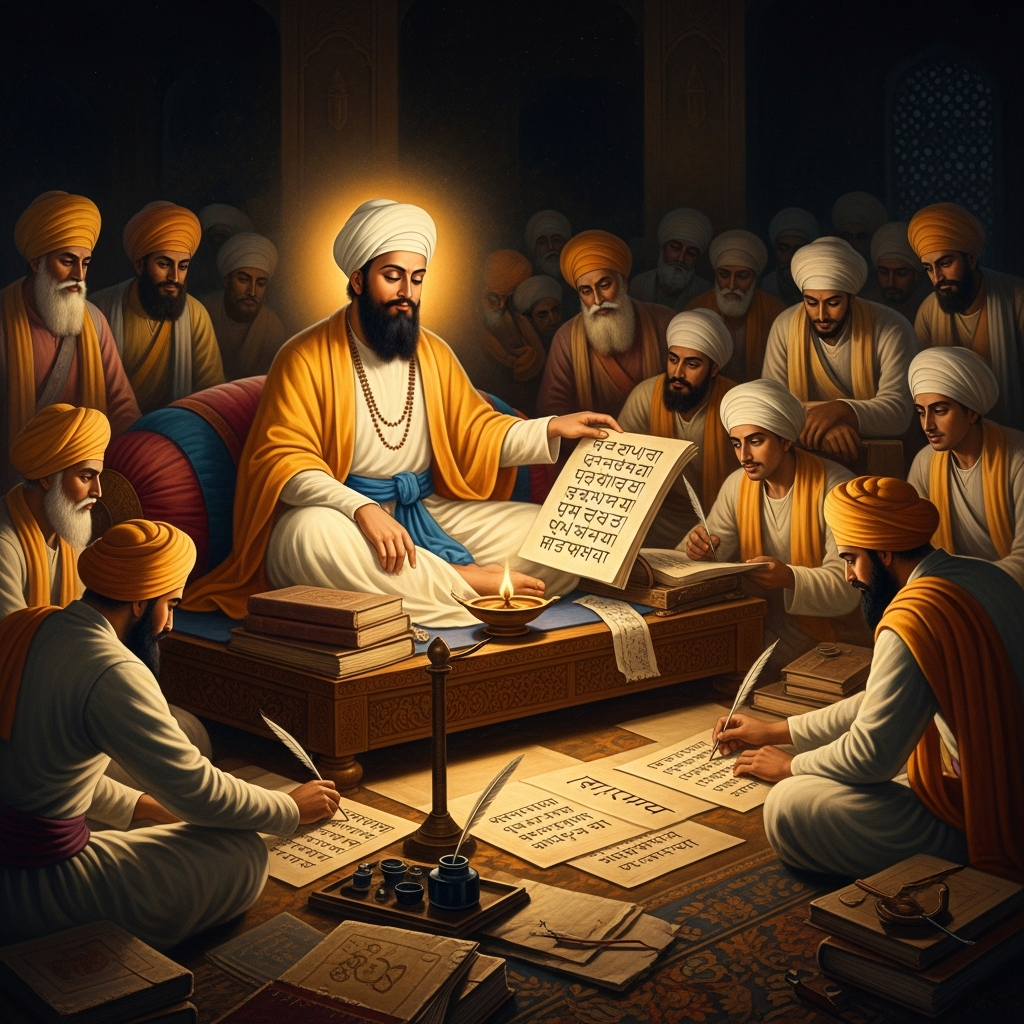
The Adi Granth — the original volume, the scripture compiled by Guru Arjan from the compositions of the Gurus and fifteen Hindu and Sufi saints, written in Gurmukhi in a single volume of 1430 pages — was installed in the completed temple in 1604.
Arjan placed it on a throne in the central hall. He appointed Baba Buddha, the eldest and most respected member of the Sikh community, as the first granthi — the reader of the scripture. Every day since 1604, without interruption, a granthi has read from the Adi Granth in the Harmandir Sahib. The daily reading — the akhand path, the unbroken reading of the entire scripture, takes forty-eight hours — cycles continuously. Pilgrims enter, sit, listen, leave. The reading does not stop.
The Adi Granth includes the compositions of Kabir, the low-caste Hindu weaver-mystic. It includes the compositions of Ravidas, the untouchable cobbler. It includes Farid, the twelfth-century Sufi who may predate Nanak by three hundred years. It includes Namdev and Trilochan and Sena and Dhanna, saints from various traditions and castes. The temple that houses this scripture, built by a Sufi’s hands, with four open doors, in a pool of water maintained by the labor of volunteers, is the architectural equivalent of the anthology it contains: a building that insists on being everyone’s.
Maharaja Ranjit Singh, in 1830, covered the upper floors of the Harmandir Sahib in gold.
He had conquered the Punjab and established the Sikh Empire, which at its height controlled territory from Kashmir to the Khyber Pass. He was the most powerful Sikh political leader in history. He spent decades at war, at politics, at the administration of a multi-confessional empire that included Muslim, Hindu, and Sikh subjects in roughly equal proportion. In his final years he turned his considerable resources to the temple.
The gold weighs approximately five hundred kilograms. It catches the Punjab sun in the morning and throws it back across the sarovar in a way that photographers have been trying to capture and almost capturing for two centuries.
Ranjit Singh did not live to see Partition, when the 1947 border divided Punjab and put Lahore, where he had built his empire’s capital, in Pakistan, and Amritsar, where the temple stood, in India. In the six weeks of Partition’s bloodiest violence, the worst atrocities in Punjab took place within miles of the golden building in the pool.
The building survived. The langar never closed.
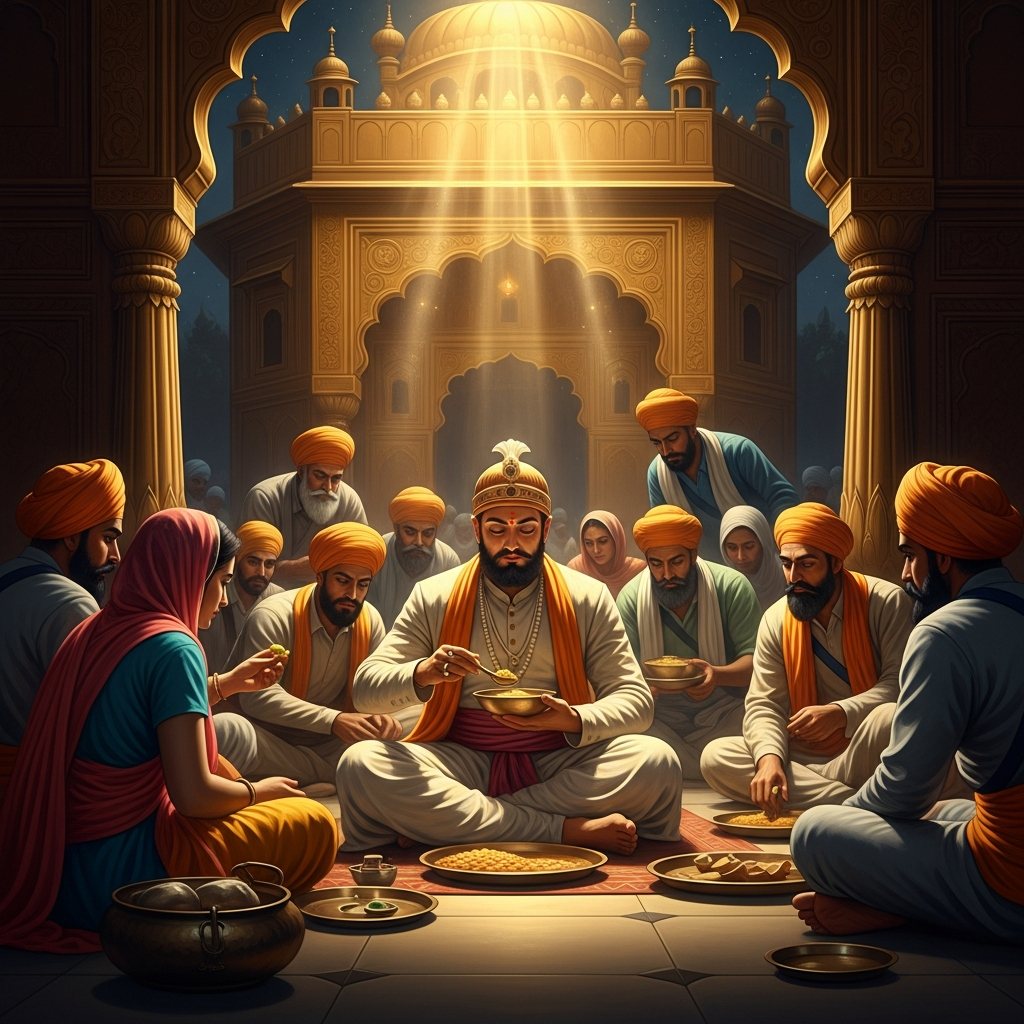
The Harmandir Sahib is visited by an estimated one hundred thousand pilgrims per day. More on festival days. The langar feeds all of them — fifty thousand meals, a hundred thousand meals, more — from the same iron pots, on the same floor, in the same rotation of volunteers who come to serve.
The pool is cleaned periodically by the community — another form of seva — the water drained, the marble scrubbed, the surface restored to the stillness that makes the gold reflection visible.
The four doors are always open. This is not a metaphor. They are literally open, twenty-four hours a day, every day of the year, regardless of weather. There is no hour at which you cannot enter. There is no category of person who is told to leave.
Guru Ram Das dug a marsh and named it nectar. His son put a book at its center and surrounded the book with water and surrounded the water with an open door on every side.
People come.
Echoes Across Traditions
Entities
- Guru Ram Das (founder of Amritsar)
- Guru Arjan Dev Ji (who built the Harmandir Sahib)
- Mian Mir (the Muslim Sufi saint who laid the foundation stone)
- the Adi Granth
- Bibi Bhani (Guru Ram Das's wife, daughter of Guru Amar Das)
Sources
- *Sri Guru Granth Sahib*, *Mahalla 4* — the hymns of Guru Ram Das
- *Sri Guru Granth Sahib*, *Mahalla 5* — the hymns of Guru Arjan, including the *Sukhmani Sahib*
- Pashaura Singh, *The Guru Granth Sahib: Canon, Meaning and Authority* (Oxford, 2000)
- Pashaura Singh & Louis Fenech (eds.), *The Oxford Handbook of Sikh Studies* (Oxford, 2014)
- Khushwant Singh, *A History of the Sikhs, Vol. I: 1469-1839* (Princeton, 1963), ch. 3–4
- J. S. Grewal, *The Sikhs of the Punjab* (Cambridge New History of India, 1990)