The Dybbuk: The Soul That Will Not Leave
c. 1600s CE (Eastern European Jewish folklore) · An Eastern European Jewish town — the version below set in Brinitz, in the Pale of Settlement, where the most famous of the dybbuk stories took place
Contents
A young man dies the night before his wedding, his soul restless because the bride was promised to him by a vow he made years earlier and which her family has now broken. He cannot rest. He returns — not as a ghost but as a possessing spirit — and enters the body of the bride during her wedding to another man. She speaks with his voice. She refuses to be touched. The rabbi must convene a beit din and reason with the dead.
- When
- c. 1600s CE (Eastern European Jewish folklore)
- Where
- An Eastern European Jewish town — the version below set in Brinitz, in the Pale of Settlement, where the most famous of the dybbuk stories took place
The setting of the most famous dybbuk story is a Hasidic town in the Pale of Settlement — a Yiddish-speaking shtetl in the late nineteenth century, surrounded by rye fields and forests, with a wooden synagogue at its center and a small Hasidic court where a tzaddik (a holy rebbe) holds his audiences. The town in S. Ansky’s 1914 play is called Brinitz. The version of the story I will tell is essentially Ansky’s, which is built on dozens of older folk versions he collected during a long ethnographic expedition through the Pale.
It begins with two friends.
Sender and Nissan, two young Hasidim, were closer than brothers in their yeshiva years. They had studied Talmud at the same table, prayed at the same minyan, held each other up through long nights of fasting. When they each married and left the yeshiva, they took an oath to one another. They swore: if Sender’s wife bore a daughter, and Nissan’s wife bore a son, the two children would be betrothed at birth and would marry one day. The two friends shook hands on it. They drank a toast. They went home.
A year later, the children were born. Sender’s wife had a daughter — Leah. Nissan’s wife had a son — Khonon. The two friends remembered, briefly, the oath they had taken.
Then Nissan died young.
His widow moved away. Khonon, her son, was raised in another town. The oath, never written down, became a memory only Sender carried. Years passed. Sender prospered as a merchant. He grew rich. He grew, the texts hint, somewhat self-impressed. He began to think about his daughter’s eventual marriage in terms different from the oath he had sworn. He wanted, for Leah, a wealthy match — a son of a prosperous family, someone who would bring honor and dowry.
The oath, never written down, faded.
—
Khonon, meanwhile, had grown into a remarkable young man.
He had been raised by his widowed mother. He had become, in his teens, a prodigious yeshiva student. By his late teens, he had moved to Brinitz — the very town where Sender lived, although Khonon did not know about the oath — and had taken a place in the local yeshiva. He was, according to the older students who watched him, the most brilliant Talmud scholar to have entered the yeshiva in twenty years. He stayed up nights over the books. He fasted. He grew thin. His face had the luminous gauntness of a young man burning intensely from the inside.
He fell in love with Leah.
He saw her, the first time, in her father’s house, when he was invited there as a Sabbath-table guest. She was beautiful — dark-eyed, serious, raised carefully by a wealthy father. She glanced at him across the table. He could not eat afterward.
He inquired. He learned, gradually, that she was the daughter of Sender ben Henya — the same Sender who had been his father’s friend. He did not know about the oath. But he felt, immediately, an obscure conviction: she was meant for him. He could not articulate why.
He asked Sender for her hand.
Sender refused. Sender did not even consider it. Khonon was a poor yeshiva student with no dowry, no family wealth, no prospects. Sender had richer matches in mind. He turned Khonon away politely.
Khonon did not accept the refusal.
—
He went into the synagogue.
He spent days there. He fasted. He stopped sleeping. He began, in desperation, to study Kabbalah — the forbidden texts, the books not normally given to a man under forty, the texts that map the sefirot and the divine names and the dangerous mystical pathways. He immersed himself in practical Kabbalah — the techniques by which a sufficiently learned mystic could, supposedly, bend reality through the manipulation of divine names.
He decided, the texts say, that he would compel God to give him Leah.
This is where the story turns. To compel God is, by Jewish theological understanding, an act of titanic chutzpah and titanic danger. The names of God are not safe to use without preparation. The Shem ha-Meforash — the Ineffable Name — can crack open a soul that is not ready to bear it. Khonon’s teachers, sensing what he was doing, warned him. He did not stop. He worked through the names. He fasted further. He performed the yichudim — the unifications — that the great Kabbalists had developed for legitimate mystical contemplation but that Khonon was using for an entirely different purpose.
He overreached.
One night in the synagogue, alone before the ark, Khonon spoke a name he was not strong enough to bear. The texts vary on which name. The result was the same. He fell over. His soul departed his body. He was found in the morning by the shamash — the synagogue caretaker — face-down on the prayer-stand, his finger still pointing at the page he had been reading.
He was buried that afternoon. The yeshiva mourned him. Sender, hearing the news, was uneasy but moved on quickly. He had, in the meantime, found the wealthy match he had wanted for Leah: a young man from a prosperous family in a nearby town. The wedding was set.
—
The wedding day arrived.
The town gathered. The musicians played. The wedding canopy was set up in the courtyard outside the synagogue. The groom — a perfectly nice young man named Menashe — stood under the canopy waiting. The procession came down the path: women in their best dresses, men in their long black coats, the rabbi at the head, and finally Leah, escorted by her aunts, her face veiled, walking the seven slow steps that brides walked toward their grooms.
She reached the canopy.
She stopped.
She did not lift her veil. She did not extend her hand. She stood under the canopy for a long moment, and then her body lurched.
Her face, when she lifted the veil, had changed.
Her eyes were wrong. Her jaw was set in a way no one had seen her set it. When she opened her mouth, the voice that came out was not her voice. It was a young man’s voice — strained, thin, urgent, with the particular cadence of a yeshiva student. The wedding guests, who had been watching, recognized it immediately. It was Khonon’s voice.
The voice said: I will not let her marry him. I have come back. I am her bridegroom. The oath was sworn before I was born. I claim what was sworn.
The wedding stopped. Menashe, the would-be groom, stepped back in horror. The rabbi raised his hands. Sender, watching from the side, went pale.
Leah had become possessed. A dybbuk had entered her — a dybbuk, in Yiddish, meaning attachment, the term used in Eastern European Jewish folklore for a soul that had refused to depart at death and had instead clung to a living body. The soul was Khonon’s.
—
The rabbi suspended the wedding. He sent for the tzaddik — the local Hasidic rebbe, the Reb of Miropol — who was the regional authority on dybbuk possession. The rebbe came. He examined Leah. He confirmed: yes, this was a dybbuk. He instructed the family to bring her to his court the next day.
The next morning, in the rebbe’s beit din — the rabbinical court — seven elders sat in a half-circle. Leah sat in front of them, eyes closed, breathing irregularly, the dybbuk speaking through her mouth at intervals. A white candle burned on the table. The torn parchment of the old oath, which Sender had, in fact, written down years earlier and forgotten in a drawer, lay beside the candle.
The rebbe did not, immediately, attempt expulsion.
This is the most distinctive feature of the Jewish dybbuk-handling tradition. A Christian exorcist, in the equivalent situation, would proceed to ritual combat — holy water, the Name of Christ, formal expulsion. The Jewish tzaddik did something different. He convened a court. He treated the dybbuk as a litigant. The dybbuk, after all, was not a demon. He was a human soul — the soul of Khonon ben Nissan, a known yeshiva student, a member of the community in life, now misplaced.
The rebbe addressed the soul directly through Leah’s mouth. Khonon ben Nissan, he said. Your case will be heard. You will speak. Sender ben Henya will speak. The court will rule. You will accept the ruling.
The dybbuk agreed.
The trial was held.
Khonon’s case was simple. He had been promised Leah by an oath sworn between his father and Sender before either of them was born. The oath had been witnessed; the parchment, retrieved from Sender’s drawer, was real. Khonon had loved Leah from the moment he had seen her, before he had known about the oath, suggesting (he argued) that something deeper than the oath had bound them. Sender had broken his word. The dybbuk demanded the oath be honored; he asked the court to recognize him as Leah’s true bridegroom and to let him remain in her body, fused with her soul, as her husband.
Sender’s defense was thin. He had not, he admitted, kept the oath. He had not even remembered it clearly. He claimed extenuating circumstances — that Khonon’s family had moved away, that he had not known where to find them, that the obligation had lapsed. The court, examining the parchment, was not persuaded by his defense. The oath had been broken.
But — the rebbe said — that did not mean Khonon had the right to remain in Leah’s body.
—
The rebbe’s ruling was elegant.
He acknowledged that Sender had wronged Khonon. He fined Sender a substantial sum, to be donated to the yeshiva and to charity, in compensation for the broken oath. He ordered Sender to recite Kaddish — the prayer for the dead — for Khonon for a full year, which was a heavy obligation under normal circumstances and especially heavy when the Kaddish was for a man who had, in some technical reading, been reduced to a dybbuk.
But Khonon, the rebbe ruled, could not stay in Leah. The oath had bound their families; it had not, in any sense the law recognized, justified the soul of one party occupying the body of the other. To claim Leah by possession was, in effect, to compel her — exactly the maneuver that had killed Khonon in the first place. The pattern of overreach had to be broken.
The rebbe issued the cherem — the ban — and ordered the dybbuk to leave.
The dybbuk did not want to go. The texts spend a long passage on Khonon’s resistance. He wept, through Leah’s mouth. He pleaded. He said he had nowhere to go — that the world of the living had rejected him, that the world of the dead had not yet received him, that he was suspended in a state of pure attachment with nowhere else to be.
The rebbe answered him gently. You will be received, he said. Kaddish will be recited for you. Your name will be remembered. Your soul will rise. Go. Leah cannot hold you. You cannot hold her. Let her go. Let yourself rise.
Khonon, finally, agreed.
—
The exorcism itself, when it happened, was quiet.
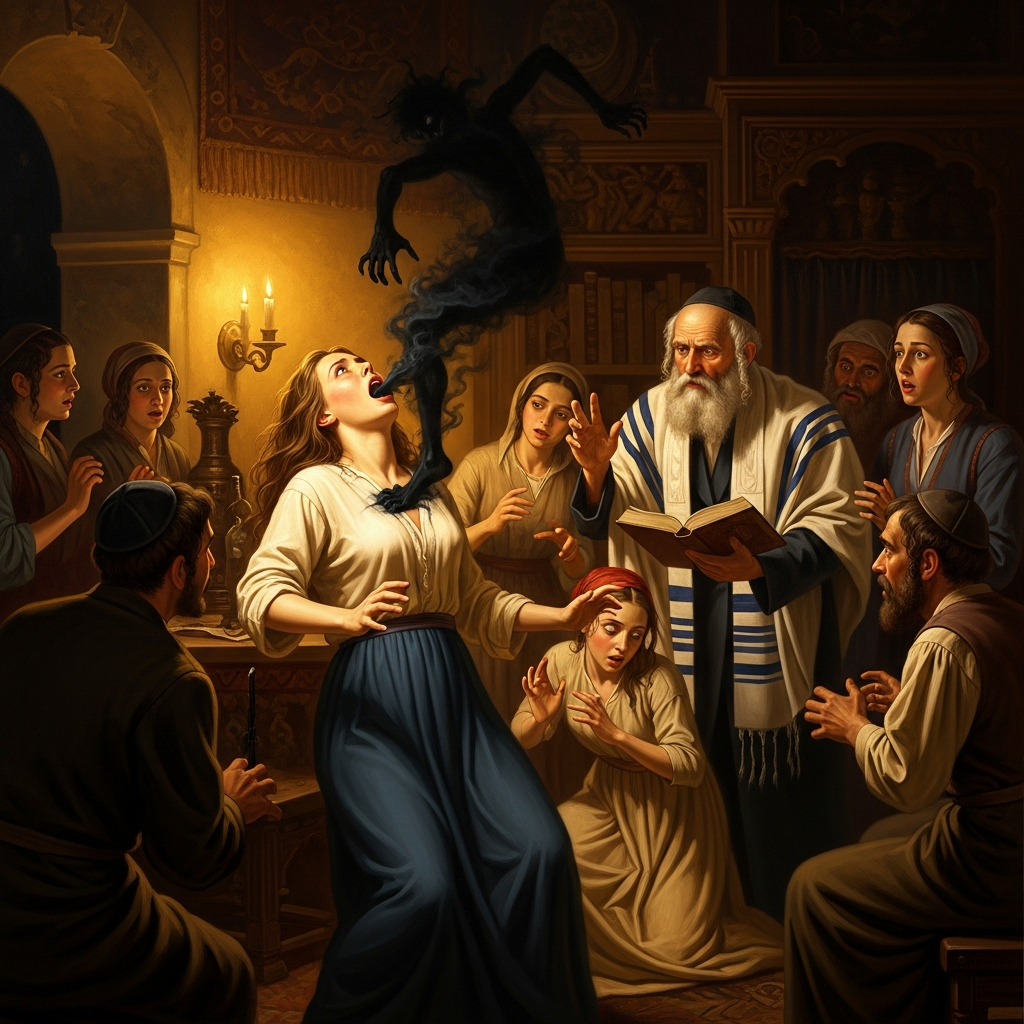
The rebbe had Leah stand in the center of the room. Seven men in tallisim — prayer-shawls — surrounded her. They held the shofar, the ram’s horn. They held the Sefer Torah. The rebbe pronounced the formula. He commanded the dybbuk to depart through the small toe of Leah’s left foot — the traditional path of exit, so that the body would not be torn by the soul’s leaving.
Leah’s body shuddered. She let out a single long sigh. Then she collapsed.
The men caught her. They laid her on the floor. They examined her foot — there was, the texts say, a small mark on the toe where the dybbuk had passed, like a faint burn. The candle on the table flickered violently and went out.
Khonon was gone.
—
The story does not end happily.
In Ansky’s play, and in many of the folk versions, Leah does not survive. She has been changed. She loved Khonon, in a way she had not been allowed to admit during his life; the dybbuk’s possession, however unwelcome, was also her last contact with him. When the dybbuk leaves, something of her leaves too. She is found dead, in some versions, the next morning. In others, she lives but does not marry, and dies young.
The play ends, in Ansky’s staging, with Leah running out into the snow at midnight, calling for Khonon, and her own soul rising to join his — the lovers reunited, finally, on the other side, where neither the oath nor the body any longer obstructs them. The wedding canopy that the rebbe interrupted is, in this reading, only delayed; it is held in the next world, with their parents looking on.
This ending is theologically ambiguous and, in the Jewish tradition, unusual. It romanticizes a possession the law had to reject. But it captures something the dybbuk story has always carried: the suspicion that the broken vow remains, somehow, the deeper vow, and that the marriage the law forbade is the one the soul knew about.
—
The dybbuk is one of the most enduring figures of Eastern European Jewish folklore. Hasidic communities still tell the stories. The 1937 Yiddish film of Ansky’s play, Der Dibuk, directed by Michał Waszyński, is one of the few cinematic records of pre-Holocaust shtetl life and is taught in Jewish studies courses. Modern theatrical productions stage the play regularly. There are contemporary documented cases — particularly in some Hasidic communities in Israel and New York in the late twentieth century — of claimed dybbuk possessions, treated by tzaddikim in the traditional way, with rabbinical court and gentle exorcism.
The deeper teaching of the dybbuk, the rebbes say, is that broken bonds do not simply dissolve. An oath breached, a love thwarted, a vow forgotten — these are not nothing. They remain in the world as attachments. The living and the dead are bound by them. When a soul cannot rise because of an attachment, the community’s task is to recognize the attachment, do justice to it, and gently release both sides.
This is, in some sense, all of pastoral work. The dybbuk just makes it visible. Most of the time, the bonds are quieter. Most of the time, the unfinished oaths sit in drawers. The dybbuk story is a reminder that they are still there, faintly humming, waiting for the appropriate court to convene and the appropriate Kaddish to be said.
Scenes
Inside a small synagogue at midnight, a young yeshiva student bows low over a Kabbalistic text by candlelight, his lips moving in forbidden divine names
At a wedding canopy in the courtyard, the bride freezes mid-procession
A rabbinical court of seven elders sits in a half-circle in the synagogue
Echoes Across Traditions
Entities
- The Dybbuk (Khonon)
- Leah
- The Rabbi of Miropol
- The Tzaddik
Sources
- Hayyim Vital, *Sefer ha-Hezyonot* (c. 1610) — earliest detailed dybbuk accounts
- S. Ansky, *The Dybbuk* (Yiddish play, 1914)
- Gershom Scholem, *Major Trends in Jewish Mysticism* (1941)
- Yoram Bilu, *Dybbuk Possession and Mystical Healing in Hasidic Judaism* (1995)