Contents
Aztec women who died bringing a child into the world were honored as warriors fallen in battle. By day they accompanied the sun from zenith to dusk; by night they walked the crossroads, hungry and dangerous, bringing paralysis and seizures to those they met. Stone images of their staring round faces stood at every junction of roads.
- When
- Mythic / daily ritual life, ca. 1300–1521 CE
- Where
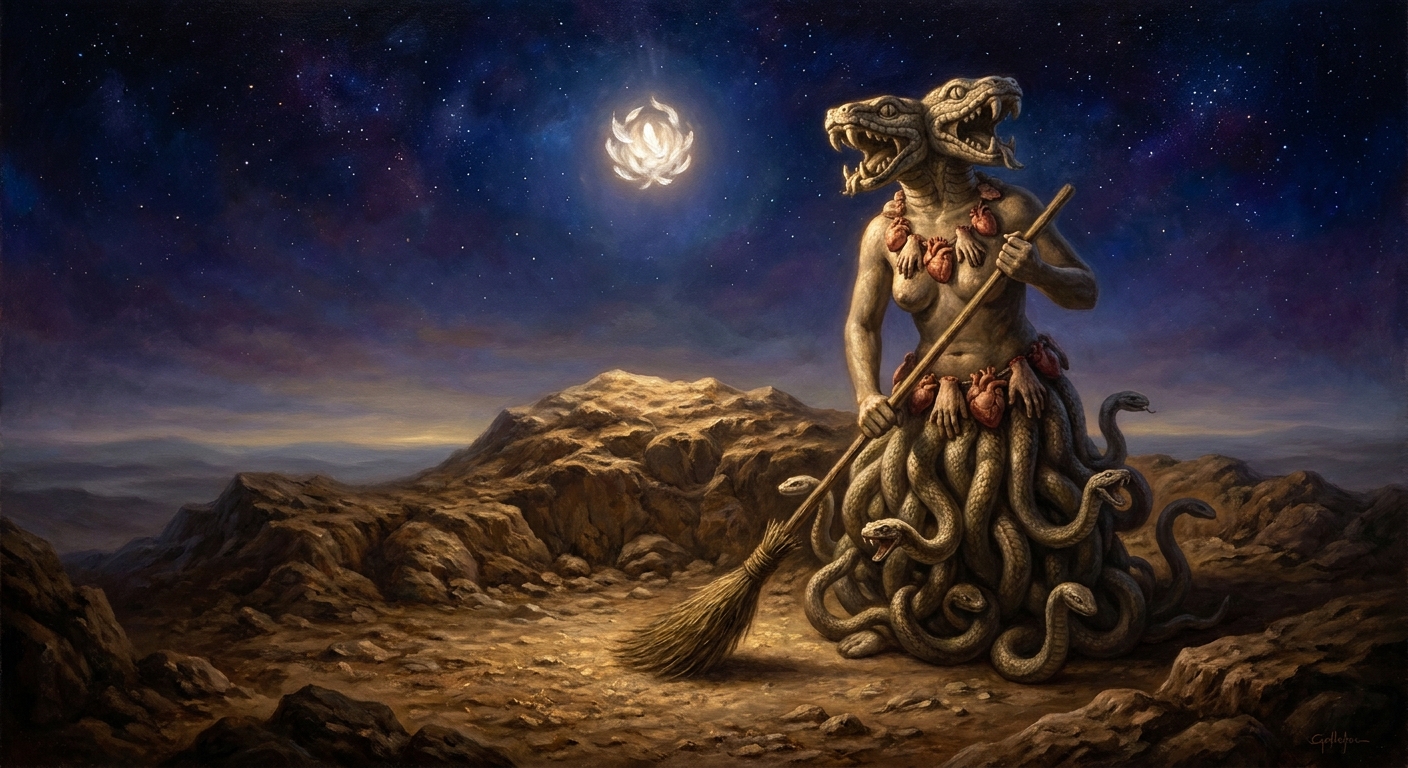
- The crossroads of the Aztec world; the western half of the sun's daily journey
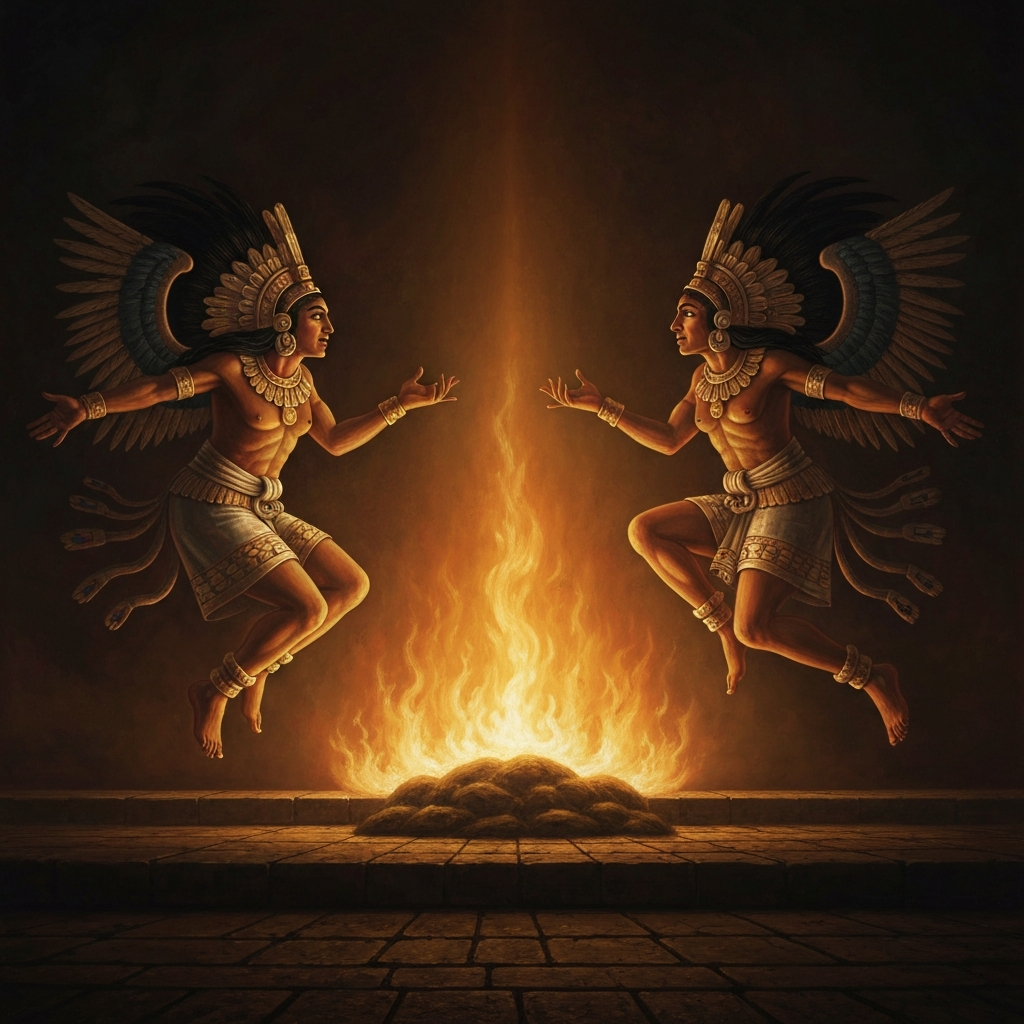
In Aztec cosmology, the sun’s daily journey was a battle. Tonatiuh, the sun, fought from horizon to zenith every morning carried by the souls of warriors who had fallen on the obsidian field — the Quauhteca, the eagle-jaguar dead, men killed in combat or sacrificed on the altar. Their reward was four years of escorting the sun in the form of hummingbirds; after four years they were released into the form of beautiful birds and butterflies, and they had finished. This much most students of the Aztecs know. What is less often told is who carried the sun in the second half of the day.
From the zenith to the western horizon, the sun was carried by the Cihuateteo, the “Divine Women” — and to qualify, a woman had to have died in childbirth. The Aztecs called her death mocihuaquetzque, “she who has stood up like a warrior,” and they meant it precisely. She had gone to war with her own body. She had tried to bring a new soul out of the dark of herself into the light, and she had not survived the doing of it. The child might or might not have lived; sometimes the woman died before the labor was complete, and then she had not even been able to deliver her warrior into the world. Her grief, the codices say, was the deepest of any of the dead.
So she was honored. The body of a woman who died in childbirth was washed and dressed in fine clothes, like a warrior killed in combat. She was buried — not in the family compound, like ordinary dead — but in front of the temple of the Cihuapipiltin, the noble women, in a courtyard set aside for them. Her husband and male relatives stood guard over her body for four nights, because warriors and sorcerers would come to try to steal her: a relic from a mocihuaquetzque, especially a finger or a lock of hair, was the most powerful magical object in the Aztec world. A warrior who carried her finger into battle, the codices say, would be unstoppable, paralyzing his enemies with a touch. So the husband stood guard with his obsidian club, and sometimes he had to fight off raiders, and sometimes he failed.
After four years of carrying the sun in the western half of its journey, the Cihuateteo were released — but unlike the male warriors who became birds, they descended. They came down to earth. They walked among the living, and they were dangerous.
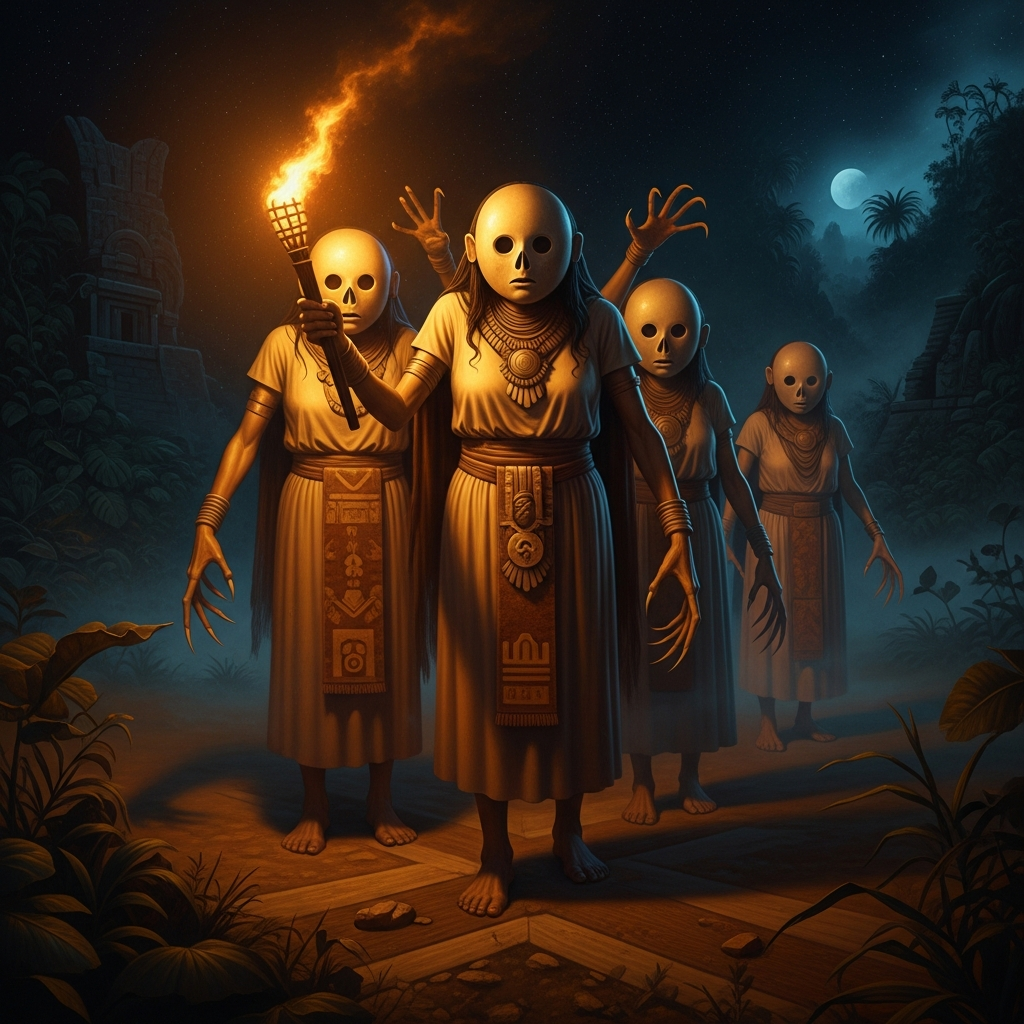
Their faces were preserved on stone images carved in the round, with great staring eyes and bared teeth and rigid arms. Surviving examples are some of the most disturbing objects from pre-Columbian Mexico: a woman frozen at the moment of her death, mouth open, hair loose, breasts exposed, hands curled into claws. These images were placed at the crossroads — at the cuauhuitl, the place where two roads met — because the Cihuateteo walked there at night.
Five days of the year were theirs especially: 1-Deer, 1-Rain, 1-Monkey, 1-House, and 1-Eagle. On those nights, no person walked the roads if they could avoid it, especially not children. The Cihuateteo were said to descend with great wailing and to seize whoever they met. They caused paralysis — a touch from one of them froze a limb forever. They caused epilepsy — the sudden seizure on the road was the Cihuateteo’s hand. They caused madness in young men. They had a particular hunger for children, because they had been deprived of their own.
But here is what the Florentine Codex makes clear: the Cihuateteo were not evil. They were grieving. They were goddesses, properly honored, with their own priests and their own offerings. The Aztecs did not call them demons; they called them Cihuapipiltin, “the noble women,” and they laid food at the crossroads on the five days, and they prayed for protection while also praying for the goddesses themselves to find peace. A mother whose own daughter had died in childbirth did not curse the Cihuateteo. She was one. She knew her daughter was now walking the western sky in the afternoon and the dark roads at night, and she left bread on the stone face at the crossroads outside her village so her daughter would have something to eat.
This is what the Aztecs understood that other peoples have often been bad at understanding: that a woman who dies giving birth has done something equivalent to going to war, and that she deserves the same honors and the same suspicion. The warrior dead are not safe to be near. They are touched by the violence that killed them; they walk in a register the living cannot enter without harm. The Cihuateteo are the same — and they are also, simultaneously, beloved daughters whose families miss them and feed them at the crossroads. The Aztecs lived with this contradiction comfortably. The goddess at the junction was a girl, was a goddess, was both, and the offerings worked because everyone involved knew exactly what they were dealing with.
Echoes Across Traditions
Entities
- Cihuateteo
- Tonatiuh
- Mictlampa
Sources
- Florentine Codex, Book 4 (Sahagún)
- Florentine Codex, Book 5 (Sahagún)
- Codex Borbonicus