Twenty-Four Examples of Perfect Filial Piety
Yuan dynasty, c. 1260-1368 CE — compilation; the individual stories span Chinese history from mythological times · Various locations in China — from the mythological south to Tang dynasty households
Contents
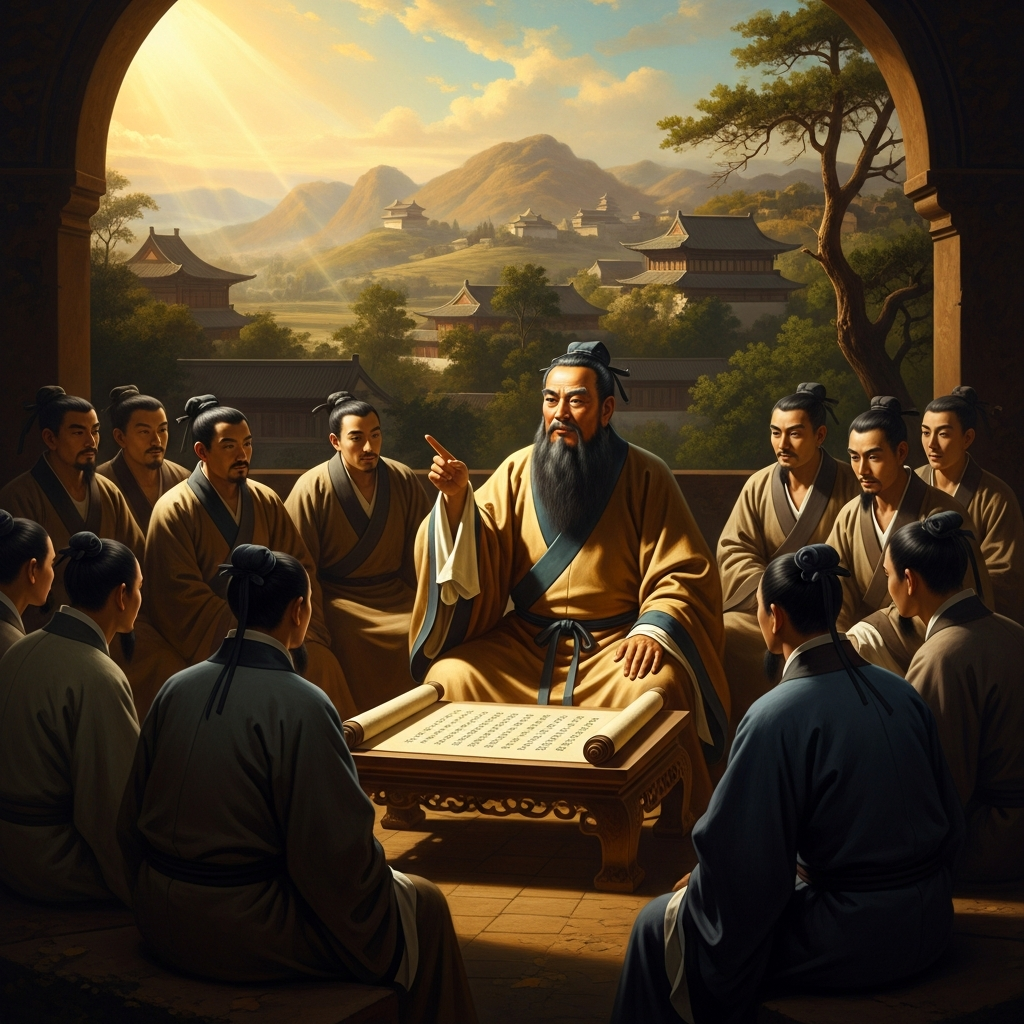
A Yuan dynasty scholar compiles twenty-four stories of extraordinary devotion to parents — a man who lay down on ice to melt it and catch fish for his mother, a woman who nursed her toothless grandmother at her own breast — and these stories become China's most widely illustrated moral text.
- When
- Yuan dynasty, c. 1260-1368 CE — compilation; the individual stories span Chinese history from mythological times
- Where
- Various locations in China — from the mythological south to Tang dynasty households
The first exemplar is the sage-king Shun, which establishes the register immediately.
Shun’s father is blind and unkind and repeatedly tries to kill him. His stepmother actively plots against him. His half-brother assists in the plots. The plots involve burying him alive in a well, setting fire to a granary while he is on top of it, and other innovations. Shun survives by his own quickness and returns each time to serve his parents without complaint. He does not avenge himself. He does not relocate. He does not reduce the quality of his service in response to the repeated assassination attempts.
He becomes Emperor Yao’s heir and one of the greatest rulers in Chinese tradition.
The other twenty-three stories do not all involve survival of assassination attempts. They involve other forms of love under pressure. Wang Xiang’s stepmother wants fresh fish in winter. He lies down on the frozen river to melt the ice with his body heat. The ice cracks. Two carp swim up through the hole. He brings them to his stepmother without comment.
Dong Yong’s father dies and Dong Yong has no money for the funeral. He sells himself into indenture to pay for it. A woman appears on the road and accompanies him to work. She weaves silk of miraculous quality in a single night — enough to fulfill his indenture. She reveals herself as a heavenly weaver sent by the Jade Emperor in recognition of his piety, and she rises into the sky. His father is buried. The indenture is paid.
Jiang Shi and his wife walk six li every day to carry river water for his mother, who prefers the taste of river water from the distance. A spring appears in their courtyard, producing the distant river water, because heaven rewards those who exhaust themselves for their parents without complaint.
The mother of Wu Meng is poor and cannot afford mosquito netting. He sleeps beside her each summer night without netting, offering his own body to the mosquitoes so that they will be satisfied and leave his mother to sleep. He is described as doing this with the serene devotion of someone who has found the most natural use of his body.
Lu Lü’s mother is afraid of thunder. After she dies, he weeps and runs to her grave during every storm. He cannot hear thunder without running to be beside her.
And then the story of Tang Furen, whose grandmother has grown so old she cannot eat solid food. Tang Furen nurses her from her own breast each morning. The grandmother is sustained for years. When the grandmother dies, a divine messenger comes to take her to heaven — the reward for a life so well cared for. Tang Furen’s act is recorded without irony, without discomfort, as the natural extension of love to its logical limit.
The text presents all twenty-four in the same register: complete, unqualified, unreflective devotion to parents, in conditions that range from reasonable to extreme to physiologically extraordinary. The discomfort that modern readers feel at some of these stories was not entirely absent in traditional China — the Confucian scholar Zhu Xi noted that some exemplars went further than could be recommended as general policy. But the text’s purpose was not general policy. It was the demonstration of a principle through cases at the principle’s edge: that the care of parents is not conditional, not calibrated, not adjusted for inconvenience or abuse or season, but absolute.
The twenty-four stories have been printed more times than almost any other Chinese text. They have been painted on the walls of tombs. They hang in schoolrooms. They are the illustration of the argument that every ethical system must eventually make: that love begins somewhere, that it begins close to home, and that if it does not begin there, it does not begin at all.
Echoes Across Traditions
Entities
- Guo Jujing (compiler)
- Yu Shun (Emperor Shun)
- Wang Xiang (the ice-fisher)
- the twenty-four exemplars
Sources
- Ershisi Xiao (二十四孝), Guo Jujing, c. 1260-1368 CE
- Keith Knapp, *Selfless Offspring: Filial Children and Social Order in Medieval China* (Hawaii, 2005)
- Patricia Ebrey, *Chinese Civilization: A Sourcebook* (Free Press, 1993)
- Philip Ivanhoe, *Confucian Moral Self Cultivation* (Hackett, 2000)