Inti and Mama Quilla: The Sun, the Moon, and the Origin of the Incas
c. 1300 CE (recorded in 16th-c. chronicles; refers to the founding of the Inca dynasty) · The high plateau of Lake Titicaca on the border of present-day Peru and Bolivia; the long ridges of the Andes; the green valley of Cuzco at 11,000 feet
Contents
From the depths of Lake Titicaca rise a brother and sister sent by their father the Sun. Inti has given them a golden staff: wherever it sinks into the earth without resistance, they are to settle and teach the people. They walk for years across the Andes. The staff finds the soft ground at last in a green valley between two rivers, and there they found Cuzco — the navel of the world.
- When
- c. 1300 CE (recorded in 16th-c. chronicles; refers to the founding of the Inca dynasty)
- Where
- The high plateau of Lake Titicaca on the border of present-day Peru and Bolivia; the long ridges of the Andes; the green valley of Cuzco at 11,000 feet
The lake is the highest navigable lake in the world.
At twelve thousand five hundred feet above sea level, on the altiplano — the high plateau between the Eastern and Western Cordilleras of the Andes — Lake Titicaca stretches across what is now the border between Peru and Bolivia. The water is dark blue, intensely cold, and almost frighteningly clear; on a still morning you can see fifty feet down through the surface. The Andean peoples who lived around it before any empire — the Pukara, the Tiwanaku, the cultures that built the great pre-Inca cities along the lake edge — considered it sacred. They believed the sun was born from it every morning. They believed the world itself emerged from beneath its surface.
The Inca foundation myth begins there.
—
In the centuries before the Inca empire, the Andean world was, by the chroniclers’ account, in disorder. Small communities lived along the rivers and on the mountain terraces. They warred with each other. They worshipped local huacas — sacred objects, springs, mountains — but had no unifying religion. They had no agriculture beyond the local. They had no medicine beyond what each curandero remembered. They had no system. They were, the texts insist, like animals.
Inti, the sun god, looked down from his celestial palace at the disordered humans below.
He saw their squalor. He saw their suffering. He saw, in particular, that they were dying young and dying often — of hunger, of cold, of the diseases that flourish where there is no civic order. Inti was, in the Inca theology, a benevolent deity. He did not enjoy watching this.
He decided to intervene.
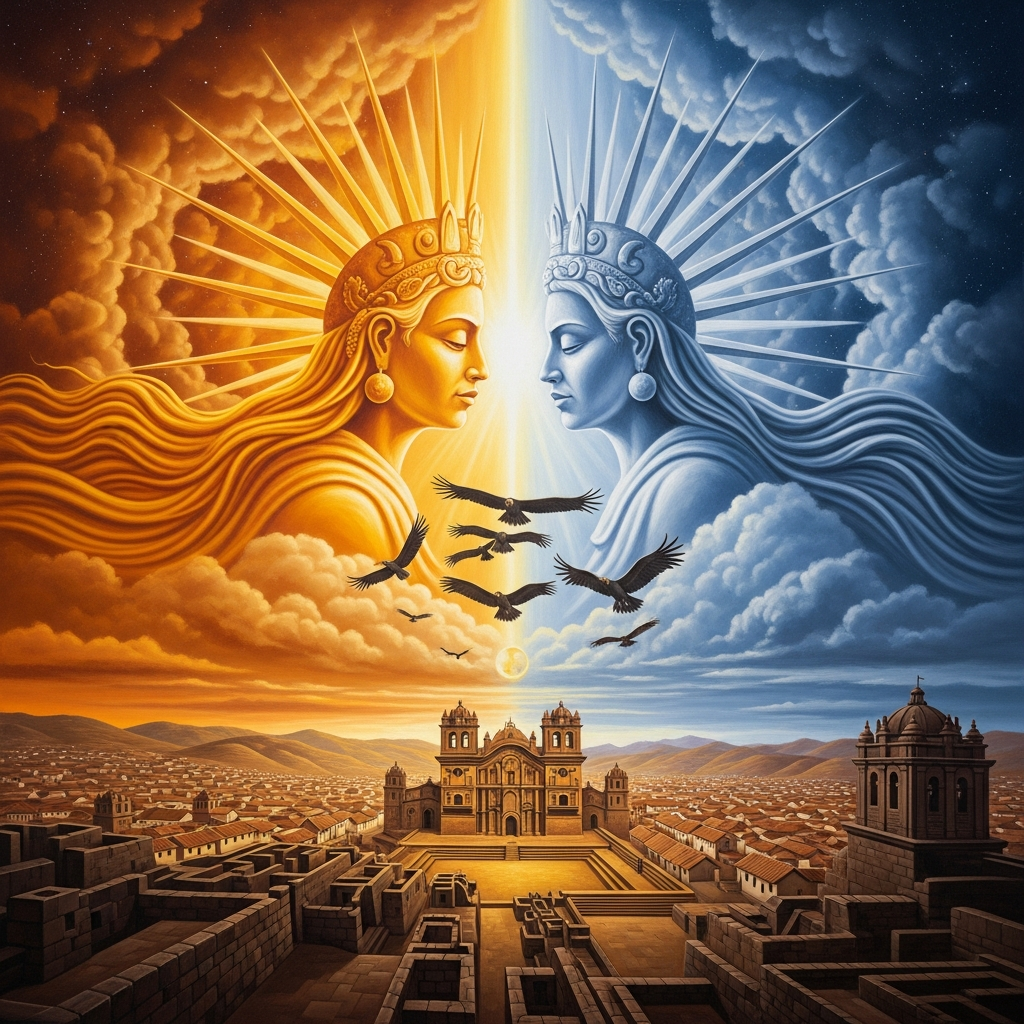
He had children. By his consort Mama Quilla — the moon goddess, silver to his gold, night to his day — he had a son and a daughter. He summoned them to his court. He explained the problem.
He gave them a mission. They were to descend to the world. They were to teach the disordered humans how to live properly: how to plant maize and quinoa, how to build stone houses, how to weave textiles, how to organize a state. They were to be the founding ancestors of a new civilization. They were to rule it and, eventually, leave their descendants to continue the work.
He gave them, as a tool of foundation, a staff of solid gold.
—
The staff was the size of a man’s arm and weighed roughly what a man could carry. It had been forged, in the celestial smithy, from gold that had no earthly origin — sun-gold, the metal that the Inca later called llampu, the sweat of the sun.
Inti gave them the rule. Walk south, he said. Test the staff at every step. Push it into the earth. When you find ground soft enough that the staff sinks all the way to its head, that is the place. Stop there. Build a city. The city will be the navel of the world. From there, govern.
He sent them down to Lake Titicaca.
The chroniclers — Garcilaso de la Vega and Juan de Betanzos, writing fifty years after the Spanish conquest — describe the descent in lyric detail. The two siblings rose, one morning at first light, from the depths of the lake. They emerged on the Isla del Sol — the Island of the Sun, near the southern end of Titicaca, where the local pre-Inca cultures had long held that creation began. The water parted at their feet. They stood, dripping, on the rocky shore of the island, and the first dawn of the new age struck them.
The brother’s name was Manco Cápac. The sister’s name was Mama Ocllo. They were married — sibling marriage, in the Inca royal line, was not only permitted but mandatory; the Sapa Inca had to marry his sister to keep the divine bloodline pure, and Manco Cápac and Mama Ocllo set the precedent. They wore tunics of fine wool and headbands of red wool with gold ornaments. He carried the staff.
They began walking.
—
They walked, the chroniclers say, for years.
They walked north out of the Titicaca basin. They climbed the high passes of the Cordillera. They crossed the altiplano. They descended into the valleys of what is now southern Peru. They crossed rivers. They climbed back up.
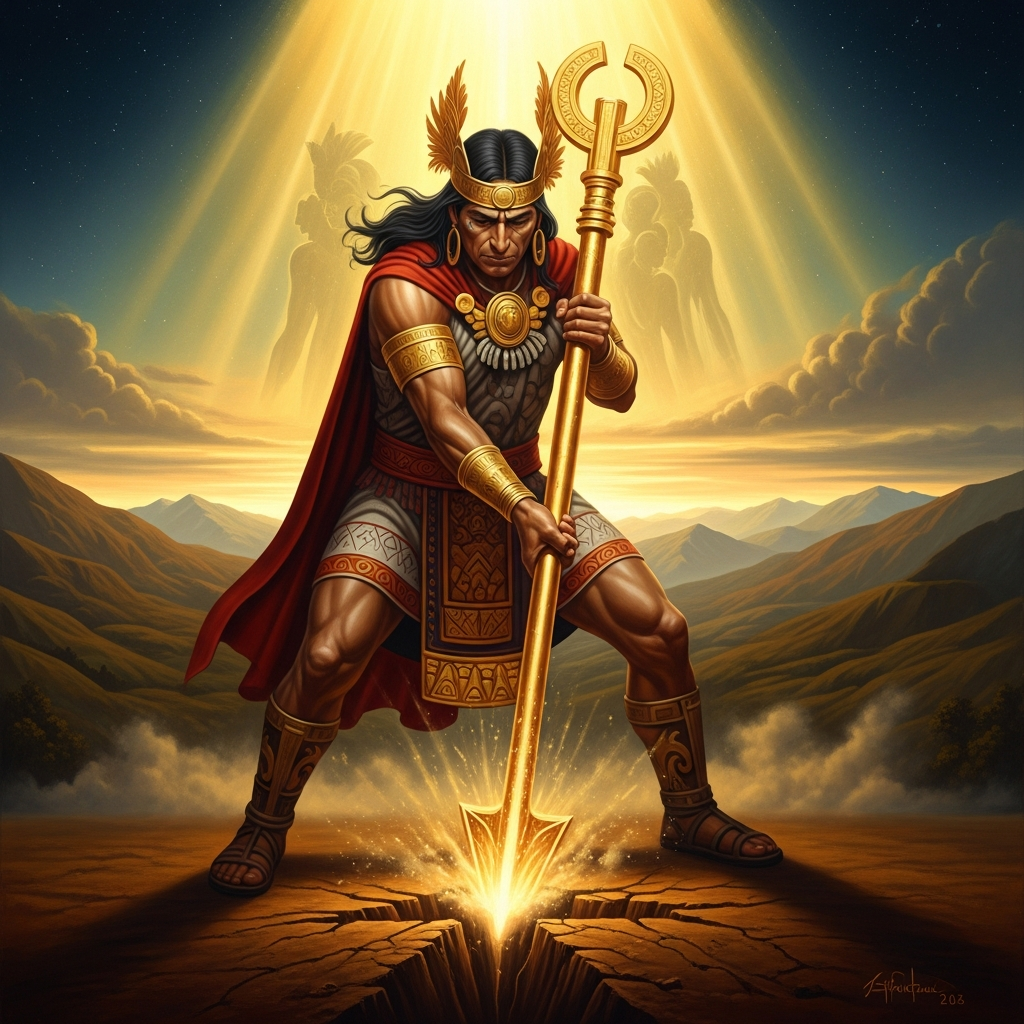
At every promising location, Manco Cápac would pause, lift the golden staff, and push it down into the earth.
The staff rang against rock at most places. The Andes are rocky. The terraces had thin soils over the bedrock. The valleys, which looked promising, often had only a few inches of dirt before the staff struck the cold mineral underneath. Manco Cápac would withdraw it, shake his head, and the siblings would walk on.
They were tested. They were tired. The Andean climate is brutal — burning sun by day, frost by night — and they walked through it for cycle after cycle of seasons, eating what they could find, sleeping where they could shelter. They began to wonder, the chroniclers hint without quite saying, whether their father had set them an impossible task. Perhaps no ground in the Andes was soft enough.
—
They arrived in a valley.
It lay between two rivers — the Saphi and the Tullumayo — in a high green basin at about eleven thousand feet, ringed by mountains, watered by snowmelt, with rich loam soil left by ancient lake sediment. Manco Cápac, who had pushed the staff into the earth a thousand times by now, did so again, almost wearily, where they had paused to rest.
The staff sank.
It sank past the soil layer that had stopped it everywhere else. It sank past the next level. It sank to its head. The golden top of the staff sat flush with the green grass.
Manco Cápac let out a long breath.
He looked at his sister. She had already begun to weep. They had found the place.
—
They named the place Cuzco. The word means navel in Quechua — the umbilical center of a body, the point at which all the lines come together. The Inca world would, eventually, be organized around four roads radiating from Cuzco to the four corners of the empire — north, south, east, west — and the empire’s name itself, Tawantinsuyu, would mean the four parts together. Cuzco was the navel from which the four parts grew.
Manco Cápac and Mama Ocllo settled. They built. They began to teach.
The chroniclers split the curriculum between the two of them along strict gender lines. Manco Cápac, in the male sphere, taught the men: how to plant maize in terraced fields, how to dig irrigation channels, how to build stone walls of fitted blocks (the famous mortarless masonry that the Spanish would marvel at), how to forge bronze, how to manage llamas and alpacas, how to organize the labor of a community. Mama Ocllo, in the female sphere, taught the women: how to weave fine cloth from the wool of the alpaca and the vicuña, how to spin thread, how to dye, how to sew, how to keep a household, how to raise children, how to prepare food.
Both of them taught the people religion. They explained the order of the gods: Inti at the top, Mama Quilla beside him, Pachamama (the earth-mother) below, the various subsidiary spirits below that. They taught the calendar. They taught the rituals. They built the first temple to Inti at Cuzco, which would, generations later, become the Coricancha — the gold-plated central temple of the Inca empire, with walls of fitted stone covered entirely in sheets of beaten gold, the most opulent religious building in the Americas.
The people of the valley accepted them. The people of the next valley over accepted them. Word traveled: a golden-staffed couple had arrived from the south, claiming descent from the sun, teaching agriculture and weaving and building. They were not warlords. They were not extorting tribute. They were, by the testimony of those who came to them, simply offering instruction.
—
The empire grew.
It did not grow fast at first. The Inca state, as the Spanish encountered it in the 1530s, had only existed in its imperial form for about a century — a remarkable expansion from the foundation under Manco Cápac, but the city of Cuzco itself had been the navel for many generations longer. The traditional Inca king-list places thirteen Sapa Incas before the Spanish arrival, beginning with Manco Cápac and ending with Atahualpa, who was murdered by Pizarro in 1533. Some of these are clearly mythical, some clearly historical, the boundary blurred.
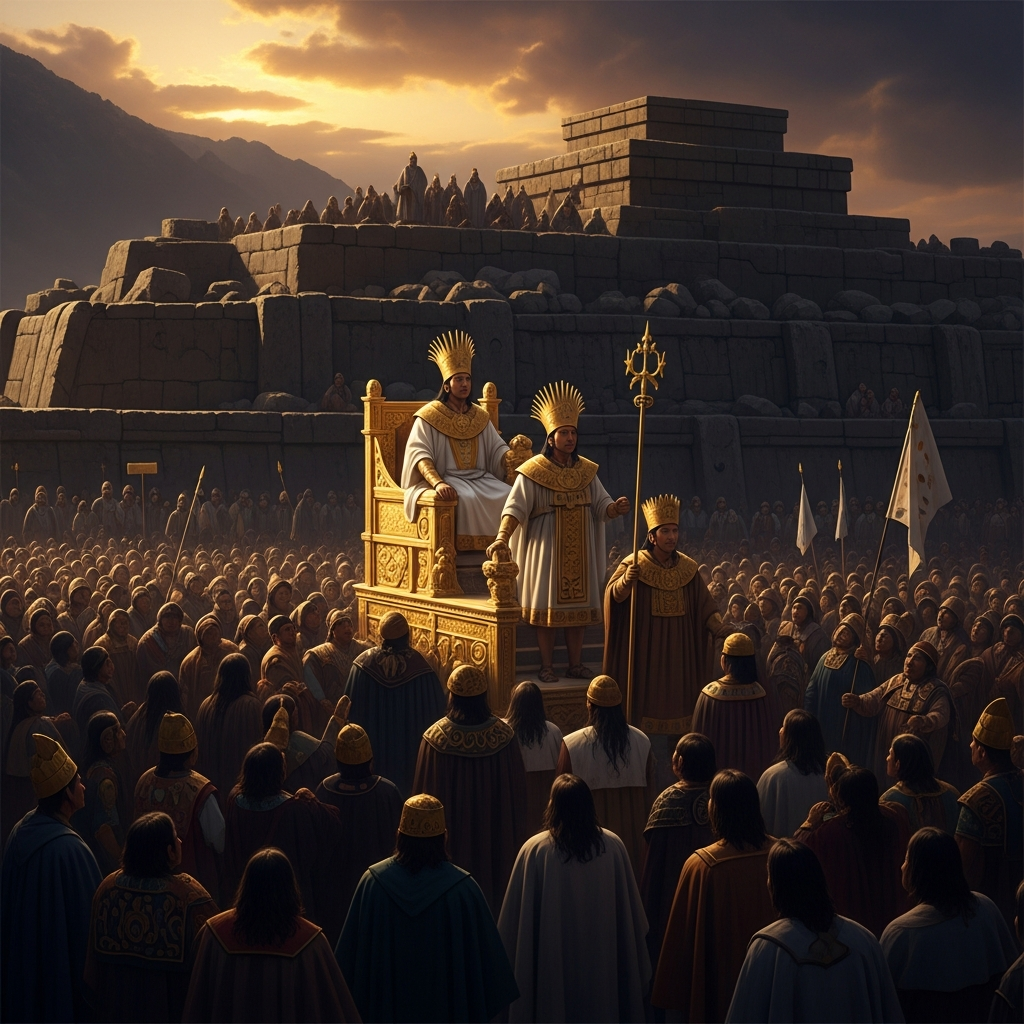
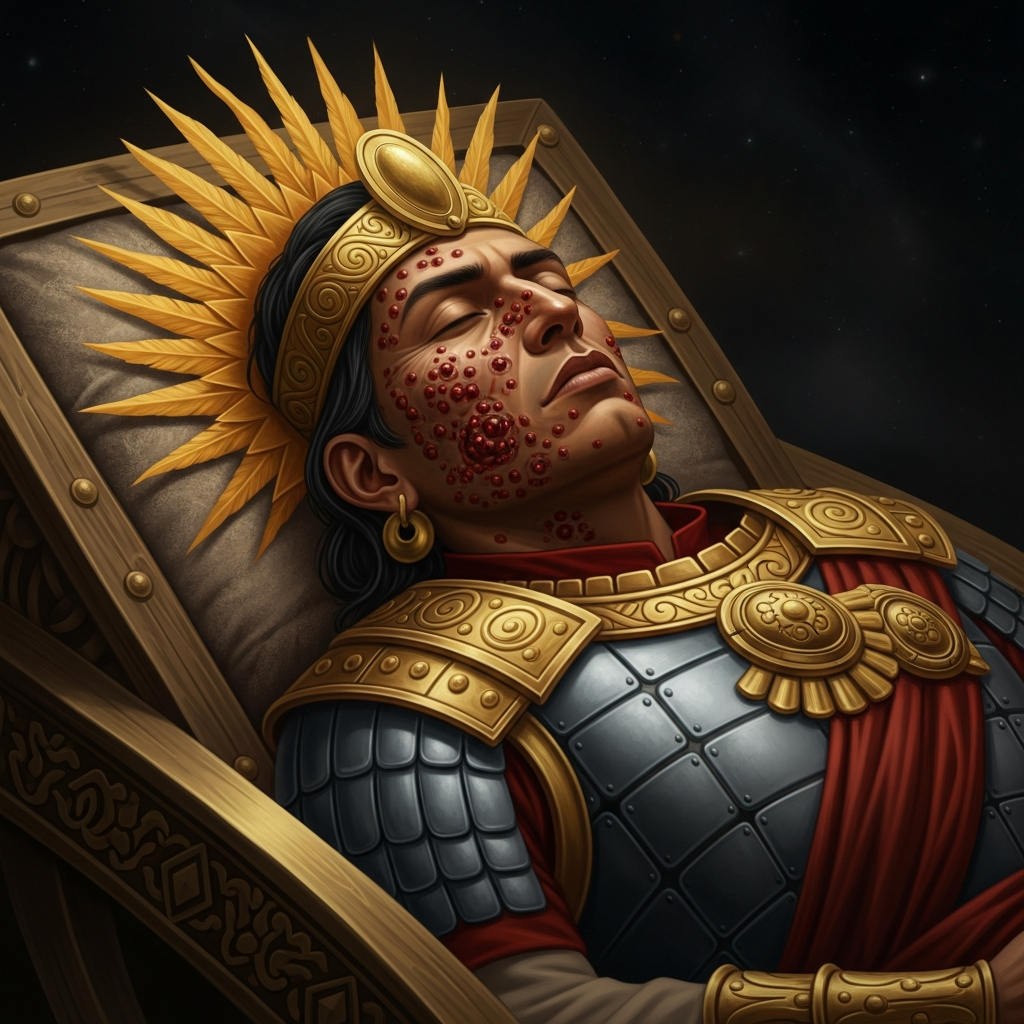
What is undisputed is the centrality of Inti. Every Sapa Inca claimed direct descent from him through Manco Cápac. Every Sapa Inca’s principal title was Intip Cori — Son of the Sun. Every Sapa Inca, in the formal cosmology, ruled with the consent of the sun-god and could be removed if Inti withdrew his blessing. The Sapa Inca’s own person was, in life, considered a manifestation of Inti on earth; commoners could not look directly at his face.
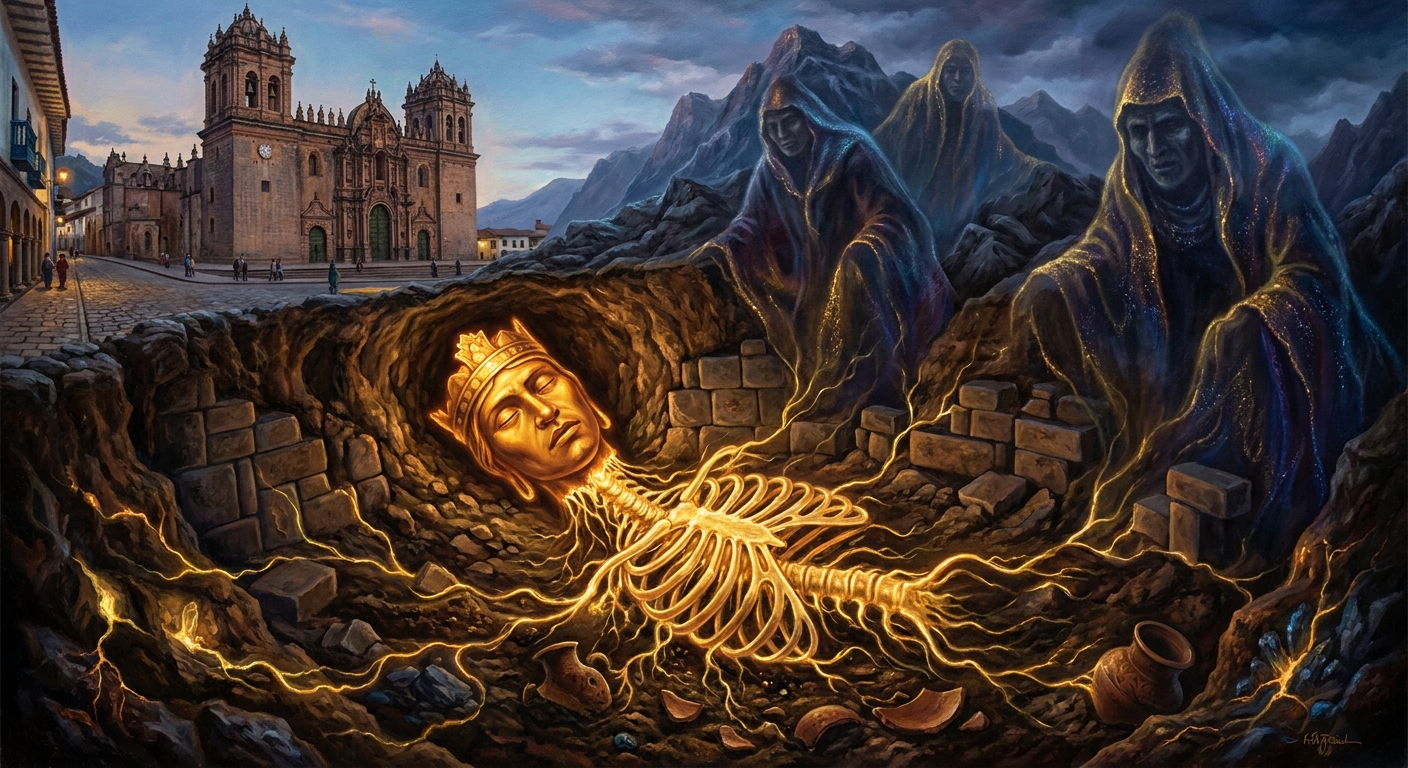
When the Spanish conquistador Francisco Pizarro arrived in the 1530s, he understood the religious situation immediately. To break the empire, he had to break Inti. He attacked the Coricancha. He had the gold sheets stripped from the walls and melted into bullion. He had the imperial mummies — the preserved bodies of the previous Sapa Incas, kept on golden thrones in the temple, brought out for festivals and consulted on policy — burned. He had the priests killed. He had Atahualpa, the last independent Sapa Inca, garrotted in a courtyard.
The empire ended. The myth did not.
—
Inti is still worshipped, in the Andes, today.
He is worshipped openly at Inti Raymi — the festival of the sun, held every year on the Cuzco plaza on June 24, the winter solstice in the Southern Hemisphere. Tens of thousands of people gather to watch the costumed Sapa Inca arrive on a litter borne by his nobles, the priests sacrifice (now symbolically) a llama, and the assembled families pay their respects to the rising sun. The festival was banned by the Spanish for three hundred years; it was revived in 1944 by Peruvian intellectuals and has run, every year since, on the Plaza de Armas in Cuzco, in front of the cathedral that the Spanish built on top of the foundations of the Inca palace.
He is worshipped quietly, all year, by Andean farmers. Manco Cápac and Mama Ocllo are, in many highland villages, still invoked at the planting of the first row of maize. The golden staff is gone — the Spanish presumably melted it down with the rest of the gold — but the place it sank still holds. Cuzco remains the navel.
To stand on the Plaza de Armas at sunrise on the winter solstice, watching the first light move across the great Inca walls that the conquistadors did not have the equipment to demolish, is to feel the staff sinking in still. The myth of finding the right place by walking until the earth accepts you turns out to have been a metaphor with very specific geological accuracy: there really is, in the Cuzco basin, a deeper layer of soft alluvial soil than anywhere else in the southern Andes. Manco Cápac was not making it up. He had his father’s instructions. The staff went in.
Scenes
On the floor of Lake Titicaca at dawn, two figures rise from the deep blue water — a young man holding a golden staff, a young woman beside him in a long white tunic
The brother and sister walk along an Andean ridge in heavy ponchos
In a green valley between two rivers, the staff sinks into the soft soil up to its golden head
Echoes Across Traditions
Entities
- Inti
- Mama Quilla
- Manco Cápac
- Mama Ocllo
- Viracocha


Sources
- Garcilaso de la Vega, *Comentarios Reales de los Incas* (1609)
- Juan de Betanzos, *Suma y narración de los Incas* (1551)
- Pedro Sarmiento de Gamboa, *Historia de los Incas* (1572)
- Gary Urton, *Inca Myths* (1999)