Contents
When an Aztec died of ordinary causes, their soul began a four-year passage through nine levels of the underworld — across a black river on the back of a dog, between mountains that clash like teeth, across a plain of obsidian wind. At the bottom waited Mictlantecuhtli, lord of bones.
- When
- Mythic / cosmological time
- Where
- Mictlan, the nine-leveled underworld beneath the earth
When an Aztec died of disease or old age, of drowning or any ordinary thing, their road did not lead up to the sun. Only warriors fallen in battle, captives gone under the obsidian knife, and women dead in childbirth ascended. Everyone else — the great majority — went down. They went to Mictlan, the place of the dead, which lay nine levels beneath the surface of the earth, and the journey took four years.
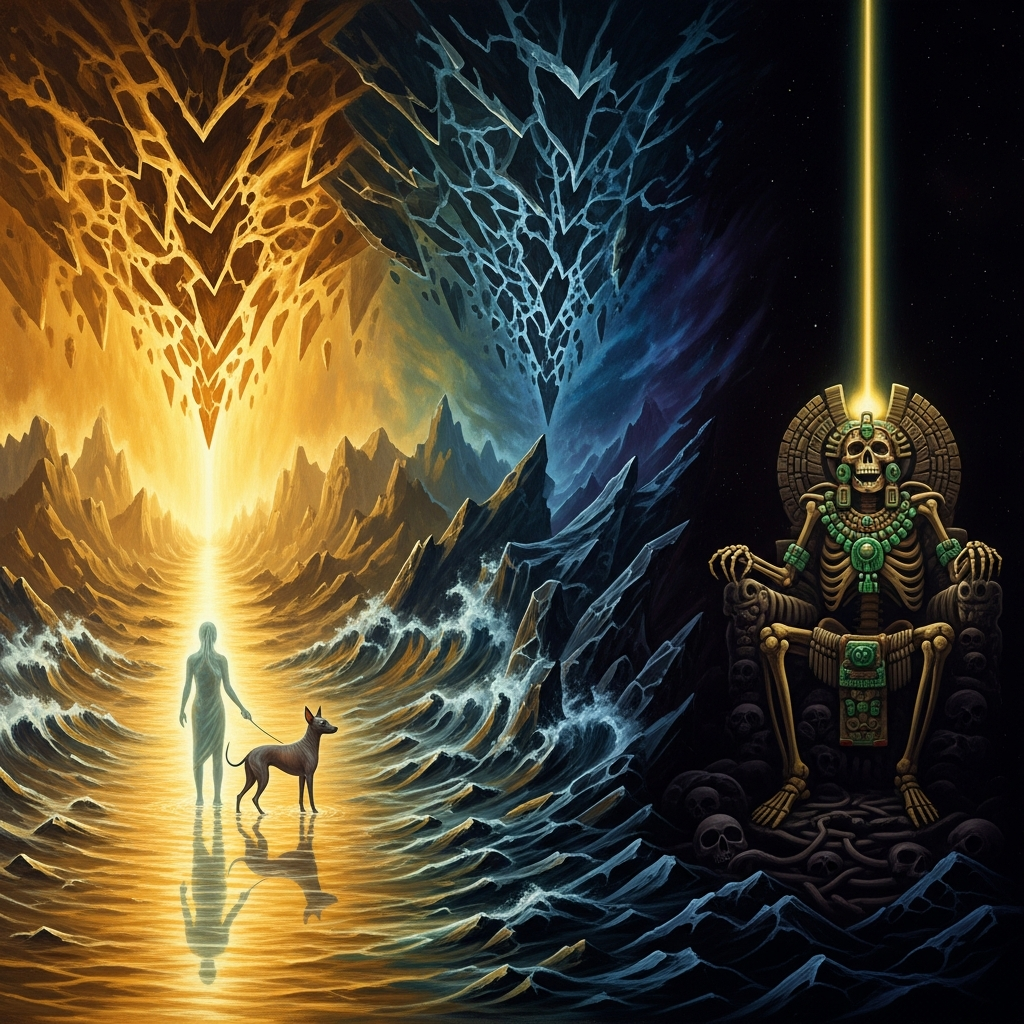
On the day of burial, the relatives placed a small reddish-yellow dog beside the body, throat cut, eyes open. The Aztecs bred this dog — the xoloitzcuintli, named for Xolotl, twin of Quetzalcoatl and lord of the evening star — for exactly this purpose. At the first level of Mictlan, the Apanohuaia, a great black river bars the way, and the soul must cross. Without the dog, the soul stands forever on the bank, unwelcome on either shore. With the dog, the soul takes hold of the dog’s back, and the dog, who knows the way, swims them across.
The second level is Tepectli Monamictlan, “the place where the hills come together.” Two great mountains clash and separate, clash and separate, like jaws. The soul must time the crossing. Some are caught and crushed; the codices do not say what becomes of them.
The third level is Iztepetl, the obsidian mountain, whose flanks are fields of black volcanic glass arranged in upturned blades. The dead must walk across, and the wind there — the fourth level, Cehuelocayan — is no ordinary wind. It is the Itzehecayan, the obsidian wind, which carries shards of obsidian on its breath. The wind flays the soul. By the time it has crossed these four levels, the soul has lost its skin, lost its flesh, become a thing of bone and grief.
The fifth level is Pancuetlacalloyan, “where one is tossed about by banners,” a place of disorientation, a wind without direction. The sixth is Temiminaloyan, where unseen archers fire arrows from the dark; the seventh is Teyollocualoyan, “the place where one’s heart is eaten,” where the jaguar Tepeyollotl waits and devours the heart, the yollotl, the seat of the self. The eighth level is the still black water Apanhuiayo, full of nothing.
The ninth and last is Chiconauhmictlan, “the ninth Mictlan,” where Mictlantecuhtli sits enthroned in his palace of bones. He wears a skull mask. His wife Mictecacihuatl sits beside him; her face is half flesh, half skull, her teeth bare even in repose. The soul, what is left of it, presents the offerings: paper, copal, the small dog who has finished its work. Then the soul dissolves. The Aztec afterlife is not punishment and not reward; it is rest, which is to say it is nothing. The travel was the trial; the arrival is the end of having been a person.
The Aztecs did not soften this. They knew where most of their dead were going. The wife who buried her husband walked home knowing he was on the riverbank now, holding a dog’s back. The mother who lost a child — if not in childbirth, but to fever — knew the child was on the obsidian wind. They burned bundles of pine for him on the four anniversaries; on the fourth year exactly, they stopped, because by then he had reached the bottom and was no longer there to be remembered. The world above kept turning. The dead kept dissolving. The dog had done its job.
Echoes Across Traditions
Entities
- Mictlantecuhtli
- Mictecacihuatl
- Xolotl

Sources
- Florentine Codex, Book 3, Appendix (Sahagún)
- Historia General de las Cosas de Nueva España
- Codex Vaticanus A