Confucius Stands at the River and Weeps
c. 497 BCE — the period of Confucius's wandering between states seeking a ruler who would employ him · A riverbank — the specific river unnamed, the moment universal
Contents
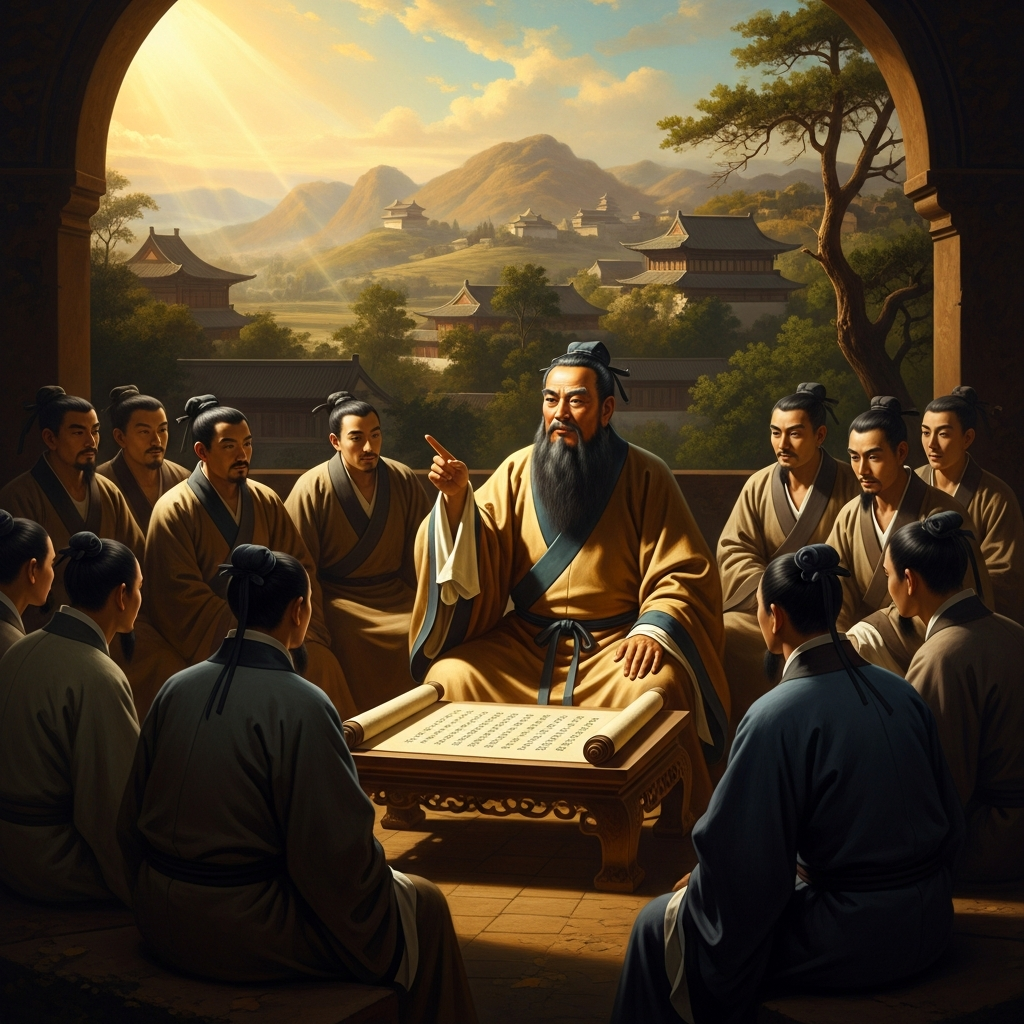
Confucius stands on the bank of a river, watches the current, and says: it goes on like this, never stopping, day or night — and his disciples do not know if he is weeping for the river or for time or for something no one has a name for.
- When
- c. 497 BCE — the period of Confucius's wandering between states seeking a ruler who would employ him
- Where
- A riverbank — the specific river unnamed, the moment universal
He stands at the river.
He has come here from the road — from the years of wandering between states with his cart and his students, from the courts where he was received politely and not employed, from the cities where the duke or the minister said yes, we would like a man like you, and then did nothing with him, from the roads between courts that have occupied the better part of his sixties. He has been on the road for thirteen years.
He stands at the river and watches the water.
The Analects records nine characters: 逝者如斯夫,不舍晝夜。
It goes on like this, does it not — not stopping day or night.
That is the whole passage. No context in the text, no question from a disciple prompting it, no explanation of what he is looking at when he speaks or what occasion has brought him to this particular bank. He stands at the river. He says it goes on like this, not stopping, day or night. The disciples record it.
The commentators for two thousand years have disagreed about what he means.
Some say he is lamenting time — that it refers to time, and the sorrow in the passage is the sorrow of a man who has tried all his life to find a ruler who would employ him, and the river is time running out, and the day and night that do not stop are the days and nights of a life running through without arriving at its purpose. By this reading, the passage is one of the most compact expressions of late-life grief in world literature.
Some say he is celebrating the Way — that it refers to the Tao, or the moral order, or the ceaseless functioning of heaven that continues regardless of human failure or success. By this reading the river is not threatening but comforting: whatever I have not accomplished, the Way continues. The day does not stop because a sage went unheeded.
Some say he is doing something that cannot be resolved into either grief or celebration: standing at the river, watching it, and saying out loud the one thing that is simply true about it, the same thing Heraclitus says about rivers in another century in another language. It goes on. Day and night. Without stopping.
Confucius is sixty-eight when he stops wandering and returns to Lu, his home state, for the last years of his life. He has three more years. He will see his most beloved disciple Yan Hui die young. He will see Zilu killed in a coup. He will compile the ancient texts — the Book of Songs, the Spring and Autumn Annals — the preservation work that outlasts the political work.
He stands at the river on the way home or on the way there, and the nine characters he says are the nine characters that have been carried for twenty-five centuries. Not a doctrine. Not a teaching. A man watching a river and saying what he sees. The river still runs. Day and night. Without stopping. What Confucius feels looking at it — whether it is grief or wonder or the stillness past both — is still at the riverbank, available to anyone willing to stand there long enough to find it.
Echoes Across Traditions
Entities
- Confucius (Kong Qiu)
- the disciples on the riverbank

Sources
- Analects (論語), book 9, chapter 16 — the river passage
- D.C. Lau, trans., *The Analects* (Penguin, 1979)
- Simon Leys, trans., *The Analects of Confucius* (Norton, 1997)
- Edward Slingerland, trans., *Confucius: Analects* (Hackett, 2003)