Contents
A widow moves her household three times to find the right neighborhood for her son's education — and when she finally stops moving, she cuts the weaving from her loom to teach the boy what happens when you abandon what you have begun.
- When
- c. 372-289 BCE — the childhood of the historical Mencius
- Where
- Three houses in the state of Zou (now Shandong Province)
The first house is near the cemetery.
Mencius is a small boy and the cemetery is interesting. The funerals that happen at the cemetery are interesting — the processions, the mourning, the elaborate procedures of burial. He and the other children play funeral. They practice the weeping. They learn to imitate the coffin-bearers. They learn the sounds grief makes. It is the most vivid theater in the neighborhood and children learn what is vivid.
His mother watches her son play funeral and moves.
The second house is near the market.
The market is interesting in a different way. The vendors call out their prices. The negotiations happen in the morning air. The haggling, the persuasion, the salesmanship of ordinary commerce — these are skills that children also learn by watching, and by imitation. Mencius begins to practice selling. He learns the patter. He learns the theatrical enthusiasm of the marketplace.
His mother watches and moves.
The third house is near a school.
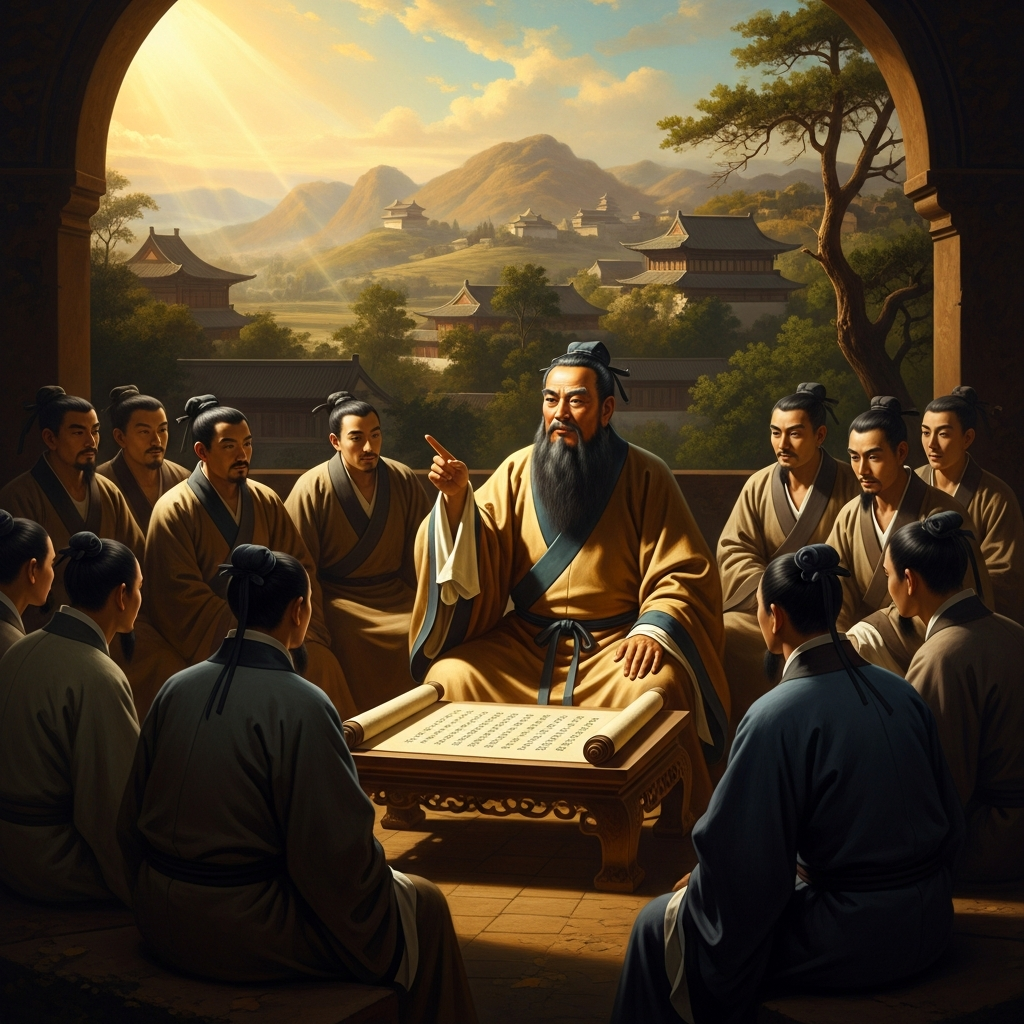
Near the school, the sounds are different: the chanting of texts, the recitation that is the ancient Chinese method of absorbing the classical tradition into the body, the sound of scholarship becoming rhythm. The children near the school learn to chant. Mencius learns to chant. He learns the forms of ritual. He learns the ceremonies of courtesy between people of different rank, the protocols that structure social life.
His mother stops moving.
She has been watching three kinds of environment produce three different children. The cemetery produced a child learning the grammar of grief as performance. The market produced a child learning the grammar of persuasion as transaction. The school produces a child learning the grammar of virtue as practice. The same child, different environments, different formations.
This is the teaching she is enacting rather than stating: that character is not innate and fixed but formed in relationship with what surrounds it, and that the parent’s most important act is not instruction but selection — the careful choosing of the surrounding.
The second half of the story is the loom.
Mencius, older now and studying in the school she chose for him, comes home one day and has left his studies. He did not finish. He grew bored or distracted or simply decided to come home. His mother is at the loom. She looks at him. She asks why he has returned.
He says he left because he felt like it.
She picks up the cutting knife and cuts the weaving from the loom — cuts the cloth right through, cuts it from the threads. The days of work are destroyed. The weaving that was half-finished is now nothing.
She says: this is what your education is if you leave it halfway.
He never leaves his studies again.
The lesson of the cut weaving has been transmitted in every Confucian discussion of education since Liu Xiang recorded it in the first century BCE: that learning is not an accumulation but a fabric, that each day’s work depends on what came before and enables what comes after, that the person who walks away from the middle does not preserve half a fabric — they produce rags. The knife is not punishment. It is demonstration. She cuts the weaving so he can see what he has just done to himself.
Mencius becomes the Second Sage of the Confucian tradition, the man who argues that human nature is fundamentally good, that morality is the natural growth of what is already in us. He arrived at this conclusion via a woman who moved three times to find the right soil for a seed she had not yet grown, and who cut the weaving rather than explain.
Echoes Across Traditions
Entities
- Mencius (Meng Ke)
- Mencius's mother
Sources
- Lienu Zhuan (列女傳), Liu Xiang, c. 18 BCE — the source of the Three Moves story
- Various traditional accounts in Four Books commentary tradition
- Patricia Ebrey, ed., *Chinese Civilization: A Sourcebook* (Free Press, 1993)
- Philip Ivanhoe, *Confucian Moral Self Cultivation* (Hackett, 2000)