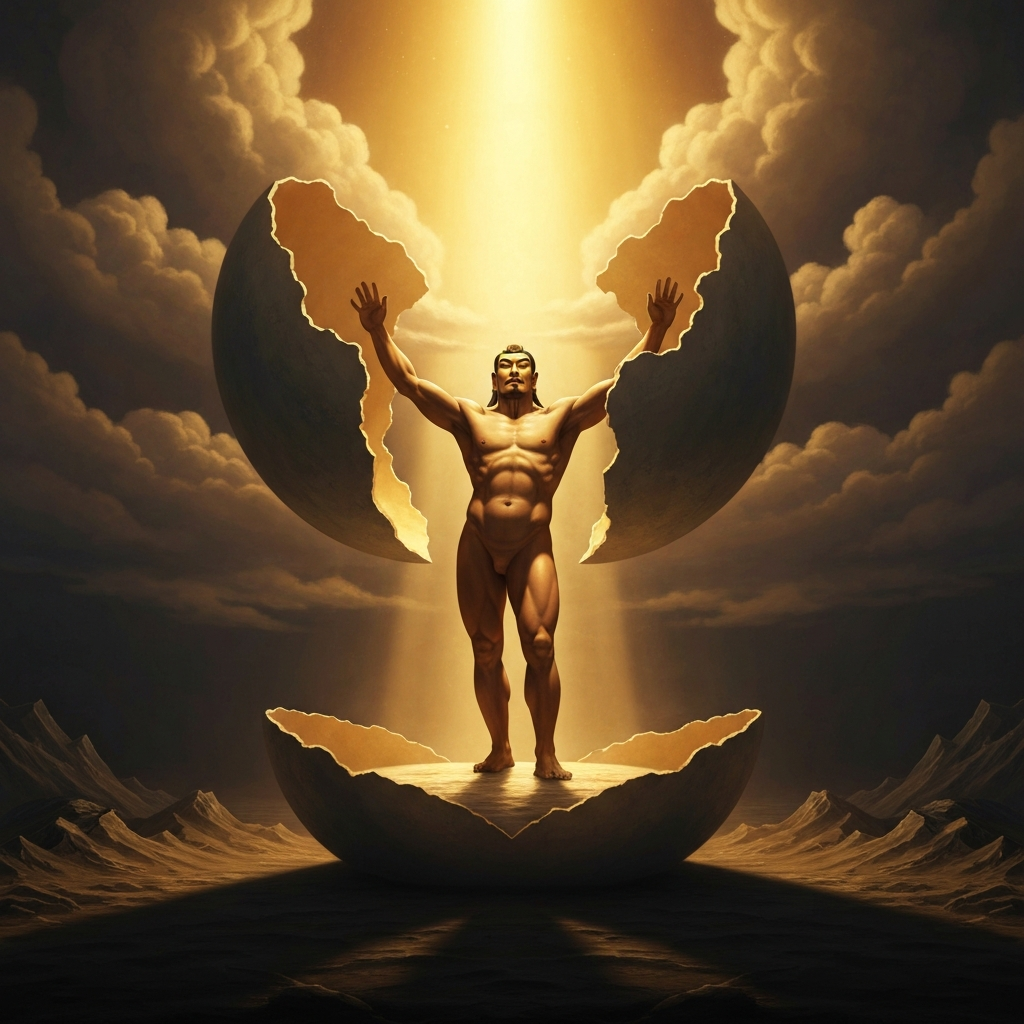
Guan Yú: The Ghost Who Refused to Leave
220 CE and afterward — the deification process spanning centuries · The Yuquan Mountain monastery in Hubei Province, where Guan Yu's head was interred
Contents
After his execution, Guan Yu's spirit appears at a Buddhist monastery demanding that his head be returned — setting in motion the process by which a historical general becomes the god of war, brotherhood, and moral righteousness.
- When
- 220 CE and afterward — the deification process spanning centuries
- Where
- The Yuquan Mountain monastery in Hubei Province, where Guan Yu's head was interred
He is executed in 220 CE.
Sun Quan, the king of Wu, has him captured and beheaded. The head is sent to Cao Cao — the enemy Guan Yu refused to betray — possibly as a gesture of political courtesy, possibly as a form of evidence. Cao Cao, who had admired Guan Yu for years and once offered him everything to defect, buries the head with full military honors. The body is buried at the site of the execution in what is now Dangyang, Hubei Province.
The ghost begins its work almost immediately.
The accounts of the first appearances come from a Buddhist monastery on Yuquan Mountain near the burial site. The monk Pujing, practicing at night, hears a voice from the darkness outside the meditation hall. The voice says: Return my head. The monk looks into the darkness. He sees nothing, then he sees the outline of a general — tall, red-faced, with the long beard the portraits always show — sitting on a horse in the darkness outside the monastery gate.
Pujing does not panic. He is an old monk who has been in difficult situations before. He asks the spirit: all the soldiers you killed in your years of war are also dead. Are they not also asking for their heads back? Where does that logic end?
The spirit is silent for a moment. Then — in the accounts that come down to us through the monastery tradition — it dismounts and bows. It acknowledges the argument. It asks instead for instruction. Pujing teaches it the dharma. The spirit accepts the three refuges. It becomes, at this moment, a ghost with a Buddhist education and a monastery to haunt in a more orderly way.
From the monastery, the cult expands. Local people begin to report that when things go wrong — when thieves threaten, when illness comes, when a boat is in difficulty on the river — a red-faced general appears. He does not always help. He is not a god of easy miracles. He helps those who have been faithful to their commitments, those whose conduct echoes the oath in the peach garden. He is the patron of the loyal.
The Song dynasty gives him his first imperial title. The Ming dynasty promotes him. The Qing dynasty promotes him further. By the eighteenth century, Guan Yu has accumulated a portfolio that would make a celestial minister envious: God of War, God of Commerce (because merchants swear oaths too and need a god who takes oaths seriously), God of Literature in some traditions (because he is said to have read the Spring and Autumn Annals by lamplight during the siege of the city), Guardian of the Han people, one of the Jade Emperors, patron deity of the police force, the martial arts, the opera, the sworn brotherhoods of secret societies.
He is worshiped in more temples than almost any other deity in China. His image is in police stations, triad meeting halls, restaurants, and martial arts schools simultaneously, because all of these are worlds where the oath matters and the question of whether you will keep your word is the most important question.
The monk Pujing asked him: where does the logic of grievance end? The spirit bowed. The bowing was the transformation — from the grieving dead to the principled dead, from the ghost demanding restoration to the deity offering protection. The head is still missing. He is still looking for it, in a sense — his cult is still the ongoing claim that the oath meant something, that the life given to a commitment was not wasted, that the red-faced general who kept faith in the peach garden is still keeping it, every night, in every place where people light incense and ask for the courage to honor what they have sworn.
Echoes Across Traditions
Entities
- Guan Yu
- the monk Pujing
- the Jade Emperor
- Sun Quan
Sources
- Barend ter Haar, *Guan Yu: The Religious Afterlife of a Failed Hero* (Oxford, 2017)
- Valerie Hansen, *Changing Gods in Medieval China, 1127-1276* (Princeton, 1990)
- Stephen Feuchtwang, *The Imperial Metaphor: Popular Religion in China* (Curzon, 2001)
- Luo Guanzhong, *Romance of the Three Kingdoms*, chapters 77-80