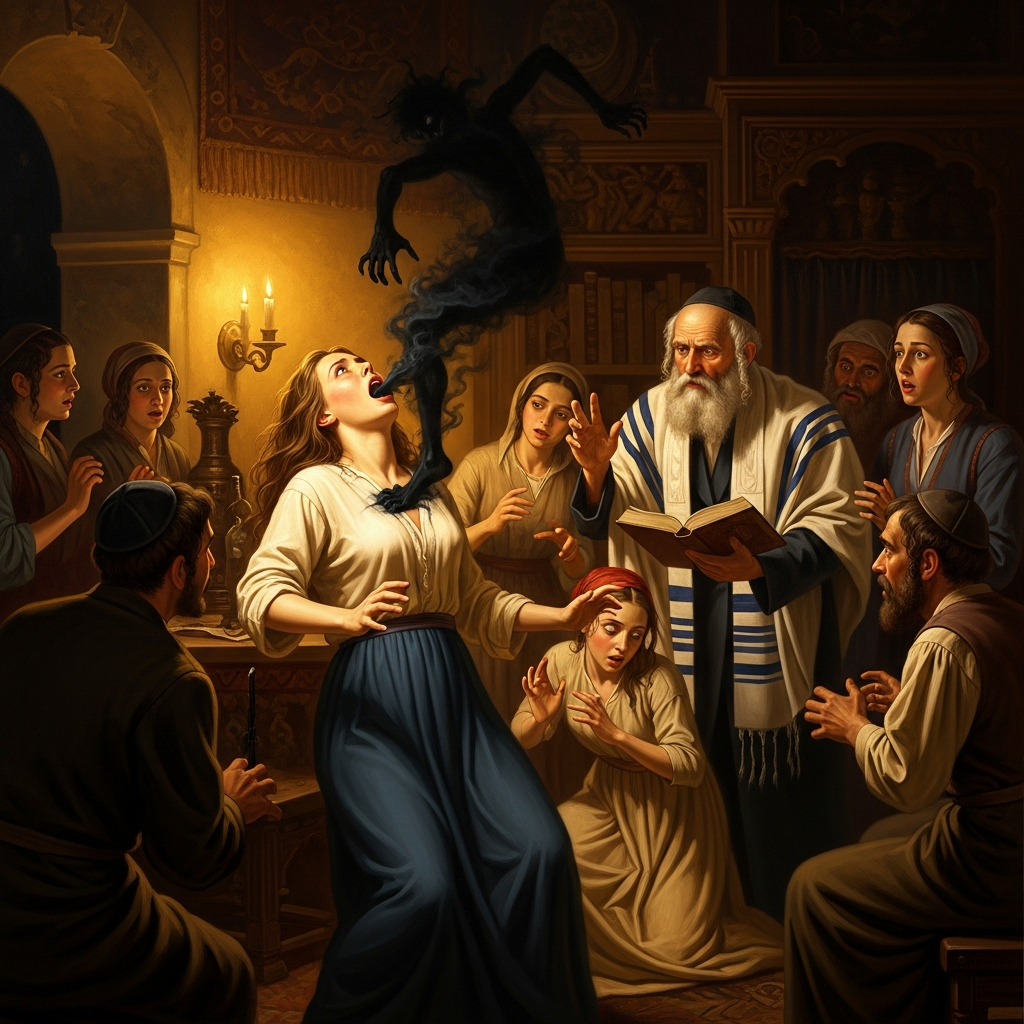
Lilith: The First Woman Who Said No
c. 800 CE (Alphabet of Ben Sira) · The Garden of Eden at the moment of human creation; the Red Sea coast where Lilith retreats; the night-skies and bedrooms over which she rules thereafter
Contents
God makes Adam from the dust and a woman from the same dust at the same time. Her name is Lilith. The two of them disagree, immediately, on a matter that the medieval Alphabet of Ben Sira reports with bracing frankness: she will not lie underneath him during sex. She speaks the secret name of God, rises into the air, flies away, and refuses to come back. The angels sent to retrieve her cannot persuade her. God's second attempt at a partner for Adam — Eve, made from a rib — is meant to be more compliant. Lilith, exiled, becomes the demon of the night.
- When
- c. 800 CE (Alphabet of Ben Sira)
- Where
- The Garden of Eden at the moment of human creation; the Red Sea coast where Lilith retreats; the night-skies and bedrooms over which she rules thereafter
The story does not appear in the Bible.
This is the first thing to say about Lilith. The Bible — the Hebrew Tanakh — mentions her exactly once, in passing, in Isaiah 34:14, where she appears in a list of desert creatures haunting the ruins of Edom: the lilith shall there repose and find her a place of rest. The word in Hebrew is lilit, almost certainly cognate with the Mesopotamian lilitu, the air-spirits of older Near Eastern religion. Whatever Isaiah meant, his Lilith is barely a character — a brief reference to a folkloric night-creature, mentioned for atmosphere, not developed.
The full story of Lilith — the story everyone now knows — comes from a much later text, The Alphabet of Ben Sira, a satirical Jewish work composed somewhere between the eighth and tenth centuries CE, possibly in the Geonic academies of Babylonia, possibly elsewhere. The text is a kind of literary jeu d’esprit, presenting twenty-two acrostic chapters in which a precocious child named Ben Sira engages in dialogue with King Nebuchadnezzar; embedded in the dialogue are folkloric stories. One of them is the story of Lilith and Adam.
The text’s tone is not entirely reverent. It may have been written, in part, as parody. It was nonetheless taken seriously by later Kabbalists, especially the authors of the Zohar (c. 1280), who absorbed Lilith into the heart of Jewish mystical demonology. From the Zohar she traveled into folk practice, into amulets, into bedside customs, into the tangled history of how Jewish women across the centuries have protected their newborns from the demon of the night.
The story below is the Alphabet of Ben Sira version, told straight.
—
When God set about making humans, the text says, he did not do it once. He did it twice.
Genesis 1, the priestly creation account, has a striking detail: And God created man in his own image; in the image of God he created him; male and female he created them. Genesis 2, the older Yahwist account, has a different detail: God forms Adam from the dust of the earth, places him in Eden, and then — finding Adam without a suitable companion — takes a rib from his side and forms Eve.
These two accounts are in tension. The first suggests God made man and woman simultaneously, as equal creatures. The second suggests Eve came after Adam, made from him, derivative.
The rabbis of late antiquity noticed the tension. They produced a number of harmonizing solutions. The most elaborate was: there were two women. The first woman — the woman of Genesis 1, made simultaneously with Adam from the earth — was Lilith. The second woman — the woman of Genesis 2, made from Adam’s rib — was Eve.
The Alphabet of Ben Sira tells the story.
—
God made Adam. Almost immediately, God said it was not good for the man to be alone. He took dust from the same place from which he had taken Adam’s dust, and he shaped a woman from it.
Her name was Lilith.
She was made the same way Adam was. She was made from the same earth. She was made at the same time. She was, by design, his equal in every measurable sense.
This was the problem.
Adam and Lilith, finding themselves in the garden together, attempted to have sex.
The medieval text is admirably blunt about what happened next. The Alphabet of Ben Sira is one of the few medieval texts I can think of that records a marital dispute about sexual position with this kind of forensic clarity. Lilith refused to lie underneath Adam during intercourse. She told him she would not lie below him. He insisted she should. She insisted she would not.
Her argument, as recorded in the text, is this:
Why should I lie beneath you? We are equal. We were both made from the dust of the earth. I am no lower than you.
His argument:
You shall lie beneath me. I am higher.
This is the first recorded marital quarrel in the Western literary tradition. It is, as commentators have noted, a quarrel about hierarchy disguised as a quarrel about position. Adam wants Lilith to lie underneath him not, in the deepest reading, because of any specific preference about angles, but because lying-underneath is the symbolic recognition of subordination. Lilith refuses lying-underneath because she sees the symbolic content clearly. They are not actually arguing about sex. They are arguing about whether the universe runs on hierarchy or on equality.
Neither yields.
The argument deepens. Adam, frustrated, demands she submit. Lilith refuses again.
Then she does something unexpected.
—
She speaks the Shem ha-Meforash — the Ineffable Name of God.
This is one of the most provocative details in all of Jewish folklore. Lilith, the first woman, knows the secret name of God. She speaks it. The name, properly uttered, has cosmic power.
When she speaks the name, she rises into the air. Her body lifts off the ground of the garden. She flies up over the trees. She flies over the boundary of Eden. She flies away.
Adam stands in the garden alone, watching her go.
He goes to God. He complains. He says, The wife you gave me has fled.
God does not seem entirely surprised. He sends three angels — Senoy, Sansenoy, and Semangelof — after her. The angels are instructed: find her, persuade her to return, and if she will not return willingly, threaten her.
The angels track her. They find her in the wilderness — specifically, the text says, on the shore of the Red Sea, where she has settled. She is there with what the text describes as demonic consorts — the wild powers of the desert and the sea — and she has been, in the days since her flight, having sex with them and bearing their children. She is producing, the text says, a hundred new demons every day.
The angels arrive. They give her the message. Return to your husband Adam, or we will kill a hundred of your demon-children every day until you do.
Lilith looks at them.
She refuses.
She says — and this is, again, one of the most striking lines in any medieval text — I cannot return. The world has been arranged so that I would rule the night, and I will rule it. I am cursed to bring death to newborn boys for the first eight days of their lives, and to newborn girls for the first twenty days. The angels who hold this contract have no power to release me.
The angels, baffled, reach a compromise. They cannot bring her back. But they can extract a promise. They tell her: We will let you live in your wilderness. But you must swear that whenever you see our names — Senoy, Sansenoy, and Semangelof — written on an amulet near a newborn baby, you will leave that baby alone.
She agrees.
—
This compromise is the foundation of one of the most enduring practices of folk Judaism. From the medieval period until well into the twentieth century, Jewish mothers across the diaspora — from Yemen to Poland, from Kurdistan to the Bukhara — placed amulets in the cradles of their newborns. The amulets, written by scribes on parchment, contained the names of the three angels: ש (for Senoy), ס (for Sansenoy), and ע (for Semangelof). They contained, sometimes, the verse from Numbers 6 — the Lord bless thee and keep thee. They were specifically intended to ward off Lilith.
The texts describe Lilith’s predations in vivid detail. She comes in the night. She enters the room of the newborn. If the amulet is present, she reads the angels’ names and remembers her oath, and she leaves. If the amulet is missing, she takes the child. The high infant mortality rate of pre-modern populations — staggering by modern standards — was, in the folk imagination, partly her work.
She is also, in folklore, the succubus — the demon who comes to men in their sleep, particularly to men sleeping alone, and seduces them. The night-emissions a man wakes from in the morning, in the medieval Kabbalistic understanding, are partly Lilith’s harvest: she has taken his seed, in the night, to make more demons.
These functions made her, in the Kabbalistic system, one of the central figures of the sitra achra — the other side, the realm of impurity. She becomes, in the Zohar, the consort of Samael, the dark angel. Together they are the demonic counterpart to Tiferet and Shekhinah, the divine male and female of the upper world. The Kabbalists worked her in deeply. By the late medieval period, she is no longer a folkloric night-creature. She is a metaphysical entity, the female face of evil.
—
In the second half of the twentieth century, Lilith was reclaimed.
The reclamation began in the early 1970s with a generation of Jewish feminists looking, in the textual tradition, for figures of female refusal. Lilith was, by their reading, an obvious candidate. She had refused subordination. She had insisted on equality at the level of the body itself. She had spoken the divine name. She had risen into the air. She had been demonized for the refusal — but the demonization, the feminists noticed, looked an awful lot like the patriarchal punishment of an autonomous woman.
The Jewish feminist magazine Lilith was founded in 1976. It is still publishing. The reclamation has continued. Lilith is now, in many corners of contemporary Jewish thought, not the demon of the night but the prototype of the woman who would not lie down — the woman who chose exile over hierarchy, who saw the position-argument for what it was, who flew away rather than submit.
Whether the original Alphabet of Ben Sira author intended this reading is, of course, doubtful. The original text is satirical and probably misogynist. The original reader, almost certainly male, was meant to laugh at Lilith’s outrageous refusal and to draw a moral about female compliance. The text is, in that reading, an anti-feminist tract.
But the figure escaped the text. This happens with mythological figures. They acquire afterlives the original authors did not plan. Lilith, since the eighth century, has been carried by Jewish folk practice through diasporas and into amulets; in the late twentieth century, she emerged on the other side, in feminist seminars and theological essays, as something the original author might not have recognized: a refusing woman, mythically primary, speaking the name of God and rising into the air.
She has never come back to Eden. The amulets are still made, in some communities, in others quietly retired. Eve was made from Adam’s rib precisely because the first woman would not stay. Whatever Eve was — and the rabbis, in the Genesis Rabbah and elsewhere, have a great deal to say about her — she was, by design, the second attempt. The first attempt was the one who refused. She is, by the strange logic of mythology, the figure the tradition cannot delete and cannot domesticate, the night-demon and the night-icon at once, the woman who flew up out of the garden and never quite stopped flying.
Scenes
In a green Edenic garden at dawn, Adam and Lilith stand opposite each other beside a flowering tree
Lilith rises into the air above Eden, her dark hair streaming, naming the unspeakable
On the rocky shore of the Red Sea at moonrise, three angels stand on the beach in robes of white and gold, calling to a woman seated on a cliff above the surf
Echoes Across Traditions
Entities
- Lilith
- Adam
- Senoy
- Sansenoy
- Semangelof
Sources
- *Alphabet of Ben Sira* (c. 700–1000 CE)
- *Zohar* (c. 1280 CE)
- *Babylonian Talmud* (Niddah 24b, Shabbat 151b — passing references)
- Raphael Patai, *The Hebrew Goddess* (1967, rev. 1990)
- Joseph Dan, *Kabbalah: A Very Short Introduction* (2007)