Sun Wukong Declares Himself Equal to Heaven
The mythological past — before the Tang Monk's journey to the West · The Jade Emperor's court in heaven, and the battlefield above the clouds
Contents
Having mastered every art and defeated every general the Jade Emperor sends against him, the Monkey King demands to be recognized as Great Sage Equal to Heaven — and refuses to accept any title that falls short of it.
- When
- The mythological past — before the Tang Monk's journey to the West
- Where
- The Jade Emperor's court in heaven, and the battlefield above the clouds
He wants a title and he wants it to be accurate.
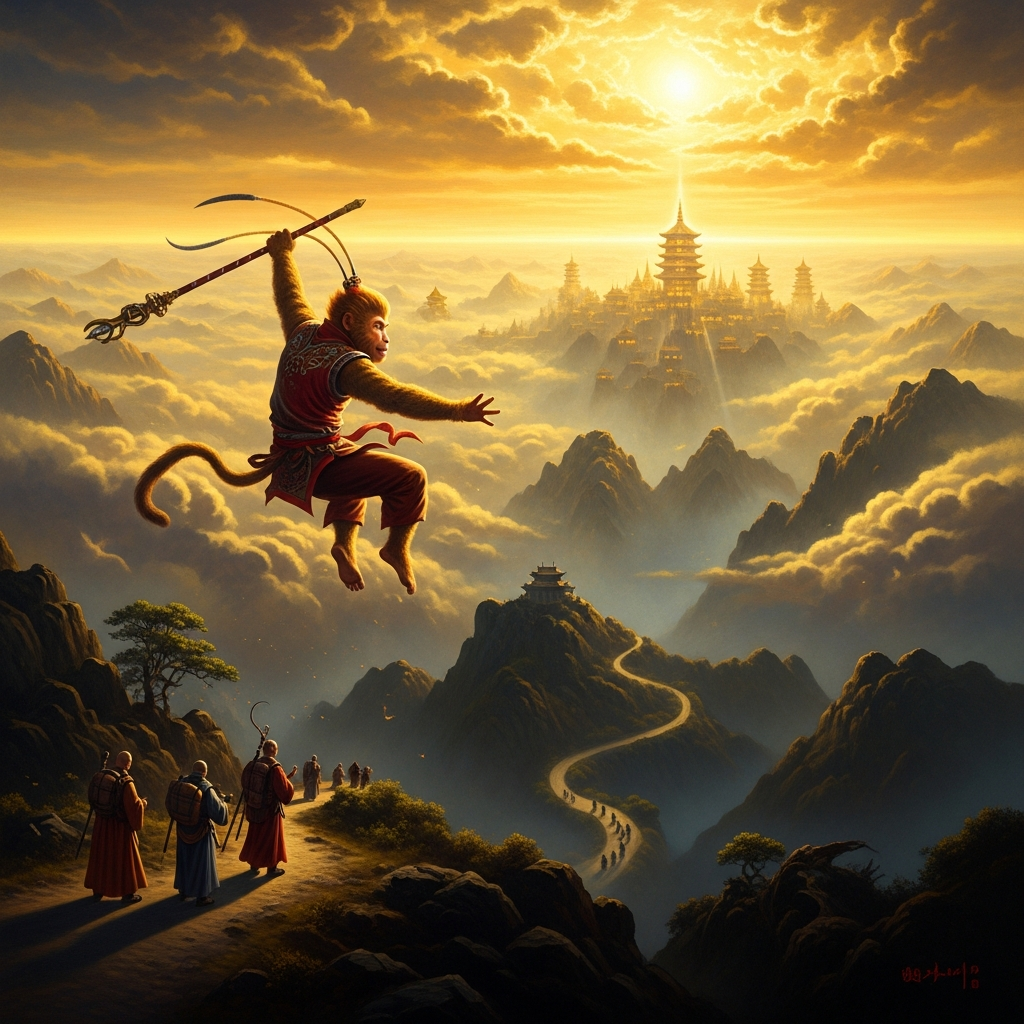
This is the thing about the Monkey King that makes him incomprehensible to the celestial bureaucracy: he does not want power, exactly — he has power, he has worked hard for it, he has acquired the 72 transformations, the cloud-somersault that covers 108,000 li in a single leap, the golden staff that extends from the size of a needle to the size of a pillar, the ability to pull hairs from his own body and blow on them to produce armies. What he wants is recognition. He wants the title that correctly names what he is, and what he is, he has concluded, is the equal of heaven.
The Jade Emperor tries to manage this the way the Jade Emperor manages everything: by giving him a title that sounds good but means nothing. Bimawen — Supervisor of the Heavenly Stables. It is a real job. The horses of heaven are important. The title comes with a salary. Sun Wukong accepts it and takes the job and then learns what the job is.
He learns that Bimawen is the lowest rank in the celestial civil service. He has been given a custodial position. He is the heavenly horse-groom.
He is outraged with the clean outrage of someone who was already on the edge of outrage and needed only the smallest push. He returns to his mountain, his kingdom of monkeys, his Water Curtain Cave. He declares himself Great Sage Equal to Heaven. He has a banner made. The banner says: Great Sage Equal to Heaven.
The Jade Emperor sends generals. Sun Wukong defeats them, one at a time, with the staff and the transformations and the military genius he acquired from his long study with the immortal master Subodhi. The battles are spectacular — the golden staff extending and retracting, the hairs-into-armies gambit, the transformations into creatures of increasing size and power. The celestial generals return to heaven in sequence, reporting failure.
The Jade Emperor takes the next step: he creates the title. The Great Sage Equal to Heaven — just the title, an empty title with no portfolio, no actual authority, an honorary rank with an impressive office on the celestial grounds and nothing to do in it. He sends the Star God Taibai Jinxing as his envoy with the offer.
Sun Wukong accepts. He has the title. He has the office. He has the banner. He is, officially, the Great Sage Equal to Heaven.
He is bored immediately.
He is invited to neither the Peach Banquet nor the divine convocations. He is recognized on paper and ignored in practice. The title is the system’s way of containing him — put the anomaly in a box, label it, file it, hope the filing satisfies it. It does not satisfy him. He discovers the Peach Garden. He eats the peaches. He steals the divine elixir from Laozi’s furnace. He crashes the banquet with the food he has already consumed from their garden.
The chaos that follows — the full mobilization of heaven’s forces, the arrival of Erlang Shen with his Third Eye, the battle that shakes the thirty-three heavens — ends only when the Buddha himself arrives and offers a wager. If the Monkey King can leap out of the Buddha’s palm, the Buddha will ask the Jade Emperor to yield heaven to him.
Sun Wukong leaps to the edge of the universe. He marks the pillar at the edge with his name. He leaps back. He has won.
He has not won. The five pillars at the edge of the universe are the Buddha’s five fingers, and the Monkey King has been inside the palm all along. He is pressed under Five Elements Mountain for five hundred years.
This is not a story about the defeat of a rebel. It is a story about the limits of a particular kind of greatness — the greatness that cannot recognize the larger container it is moving inside. Sun Wukong is genuinely great. His power is real. His title is accurate. What he cannot see, until five centuries under a mountain teach him to see it, is that even the equal of heaven is still inside something. That the sky is not the ceiling. That the palm that contains the cosmos is itself contained.
Echoes Across Traditions
Entities
- Sun Wukong (Monkey King)
- Jade Emperor
- Taibai Jinxing (Venus Star)
- Erlang Shen
- the Heavenly Generals

Sources
- Journey to the West (西遊記), Wu Cheng'en, c. 1592, chapters 3-7
- Anthony Yu, trans., *The Journey to the West*, 4 vols. (University of Chicago, 1977-1983)
- Andrew Plaks, *Four Masterworks of the Ming Novel* (Princeton, 1987)
- Monkey King adaptations across Chinese opera, film, and visual culture