The Monkey King Seeks What Cannot Die
Before the Tang Monk's journey — the deep mythological past · Flower Fruit Mountain in the Eastern Sea, then the Patriarch's cave in the Ling Tai Fang Cun Mountain
Contents
Born from a stone egg on Flower Fruit Mountain, the Monkey King rules his paradise until he realizes he will die — and sets out alone across the sea to find the immortal master who will teach him what cannot be unlearned.
- When
- Before the Tang Monk's journey — the deep mythological past
- Where
- Flower Fruit Mountain in the Eastern Sea, then the Patriarch's cave in the Ling Tai Fang Cun Mountain
He is born from a stone.
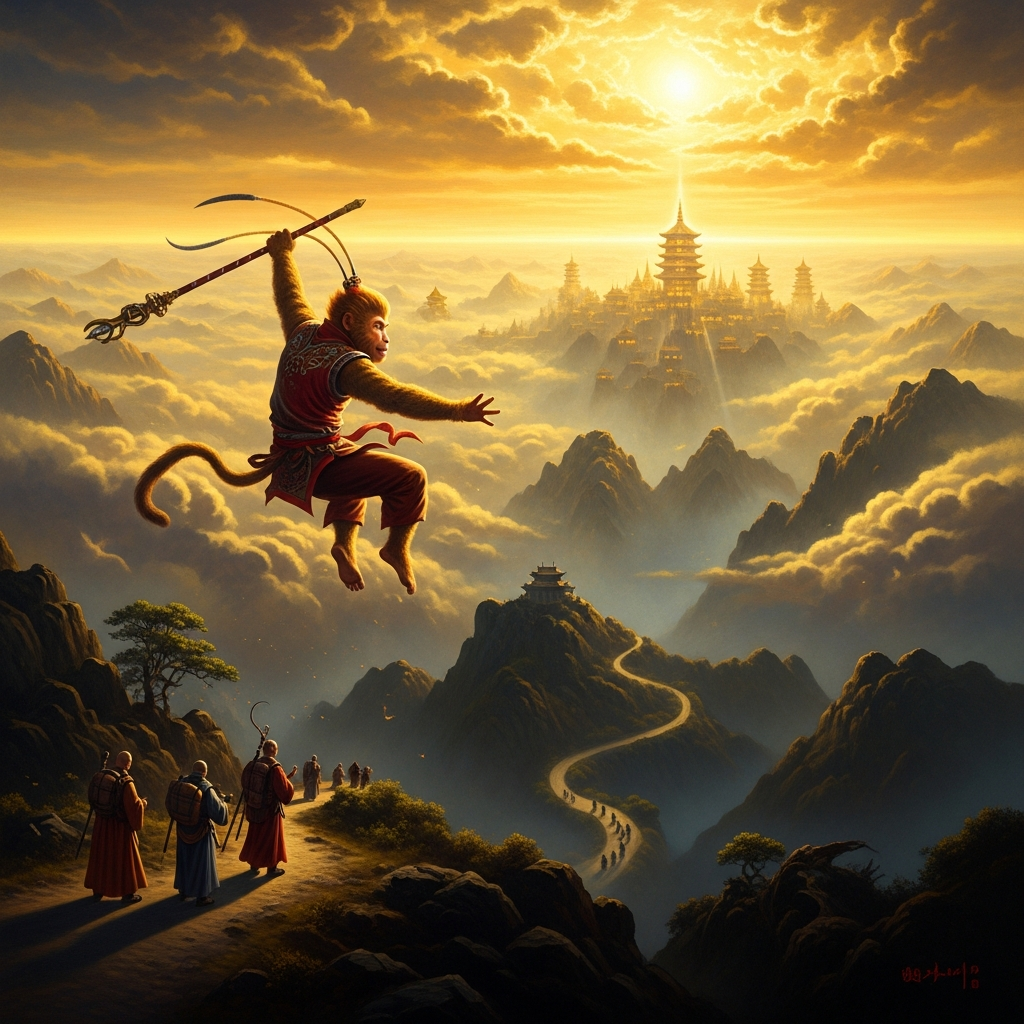
This is the beginning of everything: a stone egg on the summit of Flower Fruit Mountain, the stone that has been sitting in the mountain’s spiritual energy for forty-six thousand years, one complete cycle of the universe’s formation and dissolution, and now the egg cracks and he comes out — a stone monkey, already shining with two columns of light that strike heaven like searchlights and cause the Jade Emperor to look down from his palace to see what has arrived in the world.
He leads the monkey kingdom to paradise. He finds the Water Curtain Cave behind the great waterfall, a cool cavern of stone and running water where the whole tribe can live without the predation that has always been their condition. He is their king. He is brave, clever, stronger than the older males, generous with his discoveries. He has everything.
One night at a feast, he starts to cry.
The oldest monkeys ask him why. He says: when I think of the future, I weep. I am king of a kingdom, but I see that we are under the domination of the three powers — heaven, earth, and the King of Hell — and someday the King of Hell will send his demon soldiers to drag me away, and I do not know when, and I cannot stop it, and what is the use of all this feast if the end of every feast is that?
The oldest monkey, in some accounts, says: only Buddhas and immortals and sages are exempt from the three powers. Only they can escape death. And that is the whole of the answer, and it is all that Sun Wukong needs.
He builds a raft. He sails out on the open sea — not with equipment, not with a map, not with companions, alone on a bamboo raft across an ocean he has never crossed, toward a continent whose location he only knows in the vaguest sense, looking for a master whose name he does not have. He is motivated entirely by the refusal to die.
He crosses the South Sea Ocean and the West Sea Ocean. He wanders for many years in the human world, wearing human clothes and learning human behavior the way a monkey learns things — by imitation, quickly, retaining the surface and the technique without the underlying reasoning. He is looking for the place where immortals live.
He finds Patriarch Subodhi’s cave in the Mountain of the Mind and Heart. He enters as a pupil. He is accepted because the patriarch sees in him something worth the trouble of accepting — the complete commitment of someone who has sailed alone across the ocean to get here. Subodhi teaches him for years: the seventy-two transformations, the cloud-somersault, the art of the five elements, the defensive techniques of the body and spirit.
And then Subodhi expels him.
He expels him because Sun Wukong has shown off in front of the other students — performed his transformations with the particular glee of someone who has just become powerful and cannot contain the joy of it — and Subodhi knows that this quality will bring trouble that cannot be managed within the curriculum. He expels him with a prohibition: do not say where you learned what you know.
Sun Wukong leaves. He returns to his mountain. He has what he came for: the 72 transformations, the cloud-somersault, the techniques that will give him a lifespan exempt from the King of Hell’s authority. He is ready to test his immortality against everything that can threaten it. He is, in the structure of the story, ready to create exactly the kind of trouble that Subodhi predicted.
The stone egg cracked open on Flower Fruit Mountain. The monkey wept at a feast. He sailed alone across the sea. He found what he was looking for. Now he is going to discover that the things you get from immortality masters are not the same as the thing you were looking for when you went looking, and that distinction is the entire rest of the story.
Echoes Across Traditions
Entities
- Sun Wukong
- Patriarch Subodhi
- the stone egg
- the monkey kingdom
Sources
- Journey to the West (西遊記), Wu Cheng'en, c. 1592, chapters 1-2
- Anthony Yu, trans., *The Journey to the West* (University of Chicago, 1977)
- C.T. Hsia, *The Classic Chinese Novel: A Critical Introduction* (Columbia, 1968)
- Wilt Idema & Lloyd Haft, *A Guide to Chinese Literature* (University of Michigan, 1997)