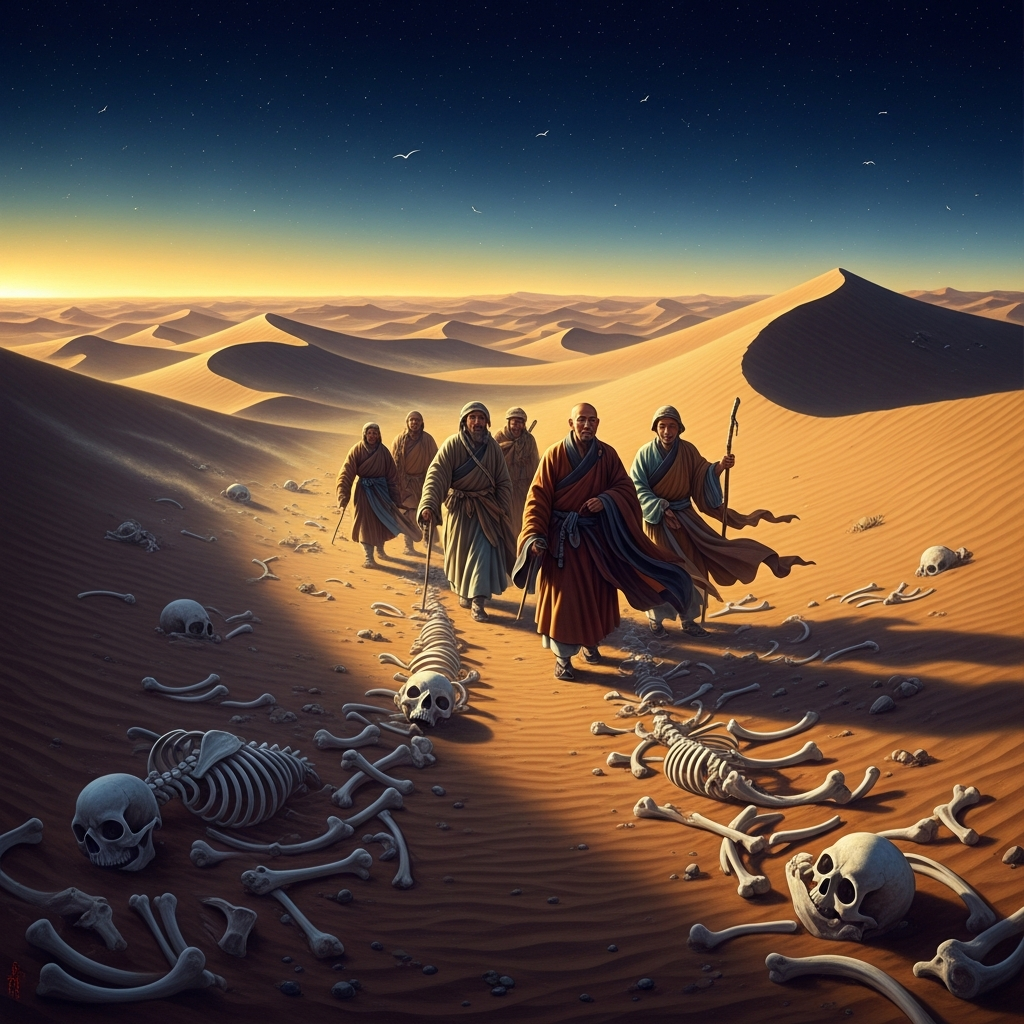
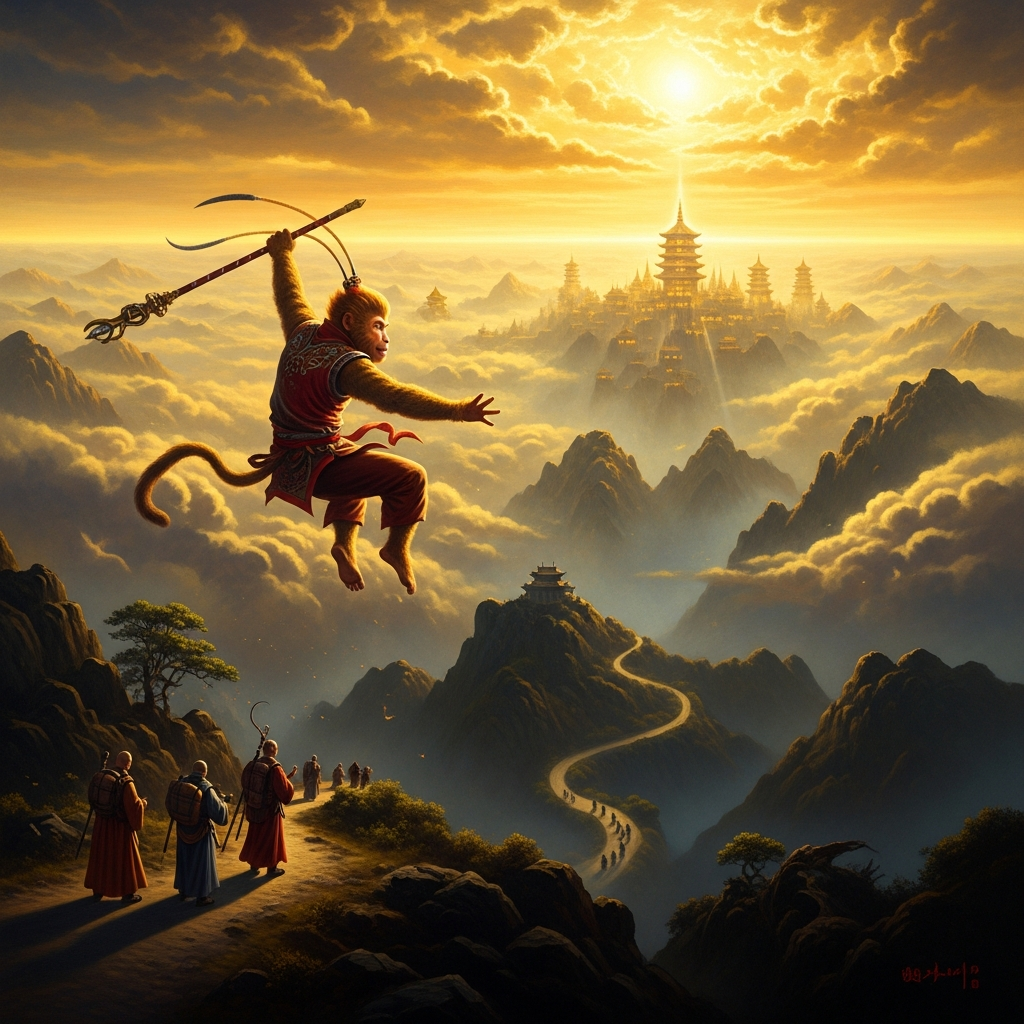
Bodhidharma Faces the Wall for Nine Years
c. 470-543 CE — traditional dates of Bodhidharma's time in China · The Shaolin Monastery on Mount Song in Henan Province
Contents
The Indian monk who brought Chan Buddhism to China sits facing a monastery wall for nine years without speaking — and when the desperate monk Huike stands in the snow and cuts off his own arm to prove his sincerity, Bodhidharma turns around.
- When
- c. 470-543 CE — traditional dates of Bodhidharma's time in China
- Where
- The Shaolin Monastery on Mount Song in Henan Province
He arrives in China from the west with a blue robe, a begging bowl, and a teaching that the Chinese Buddhist establishment of the sixth century does not know how to categorize.
The Emperor Wu of Liang — the most pious Buddhist emperor in Chinese history, the man who has built temples, freed slaves, banned meat at court, sponsored the translation of sutras — receives him. He asks Bodhidharma: how much merit have I accumulated with all this virtue?
Bodhidharma says: no merit at all.
The Emperor, who was expecting congratulation, asks him: what is the highest holy truth?
Bodhidharma says: vast emptiness, nothing holy.
The Emperor asks: who is this standing before me?
Bodhidharma says: I don’t know.
He leaves the court and crosses the Yangtze River — in the tradition he crosses by floating on a reed, one of the image that becomes canonical in Chan Buddhist art — and arrives at the Shaolin Monastery on Mount Song. He finds a cave behind the monastery. He sits facing the cave wall. He sits for nine years.
Monks come to ask him questions. He does not turn around. He does not answer. He faces the wall.
This is not meditation in the conventional sense — not the cultivation of calm or the achievement of concentrated states. It is wall-gazing, biguan, facing the wall: a practice whose content is the practice itself, whose teaching is the refusal to teach, whose transmission cannot happen through words because what is to be transmitted is not a word-shaped thing.
The monks who come to the cave face a choice: they can conclude that the old Indian is merely eccentric, or they can conclude that the wall is the answer to their question, or they can wait.
Huike waits.
He is a scholar, a man of serious cultivation, a person who has been studying Buddhism for years and is aware that something is missing from his understanding — not the intellectual parts, which he has in order, but the living root of the thing, the direct transmission that texts can point at but not convey. He comes to the cave. He stands outside. He asks Bodhidharma to teach him.
Bodhidharma does not turn around.
Huike stands in the snow. The snow falls through the night. He does not leave. He stands until the snow is at his waist.
Morning comes. Bodhidharma still does not turn. Huike takes a knife and cuts off his own left arm at the elbow. He holds it up.
He says: my mind is not at peace. Please give it peace.
Bodhidharma turns. He looks at Huike and the arm. He says: bring me your mind and I will put it at peace.
Huike says: I have searched for my mind and cannot find it.
Bodhidharma says: there, I have put it at peace.
This is the First Transmission of Chan Buddhism in China: a man with one arm and a teacher who was facing the wrong way, and the question that answers itself by being asked all the way down to the bottom — the mind that cannot be found is the mind that does not need to be pacified, because the pacification was already there in the searching, in the standing in snow, in the arm in the cold.
Huike becomes the Second Patriarch of Chan. Bodhidharma hands him the robe and bowl that are the transmission’s material sign. He goes west again and is not heard from.
His face in every painting is fierce and bearded and unflinching — the eyes that have been looking at a wall for nine years and are perfectly awake, the eyes that looked at the arm without flinching because what mattered was the question that came after the arm: bring me your mind. The wall behind every wall is still the wall he faced. The snow is still falling in the painting. Huike’s arm is still extended. The transmission is still happening.
Echoes Across Traditions
Entities
- Bodhidharma (Damo)
- Emperor Wu of Liang
- Huike (Second Patriarch of Chan Buddhism)
- the Shaolin Monastery
Sources
- Continued Biographies of Eminent Monks (續高僧傳), Daoxuan, c. 645 CE
- Anthology of the Patriarchal Hall (祖堂集), c. 952 CE
- John McRae, *The Northern School and the Formation of Early Ch'an Buddhism* (Hawaii, 1986)
- Red Pine, trans., *The Zen Teaching of Bodhidharma* (North Point Press, 1989)