Sun Wukong's Pilgrimage to the West
c. 600 CE (the historical Xuanzang's pilgrimage); 1592 CE (Wu Cheng'en's novel) · Mount Huaguo where Sun Wukong is born; the celestial court of the Jade Emperor; Five Elements Mountain where he is imprisoned; the long road from Tang China to India and back
Contents
A stone egg cracks open on a mountaintop and a monkey is born from it. He learns immortality, steals the peaches of the Queen Mother, declares himself Equal to Heaven, fights an army of celestial generals, and is finally trapped under a mountain by the Buddha himself for five hundred years — until a young Buddhist monk passes by, lifts the seal, and asks the monkey to escort him to India and bring back the sutras.
- When
- c. 600 CE (the historical Xuanzang's pilgrimage); 1592 CE (Wu Cheng'en's novel)
- Where
- Mount Huaguo where Sun Wukong is born; the celestial court of the Jade Emperor; Five Elements Mountain where he is imprisoned; the long road from Tang China to India and back
He is born from a rock.
On the summit of Mount Huaguo — Flower-Fruit Mountain — there has stood, since the beginning of the world, a stone of unusual size and unusual shape: thirty-six feet around, twenty-four feet tall, faintly luminous on cold mornings. The stone is alive. It has been gathering, for an unmeasurable length of time, the energies of heaven and earth — sun and moon, wind and water — and within it a small life is forming.
One morning, the stone cracks. A perfectly round egg rolls out of the crack onto the moss. The egg is exposed to the wind for a few minutes; then it splits open, and a small wet monkey, fully formed, blinks up at the sun.
He is, from the beginning, exceptional. He stretches. He walks down the mountain. He drinks at a stream. He bows to the four directions. From his eyes, the texts say, two beams of golden light shoot up into the heavens — light strong enough to disturb the Jade Emperor on his throne.
The Jade Emperor — the bureaucratic ruler of the Chinese pantheon — looks down from heaven, sees the beams, sends a messenger to investigate. The messenger reports that a stone monkey has been born on Earth. The Emperor, after consideration, decides not to interfere. He is born of stone, the Emperor says. He is a creature of natural origin. Let him live.
The Emperor will regret this decision.
—
The monkey, named Sun Wukong — Sun meaning grandson, Wukong meaning aware of emptiness — quickly becomes the king of the monkeys on Mount Huaguo. He leads them. He governs them. He throws elaborate banquets. He is happy for several centuries.
Then he watches an old monkey die.
He realizes, suddenly, that he too will die. He has not thought about this. The realization upsets him so deeply that he cannot eat. He decides he will not accept it. He builds a raft, leaves Mount Huaguo, sails across the sea, walks into the human world, and begins searching for someone to teach him immortality.
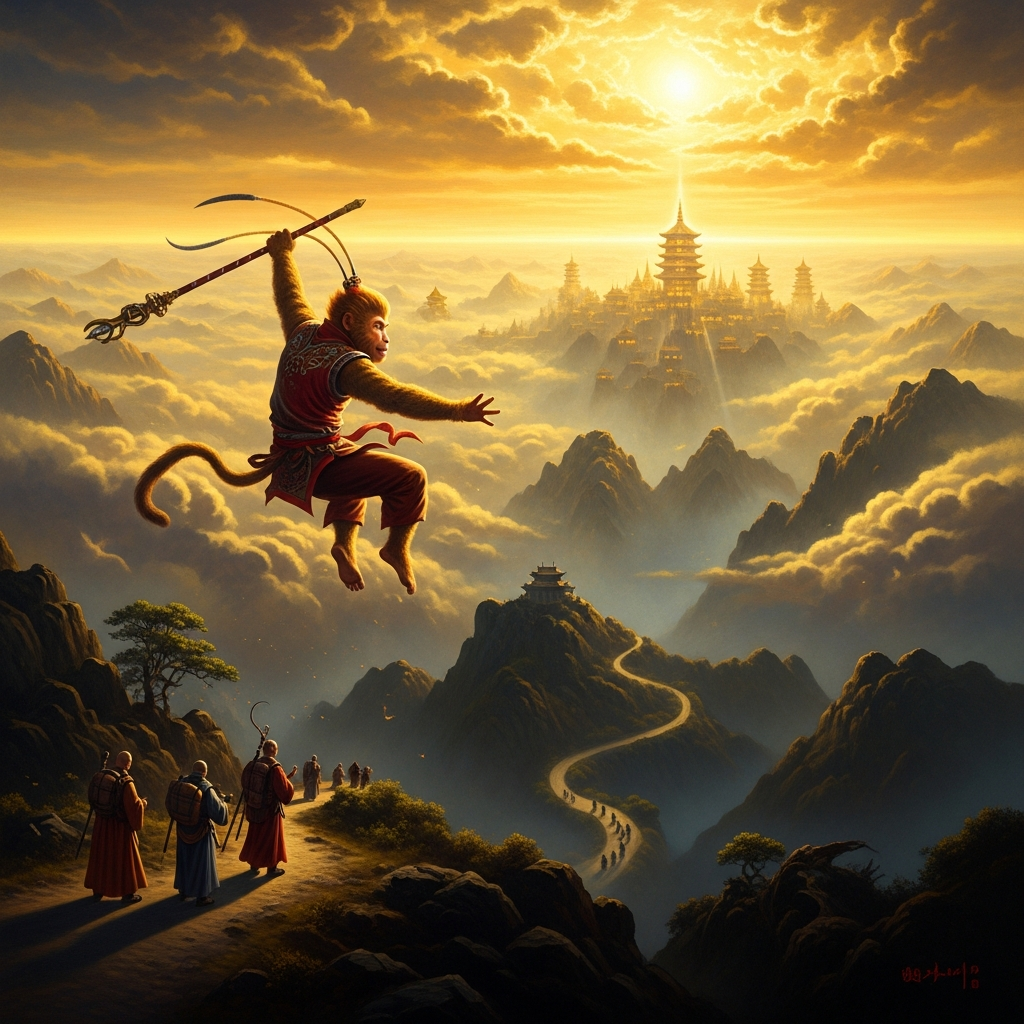
He finds, eventually, a sage — Master Subodhi — in a remote mountain monastery. He becomes a student. Over years, he learns the Seventy-Two Transformations (the ability to become any creature or object), the cloud-somersault (the ability to travel a hundred and eight thousand miles in a single leap), and most importantly the secrets of internal alchemy that grant near-immortality.
Master Subodhi, sensing that Sun Wukong’s character has not been correspondingly disciplined, eventually expels him with a warning: Never tell anyone where you learned what you learned.
Sun Wukong returns to Mount Huaguo. He is, now, a force.
—
He goes to the Dragon Kings of the Eastern Sea and demands a weapon. They show him their armory; nothing pleases him. He spots a great iron pillar at the bottom of the ocean — used as a measuring rod for ocean depths since the time of the great flood — and orders it. The Dragon King protests. Sun Wukong reaches out and lifts it. He commands it to shrink. It shrinks. He commands it to grow. It grows. It is, he announces, his now. He calls it the Ruyi Jingu Bang — the Will-Following Golden-Banded Staff. He tucks it behind his ear and walks out.
He goes to the Underworld and finds his name in the Book of the Dead. He crosses it out. He crosses out the names of every monkey on Mount Huaguo. He hands the book back. The Underworld bureaucracy reports him to heaven.
The Jade Emperor, at last, decides he must do something. He invites Sun Wukong to heaven on a pretext — a job offer. Come up, Stone Monkey. We have a position for you. The position of Stable-Master to the Celestial Horses. Sun Wukong, flattered to be invited, accepts.
Heaven is more complicated than he expected. He is given his stable. He performs his duties for two weeks. Then he asks, curious, what rank his title carries.
He is told: the lowest rank in the celestial bureaucracy. Below grooms.
He is humiliated. He flips over the imperial banquet table on his way out. He returns to Mount Huaguo and proclaims himself Qitian Dasheng — Great Sage Equal to Heaven. He carves the title on a banner. He hangs it from his cave.
The Jade Emperor sends an army.
—
Sun Wukong defeats the army.
He defeats the second army. He defeats the celestial generals one after another. He grows to a giant and pulls down the gates of heaven. He fights with his staff against a wall of armored gods and sweeps them aside. He invades the Peach Garden of the Queen Mother of the West, where the peaches of immortality ripen, and eats every single peach. He invades the laboratory of Lao Zi the alchemist and drinks every vial of the elixir of immortality stockpiled there.
He is, by this point, multiply immortal. The texts dwell on this with delight. He has at least four overlapping forms of indestructibility. He cannot be killed.
The Jade Emperor sends, finally, the most powerful celestial fighter — Erlang Shen, the three-eyed warrior — against him. They fight for a hundred and seventy-two transformations: the monkey becomes a sparrow, Erlang becomes a hawk; the monkey becomes a fish, Erlang becomes a cormorant; the monkey becomes a temple, Erlang spots the impossible flagpole behind it. They are evenly matched.
Lao Zi, watching, throws a magic ring at Sun Wukong. It catches him on the head. He stumbles. Erlang’s hounds catch him. He is bound.
He is taken back to heaven in chains. He is sentenced to execution. The execution does not take. He cannot be beheaded — the executioners’ axes break on his neck. He cannot be incinerated — Lao Zi’s furnace, into which he is thrown for forty-nine days, only refines his eyes into golden eyes that can see through illusion. The furnace bursts open and he climbs out angrier than before.
The Jade Emperor, in despair, sends a messenger to the Western Heaven, to the Buddha himself.
—
The Buddha arrives.
He is the Buddha — calm, golden, smiling. He looks at Sun Wukong and asks: What is your complaint, Stone Monkey?
Sun Wukong, with the bravado of a creature who has just defeated heaven, says: I want the throne of the Jade Emperor. I am Equal to Heaven. I have earned it.
The Buddha smiles. That is not a small request.
He extends his hand. Let us make a wager, the Buddha says. If you can leap out of my palm, the throne is yours. If you cannot, you accept what I decide.
Sun Wukong looks at the Buddha’s hand. It is the hand of a normal-sized man. He laughs. He can leap a hundred and eight thousand miles in a single bound. The hand cannot be more than a foot across.
He leaps.
He soars across the universe. He flies for what feels like an enormous distance. He arrives — he believes — at the edge of the cosmos. There are five great pillars of flesh ahead of him, marking the boundary. He pisses on one of them, to mark his passage, and writes his name on it: Great Sage Equal to Heaven was here. He somersaults back.
He lands on the Buddha’s palm.
Pay up, he says.
The Buddha says, gently: Look at my middle finger.
Sun Wukong looks. There is a smell of monkey urine on the Buddha’s middle finger. The five pillars he flew to were the Buddha’s five fingers. He has not left the palm.
—
The Buddha closes his hand.
He carries Sun Wukong out of heaven. He flips his palm and turns it into a mountain — Five Elements Mountain — pinning Sun Wukong beneath it. He places a paper seal on the peak with a six-syllable mantra written on it: Om Mani Padme Hum. He tells the monkey: Stay here until you are ready.
Sun Wukong is buried under the mountain. His head sticks out at the top. Iron rings pin him to the rock. He can move only his face.
He is left there for five hundred years.
Travelers walk by. Children climb the mountain on the way to school. Pilgrims pass with bundles on their backs. The seal on the peak holds. The monkey, the trickster, the Equal-to-Heaven, lies pinned under the rock with the wind in his face and the years passing and nothing to do but think.
He thinks for a long time.
—
Five hundred years later, a young Buddhist monk passes that way.
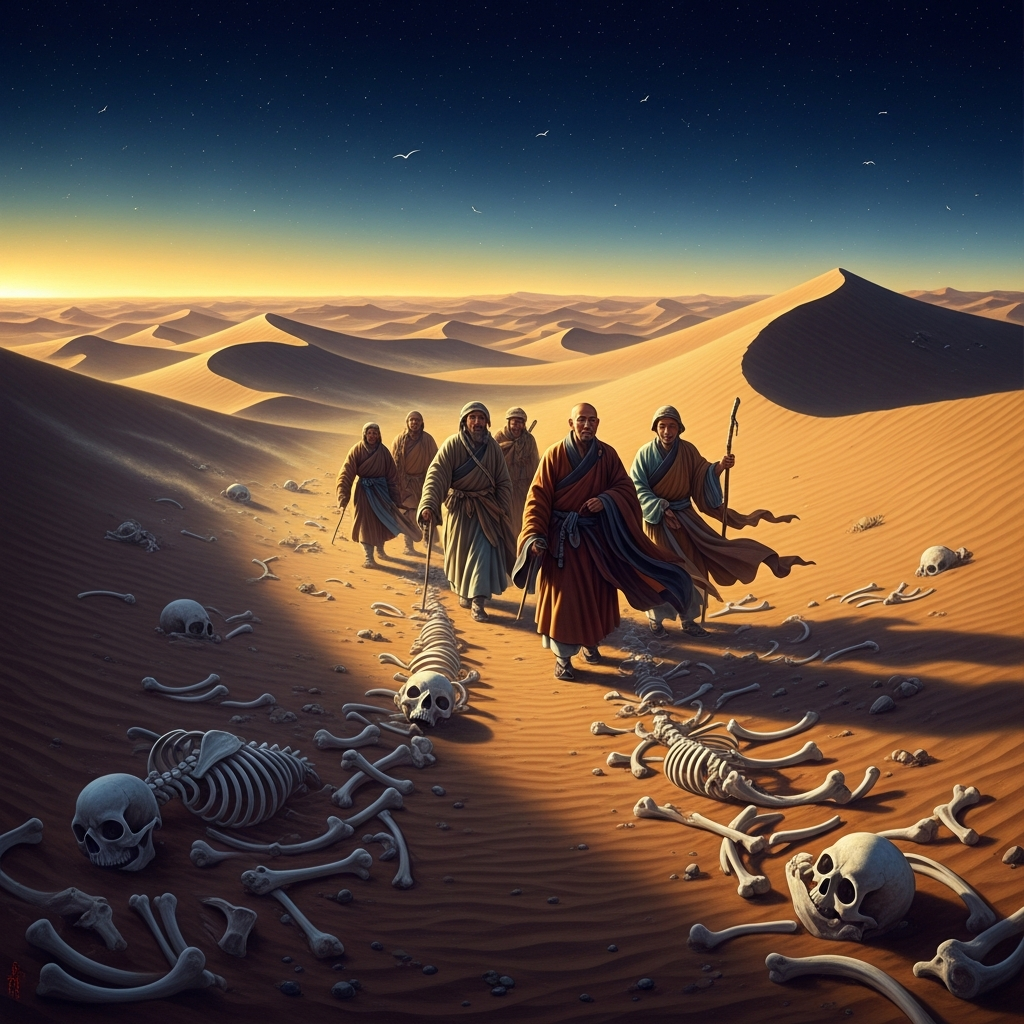
His name is Tang Sanzang — Tripitaka in Sanskrit translation — and he is, in the historical layer of the legend, the actual seventh-century Chinese pilgrim Xuanzang, who walked from Tang-dynasty China to India and back to retrieve Buddhist sutras. The novel mythologizes his journey heavily.
Tang Sanzang has been commissioned by the Tang emperor to travel west and bring back the true teachings. He has been told, by the bodhisattva Guanyin in a dream, that he will need protectors. He has been told, specifically, where to find his first protector.
He climbs the Five Elements Mountain.
He sees the monkey’s head sticking out of the rock. He hears Sun Wukong’s voice — quieter now, after five hundred years of weather — calling out: Master. Are you the master? Are you the one I have been waiting for?
Tang Sanzang asks who he is.
Sun Wukong tells him. He tells the whole story — the rebellion, the Buddha’s palm, the mountain, the long sentence. He says: I have been pinned here five hundred years. I have, slowly, repented. Lift the seal. Let me out. I will travel with you. I will protect you. I will not lift my staff against heaven again.
Tang Sanzang considers. He is a small frightened monk. He has been told he will have monstrous companions. He climbs to the peak. He peels off the paper seal.
The mountain explodes outward in a cloud of dust. Sun Wukong leaps free. He is older. He is leaner. He is, recognizably, a different monkey from the one who fought heaven. He bows to Tang Sanzang. He calls him Master.
The pilgrimage begins.
—
Tang Sanzang gathers two more companions on the road. Zhu Bajie — Pig of the Eight Precepts — was once a celestial general, demoted to earth and reborn into a pig’s body for harassing the moon goddess; he is gluttonous, lazy, lustful, and weak-willed, but he is loyal in spurts. Sha Wujing — Sand-Aware-of-Purity — was once a celestial general, demoted to earth for breaking a celestial wine-cup, reborn as a river ogre; he is quiet, dutiful, the steadiest of the four. The white horse Tang Sanzang rides is, eventually, revealed to be a dragon prince serving out his own sentence.
Together they walk west. The novel has them face eighty-one ordeals — bandits, demons, seductresses, false monasteries, kingdoms ruled by monsters, rivers that cannot be crossed, mountains that cannot be climbed. Sun Wukong defeats nearly all of them. When he cannot, the bodhisattva Guanyin descends to help. When even she cannot, the Buddha himself intervenes.
The pilgrimage takes fourteen years.
They reach the Western Paradise. The Buddha, who pinned Sun Wukong under a mountain for five centuries, receives them with grace. He gives Tang Sanzang the sutras — at first, mischievously, blank scrolls (a teaching about the limits of language); then, when Sanzang protests, the real ones. The four pilgrims and the horse fly back to China.
Tang Sanzang teaches the sutras. The Tang Emperor honors him. Each pilgrim is rewarded according to his merit. Sun Wukong, after his fourteen years of disciplined service, is granted full Buddhahood. He becomes the Buddha Victorious in Battle. The wild monkey of Mount Huaguo, the rebel against heaven, the prisoner under the Five Elements Mountain, ends as a Buddha.
It is the perfect Chinese Buddhist parable. The trickster is not destroyed. The trickster is not exiled. The trickster is sent on the road with a monk to protect, and after eighty-one ordeals, the trickster is the one who has changed most. Discipline is not silence. Discipline is finding the right work for the wildness, and walking west.
Scenes
On the misty summit of Mount Huaguo, a moss-covered stone egg cracks
Sun Wukong in golden armor and tiger-skin kilt, wielding his iron staff against ranked celestial generals; the Jade Emperor's court chamber lies in ruins behind him
On a dusty road through the western mountains, the monk Tang Sanzang rides a white horse, the monkey Sun Wukong walks ahead with staff over shoulder, the pig Zhu Bajie carries the luggage, and Sha Wujing walks rearguard with his crescent staff
Echoes Across Traditions
Entities
- Sun Wukong
- Tang Sanzang
- Zhu Bajie
- Sha Wujing
- The Buddha
- The Jade Emperor
- Guanyin
Sources
- Wu Cheng'en, *Journey to the West* (*Xiyou Ji*, c. 1592 CE)
- Anthony C. Yu (trans.), *The Journey to the West* (4 vols., 1977–1983, rev. 2012)
- W. J. F. Jenner (trans.), *Journey to the West* (1982)
- Glen Dudbridge, *The Hsi-yu chi: A Study of Antecedents to the Sixteenth-Century Chinese Novel* (1970)