Pwyll, Lord of the Otherworld
circa 500-700 CE — the mythic setting of the Mabinogion, dark-age Wales · The Forest of Glyn Cuch, Dyfed, Wales, and Annwfn — the Welsh Otherworld
Contents
A Welsh chieftain hunting in the forest discovers his hounds have stolen a kill from a strange pack, and in making amends to the other hounds' owner — the king of the Otherworld — spends a year in the underworld and returns forever changed.
- When
- circa 500-700 CE — the mythic setting of the Mabinogion, dark-age Wales
- Where
- The Forest of Glyn Cuch, Dyfed, Wales, and Annwfn — the Welsh Otherworld
He drives the white hounds off the carcass without thinking.
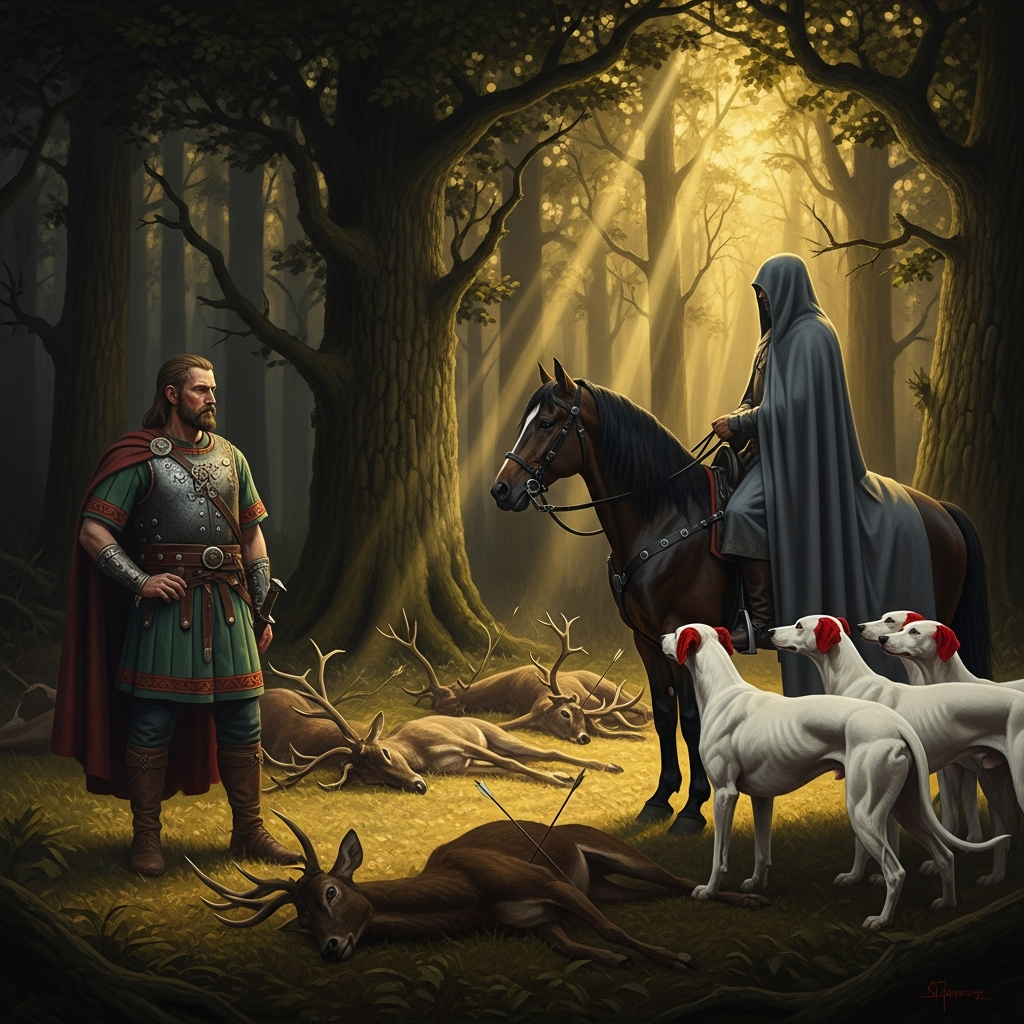
Pwyll, lord of Dyfed, is hunting in Glyn Cuch when his dogs come onto a stag. But there are other hounds at the stag before him — dogs he has never seen, impossibly white, with red ears, the specific coloring that marks Otherworld animals throughout Welsh and Irish tradition. He beats them off and sets his own pack on the kill.
The stranger arrives.
He is mounted on a large grey horse and he is dressed for the hunt, and his face carries the particular quality of contained anger that belongs to a man who is deciding whether to be offended or merely patient. His name is Arawn. He is the king of Annwfn, the Welsh Otherworld.
“I have never done to you what you have done to me,” Arawn says. “You drove off my dogs from a kill they had chased and exhausted, and you fed your dogs on their labor. That is a dishonor that demands amends.”
Pwyll, to his credit, agrees immediately. “What amends?”
Arawn proposes an exchange: Pwyll will take Arawn’s place in Annwfn for one year and one day. Arawn will take Pwyll’s place in Dyfed. Each will wear the other’s form. At the end of the year, Pwyll must meet and defeat Arawn’s great enemy Hafgan at a ford — but he must strike once and only once, because a second strike on Hafgan heals the first, and only a single blow will kill him.
Pwyll agrees.
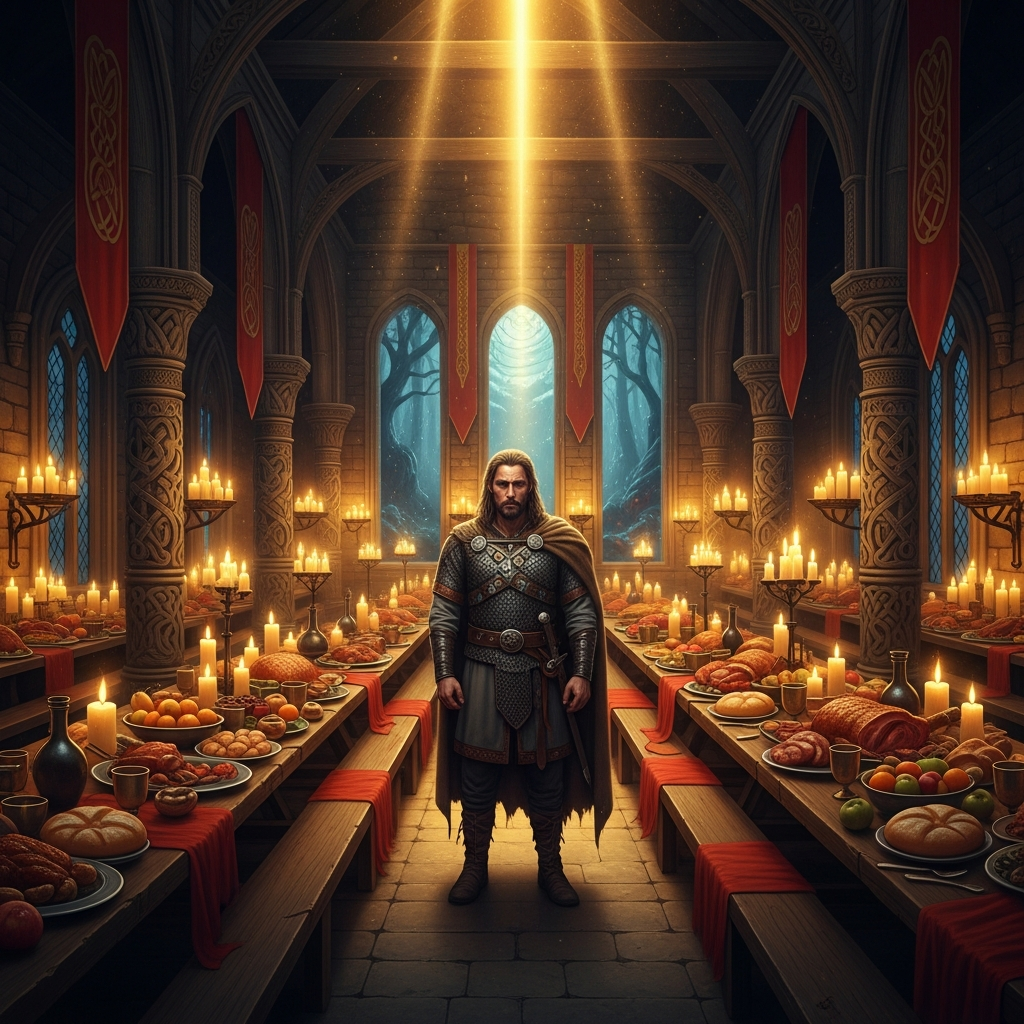
He spends a year in Annwfn in Arawn’s body, ruling with the judgment and care that Arawn would have brought, hunting with Arawn’s companions, sleeping every night beside Arawn’s wife without touching her — because though she is warm beside him in the bed of the king of the Otherworld, she is Arawn’s wife, and the whole point of this year is the honoring of a bond. He does not touch her. Every night, for a year.
At the ford, he meets Hafgan. He strikes once, a devastating blow. Hafgan falls. Hafgan calls from the ground: “Finish me — no man has ever given me a mortal blow before and I ask for it.” Pwyll refuses the second strike. He knows what Arawn told him. Hafgan dies of the single wound.
Arawn returns to Annwfn and finds his kingdom entirely in order. His court is prosperous. His enemies are defeated. And in the bed at night his wife remarks that this past year their relationship has been more companionable and considerate than it has been in years — and Arawn understands what Pwyll did for an entire year beside his wife.
He grants Pwyll the title: Penn Annwfn. Head of the Otherworld.
Pwyll returns to Dyfed and finds his own domain equally well-administered. The exchange is complete. The two lords resume their own shapes.
But the year in Annwfn has changed Pwyll in ways that don’t require articulation. He has spent a year governing the dead, ruling from the Otherworld, holding to a standard of honor so strict it required him to master his own desire for three hundred and sixty-five nights. He comes back to the surface world with the specific gravity of a man who has been somewhere most people don’t come back from, and who chose correctly every time he was tested.
This is why Rhiannon, when she appears on her white horse on the hill above Arberth, chooses Pwyll to pursue. She is from Annwfn herself. She knows who can enter that world and return with honor intact.
Echoes Across Traditions
Entities
- Pwyll
- Arawn
- Hafgan
- Rhiannon
Sources
- Jeffrey Gantz, trans., *The Mabinogion* (Penguin, 1976)
- Sioned Davies, trans., *The Mabinogion* (Oxford World's Classics, 2007)
- Proinsias Mac Cana, *Celtic Mythology* (Hamlyn, 1970)