The Birds of Rhiannon
circa 500-700 CE — the mythic age of the Mabinogion, following the war with Ireland · The island of Gwales (Grassholm), off the Pembrokeshire coast, Wales
Contents
In the Otherworld islands, seven warriors keep vigil over the head of the slain giant-king Bendigeidfran — but they do not notice the decades passing, because three birds sing to them from across the water, and the birds' song holds time in suspension.
- When
- circa 500-700 CE — the mythic age of the Mabinogion, following the war with Ireland
- Where
- The island of Gwales (Grassholm), off the Pembrokeshire coast, Wales
The birds are small and they come from the sea.
Seven men have survived the war with Ireland — the terrible war that began with Branwen’s mistreatment and ended with the destruction of two nations. Bendigeidfran, the giant king of Britain, is dead. His head has been cut off at his own request, and these seven men are tasked with carrying it to the White Mount in London for burial. It is a long journey, with specific stages.
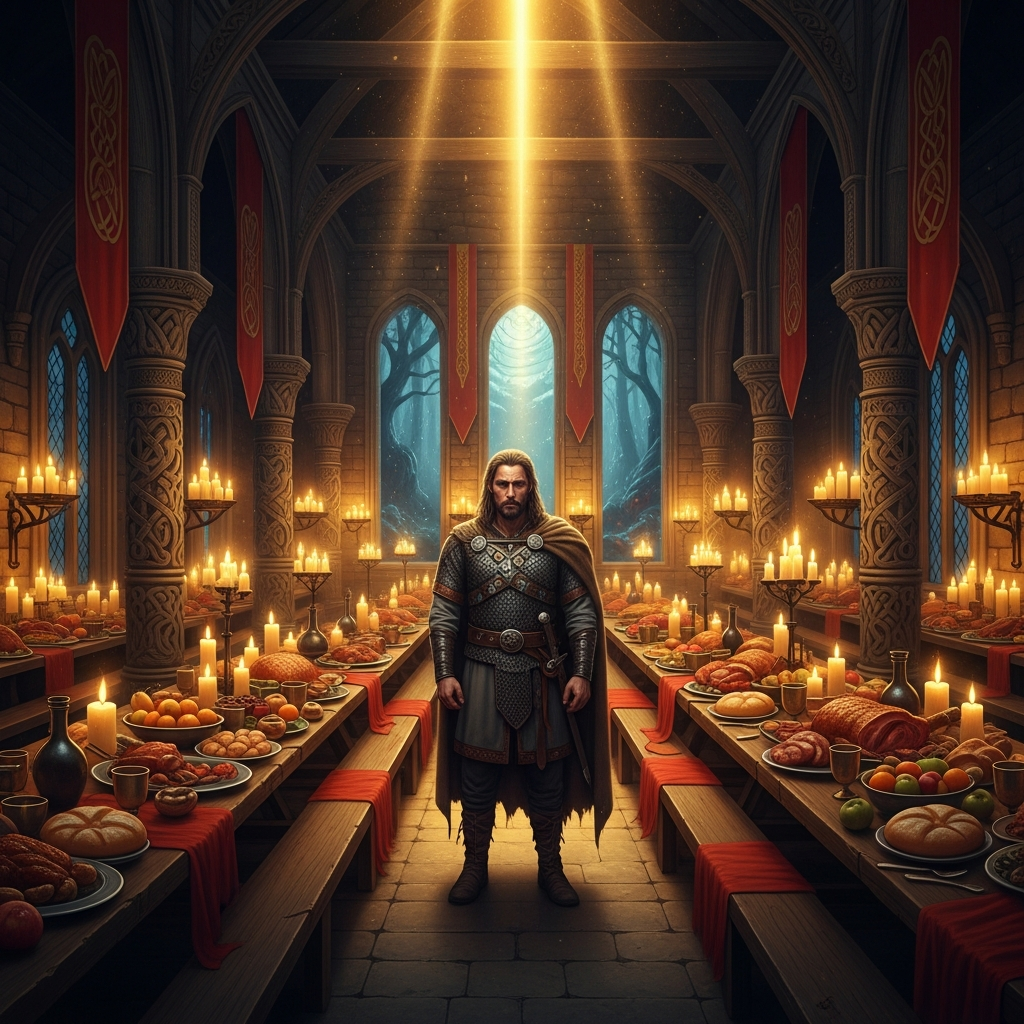
The first stage is eighty years at Harlech, feasting. The head of Bendigeidfran sits at the table with them and speaks, and is good company, and they do not feel the eighty years pass because the head is present and the grief of his death does not become fully real while the head is with them. This is the first miracle of the carrying.
The second stage is the island of Gwales.
Gwales is off the Pembrokeshire coast, a small island above the sea. They find a great hall there — a hall with three doors, two open and one closed. The closed door faces toward Cornwall and toward the grief that is waiting for them on the mainland. They are told: do not open that door. While it stays closed they may stay in the hall as long as they please, and the seventy-odd years of grief and war and terrible things they have witnessed will not press on them.
The birds arrive.
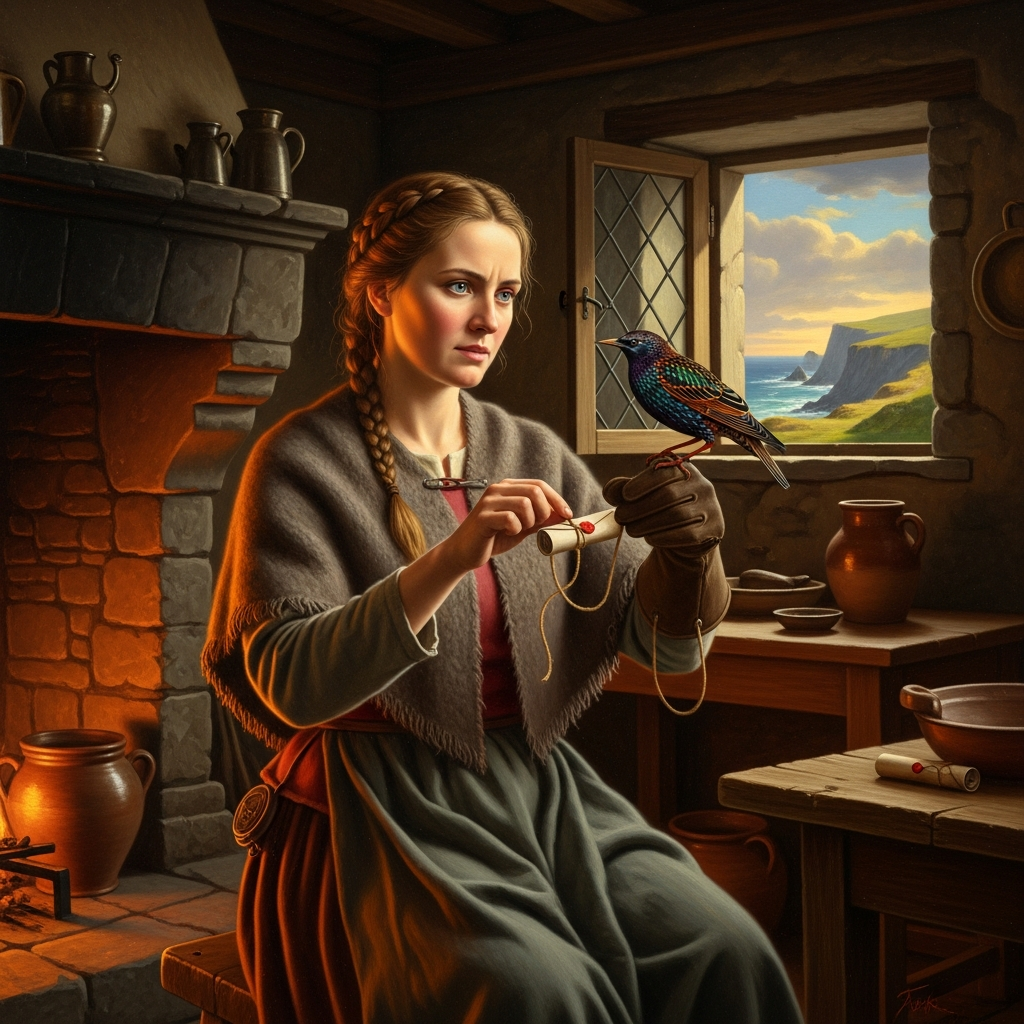
They come from the sea and land near the hall’s open windows and begin to sing. These are the birds of Rhiannon — three birds who are said to sing such that the distant is made near and the near made distant, and the dead are as vivid as the living, and the living grief of the terrible war in Ireland is as remote as a story someone told once that you only half-remember.
They are small birds with the look of birds from somewhere else entirely: the specific quality of a creature at home in a world slightly adjacent to this one, making a sound that belongs to that adjacent world and leaks through when the song is at its height.
The seven men sit in the hall on Gwales for eighty-seven years. They count the years later, when it is over, and are astonished. The birds sing and the time passes the way a long afternoon passes when you are entirely absorbed: not without content, not unconscious, but without the quality of accumulation that makes time feel like weight.
Bendigeidfran’s head is with them. The birds sing. The closed door stands closed.
Then one of the seven men — Heilyn son of Gwyn — opens the door.
He says he will see whether what was told about it is true, and he opens it and looks toward Cornwall and the open sea.
The grief arrives.
It comes all at once, eighty-seven years of deferred mourning, the losses they survived in Ireland, the losses they carried from before Ireland, the weight of Bendigeidfran’s death that they have been carrying in the form of his living head. They feel it together in the hall on Gwales, and it is the grief of all those years pressing into the present moment simultaneously.
They take the head and finish the journey to London.
The birds are gone. The door is open. The island of Gwales is behind them, and the song that held them there is finished, and the particular mercy of that music — that it could keep the grief at the right distance for as long as they needed — was given by Rhiannon, who knows what it costs to carry what you love when it is gone.
Echoes Across Traditions
Entities
- Rhiannon
- Pryderi
- Manawydan
- The seven survivors
- Bendigeidfran's head
Sources
- Jeffrey Gantz, trans., *The Mabinogion* (Penguin, 1976)
- Sioned Davies, trans., *The Mabinogion* (Oxford World's Classics, 2007)
- Rachel Bromwich, *Trioedd Ynys Prydein: The Welsh Triads* (University of Wales Press, 2006)