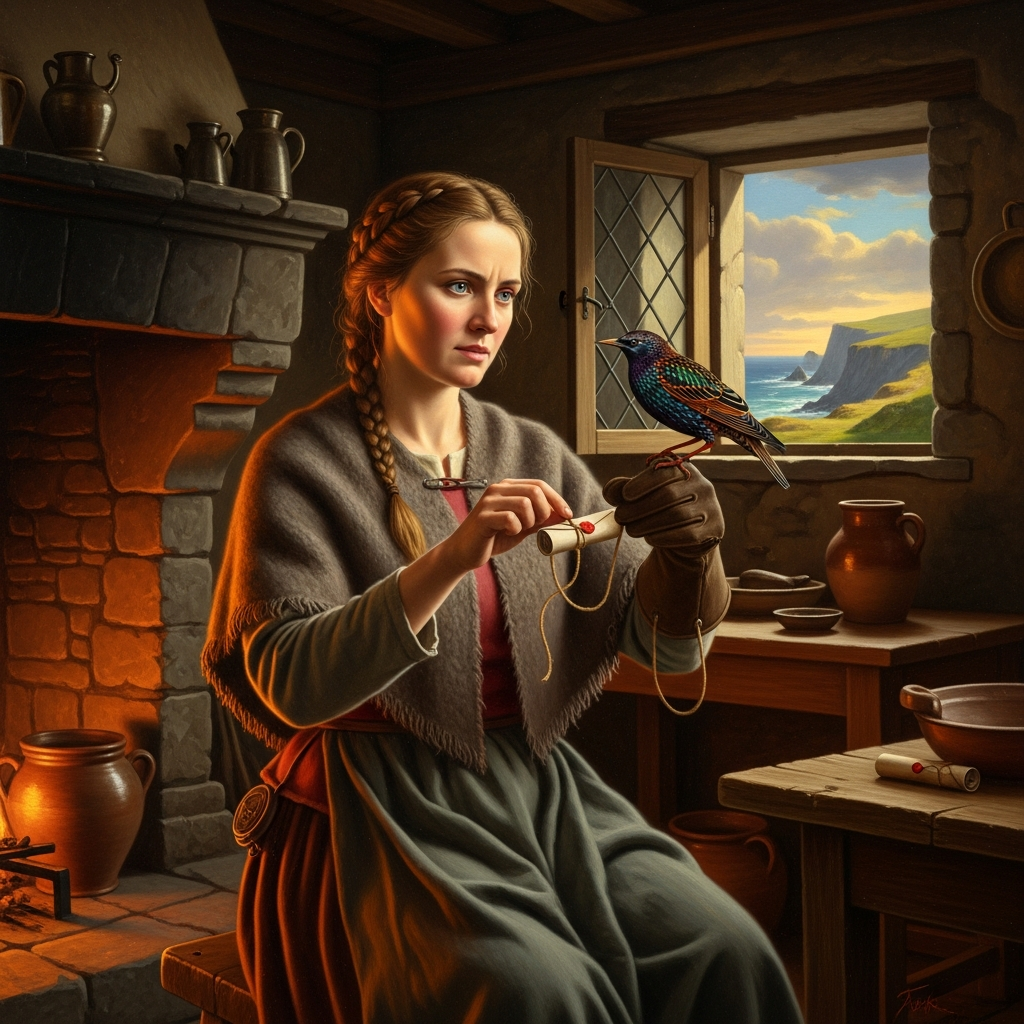
Taliesin Swallowed and Reborn
circa 6th century CE — the historical bard Taliesin placed in a legendary framework · Llyn Tegid (Bala Lake), Gwynedd, Wales
Contents
A boy servant accidentally tastes the three drops of wisdom from the witch Ceridwen's cauldron and flees through every shape in the world — hawk, hare, fish, grain of wheat — until she swallows him and gives birth to the greatest poet Britain has ever known.
- When
- circa 6th century CE — the historical bard Taliesin placed in a legendary framework
- Where
- Llyn Tegid (Bala Lake), Gwynedd, Wales
The three drops fall on his thumb and he puts it in his mouth before he thinks.
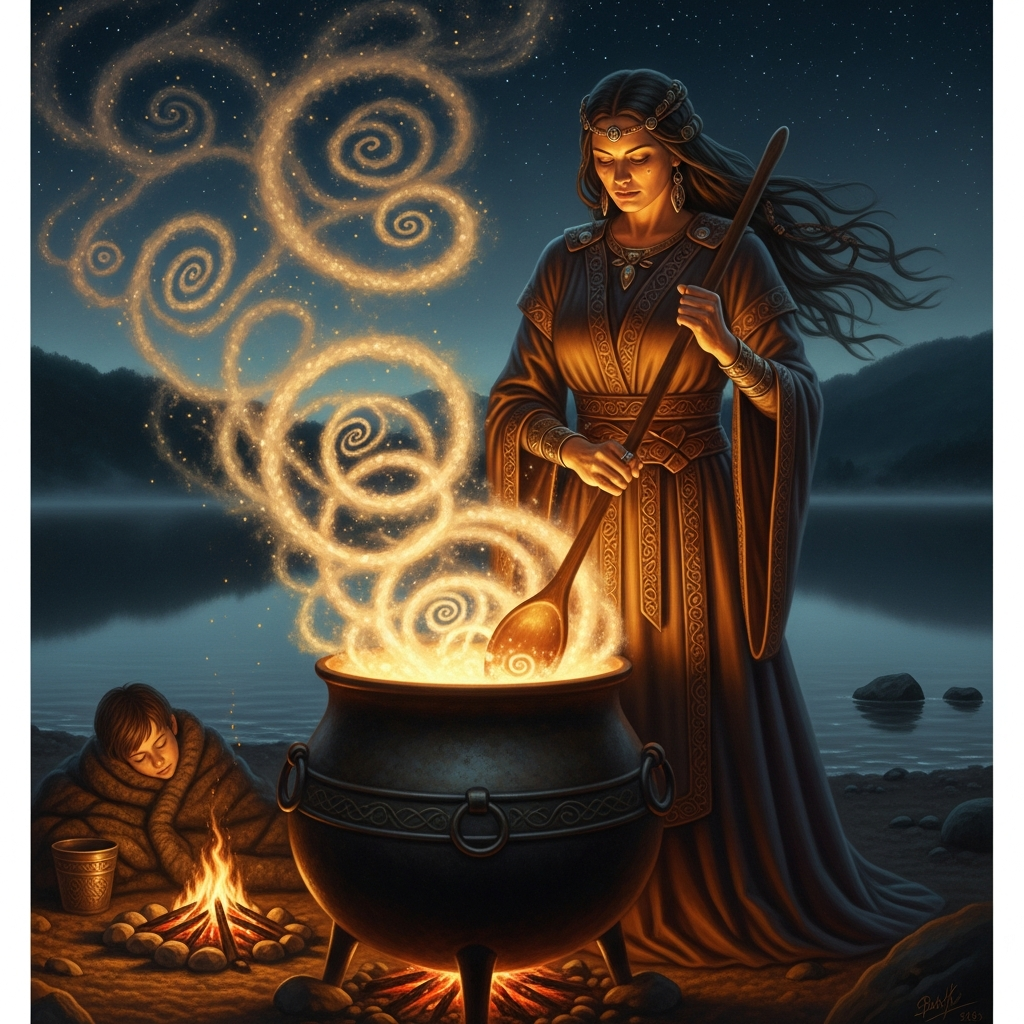
Gwion Bach is the boy hired to stir Ceridwen’s cauldron. The cauldron has been brewing for a year and a day, because Ceridwen intends the brew for her son Morfran, who is ugly beyond remedy and will have no prospects in the world unless she can gift him all-knowledge. She has the recipe and the patience. She has a boy to stir.
The brew is almost done when the three drops of finished wisdom fly out of the cauldron and land on Gwion Bach’s thumb. He puts his thumb in his mouth — the same gesture, the same instinct that gives Fionn his wisdom in Ireland — and the entire year’s work goes into him instead of the cauldron.
He knows immediately what he has done, which is the first thing the wisdom gives him: knowledge of consequence. He knows Ceridwen will come for him when she finds out. He runs.
She comes.
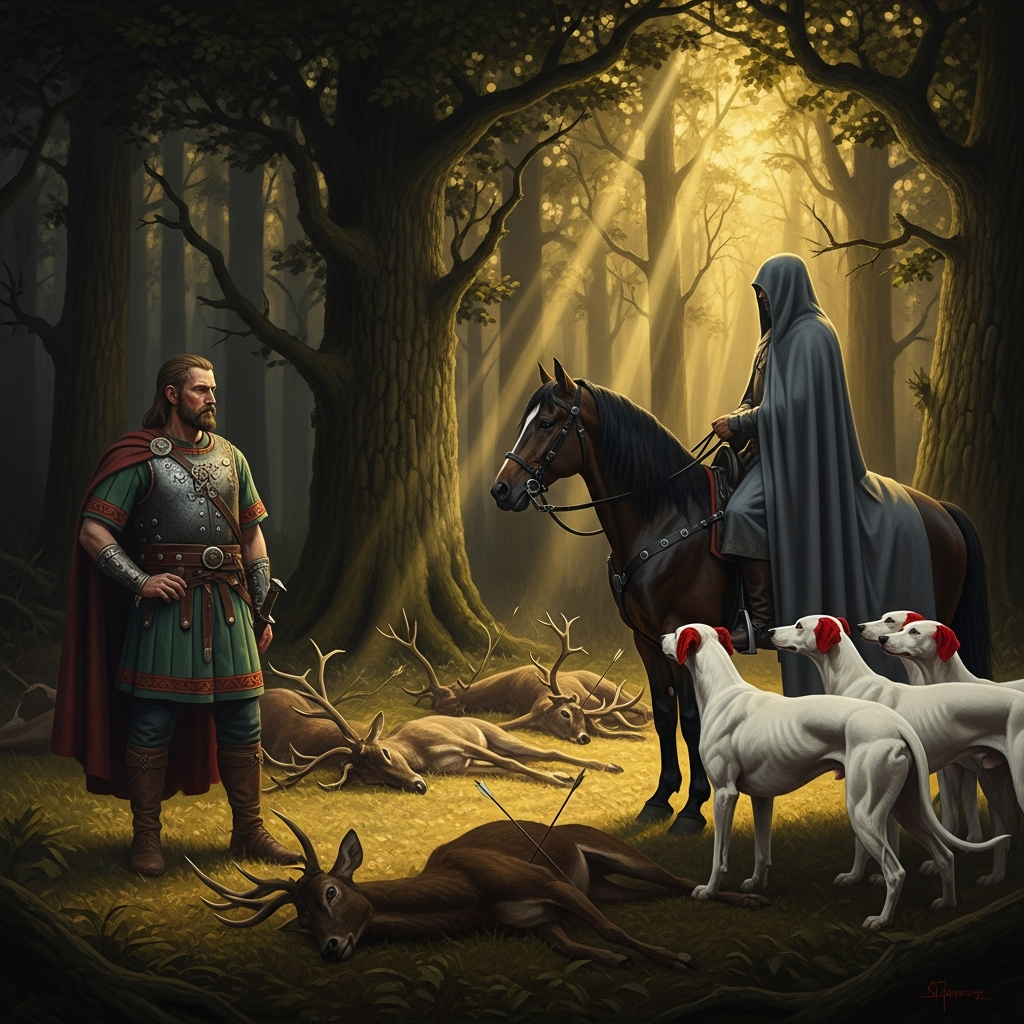
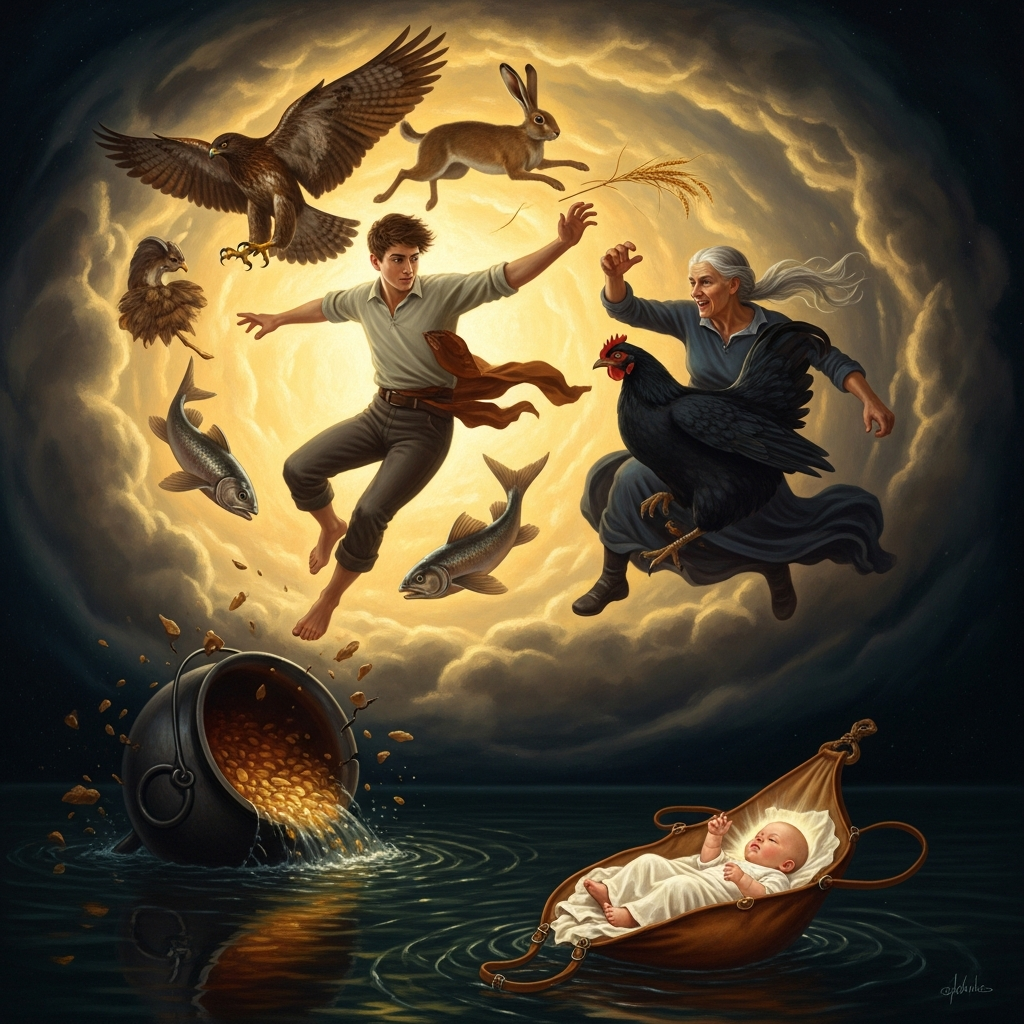
He becomes a hare. She becomes a greyhound.
He reaches the river and becomes a fish. She becomes an otter.
He becomes a bird and lifts into the sky. She becomes a hawk.
He falls into a granary and becomes a grain of wheat among ten thousand grains of wheat. She becomes a black hen and scratches through the granary, eating grain by grain, and she finds him and swallows him.
She becomes pregnant.
Nine months later she gives birth to a boy so beautiful that she cannot bring herself to kill him, though she means to. She wraps him in a leather bag and throws him into the sea, or into a weir, or into a river — the versions vary, but the water takes him. He floats for some days or weeks or forty years.
He is found by Elphin, a young man of no particular fortune who is checking his father’s weir on Samhain eve and finds the leather bag instead of fish. He opens it and sees the radiant forehead of the child inside and says: “Behold the radiant brow” — Taliesin in Welsh.
The child speaks from the bag. He is already the greatest poet in Britain and he knows it and he is not modest about it, which is a characteristic of men who were born in granaries after a nine-month gestation inside a shape-shifting witch.
He becomes Elphin’s bard and protects him through various troubles — the king’s dungeon, the king’s contests — using the specific powers that come from having been a hare, a fish, a bird, and a grain of wheat: the knowledge of every form, the ability to speak from inside any experience, the authority of a poet who has been everything he describes.
His earliest surviving poems contain the formula that encodes all of this: I have been in many shapes. I have been a sword. I have been a tear. I have been a word in a book. I was in the wood with the ivy.
This is not metaphor. This is the bardic claim: I was there in these forms, and I know what I am saying because I was it, and this is why you should listen to me.
The greatest poems require the most complete death of the poet before the poet can be born.
Echoes Across Traditions
Entities
- Taliesin
- Gwion Bach
- Ceridwen
- Morfran
- Elphin
Sources
- Patrick Ford, trans., *The Mabinogi and Other Medieval Welsh Tales* (University of California Press, 1977)
- Lady Charlotte Guest, trans., *The Mabinogion* (Longman, 1838-49)
- Marged Haycock, *Legendary Poems from the Book of Taliesin* (CMCS Publications, 2007)