Ceridwen's Cauldron and the Year of Brewing
circa 6th century CE — the legendary context of the historical bard Taliesin · Llyn Tegid (Bala Lake), Gwynedd, Wales
Contents
The witch of Llyn Tegid brews a cauldron of wisdom for a full year to compensate her ugly son for the beauty she could not give him — and her meticulous preparations, her exhausting vigil, and her final transformation of purpose are the myth of inspiration itself.
- When
- circa 6th century CE — the legendary context of the historical bard Taliesin
- Where
- Llyn Tegid (Bala Lake), Gwynedd, Wales
She has the recipe and the patience.
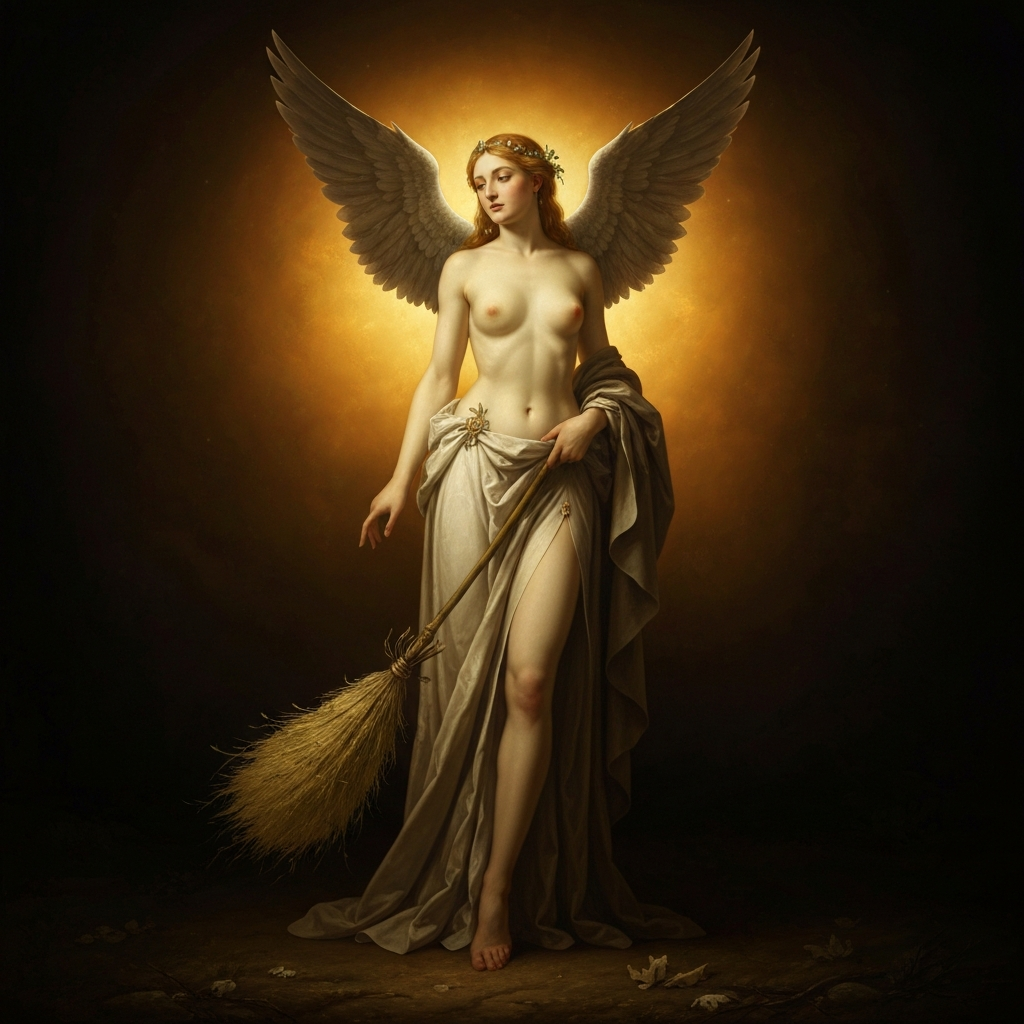
Ceridwen, wife of Tegid Foel, lives on the banks of Llyn Tegid with two children: a daughter of exceptional beauty and a son named Morfran, whose face is described in the sources with unusual bluntness — he is profoundly ugly, and the world will not be kind to him for it. She cannot change his face. She can give him what beauty cannot give: awen, poetic inspiration, all-knowledge, the quality of mind that outlasts any surface.
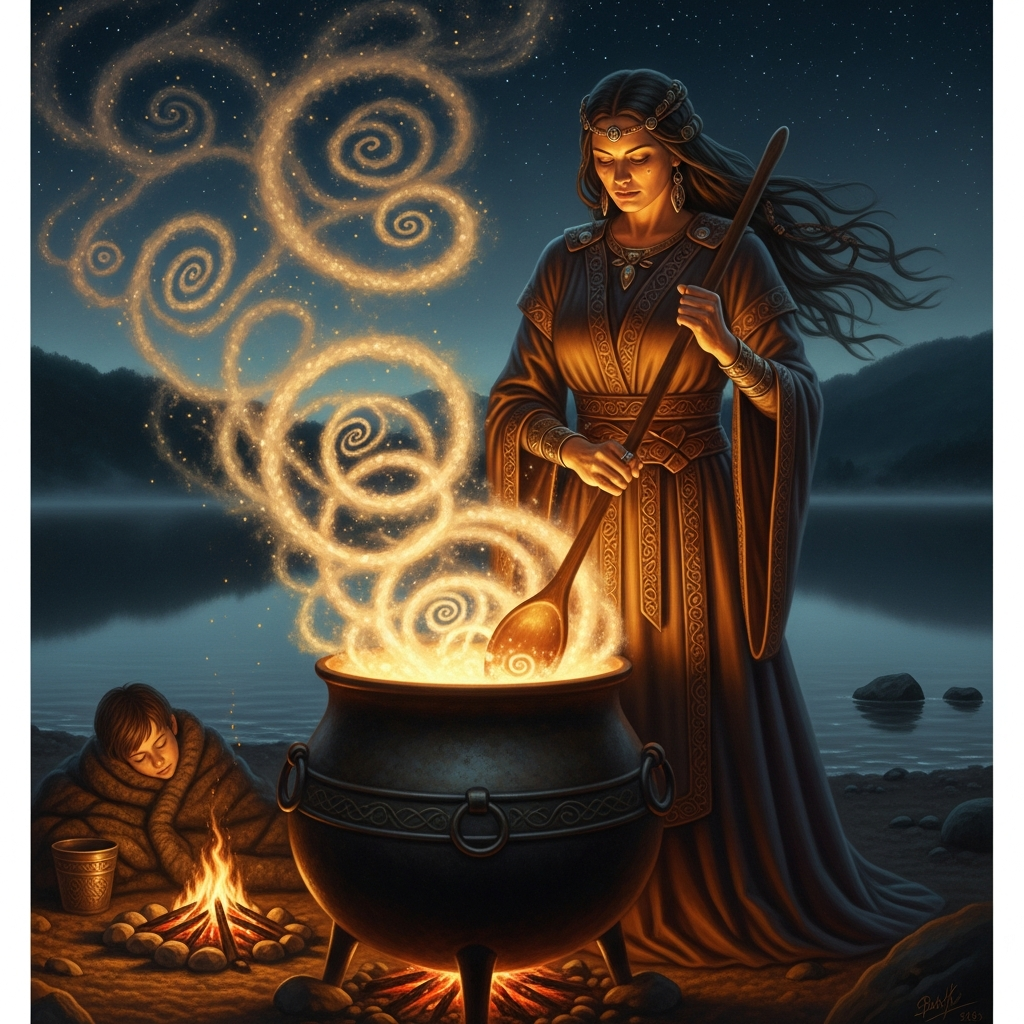
She opens the Book of the Fferyllt — the alchemical knowledge attributed to Virgil in medieval Welsh tradition — and finds the recipe. She will need a cauldron. She will need specific herbs gathered at specific times. She will need a fire that never goes out for one year and one day. She will need two helpers: a blind man named Morda to keep the fire, and a boy named Gwion Bach to stir.
She begins.
For a year she tends the brew. She gathers the herbs herself, at the planetary hours when their properties are strongest. She checks the fire. She monitors the consistency. She is meticulous and she is patient, which is the quality the recipe requires above all others: this is not an art that rewards impatience, and Ceridwen has the kind of patience that comes from having a son whose face has been unkind to him since birth.
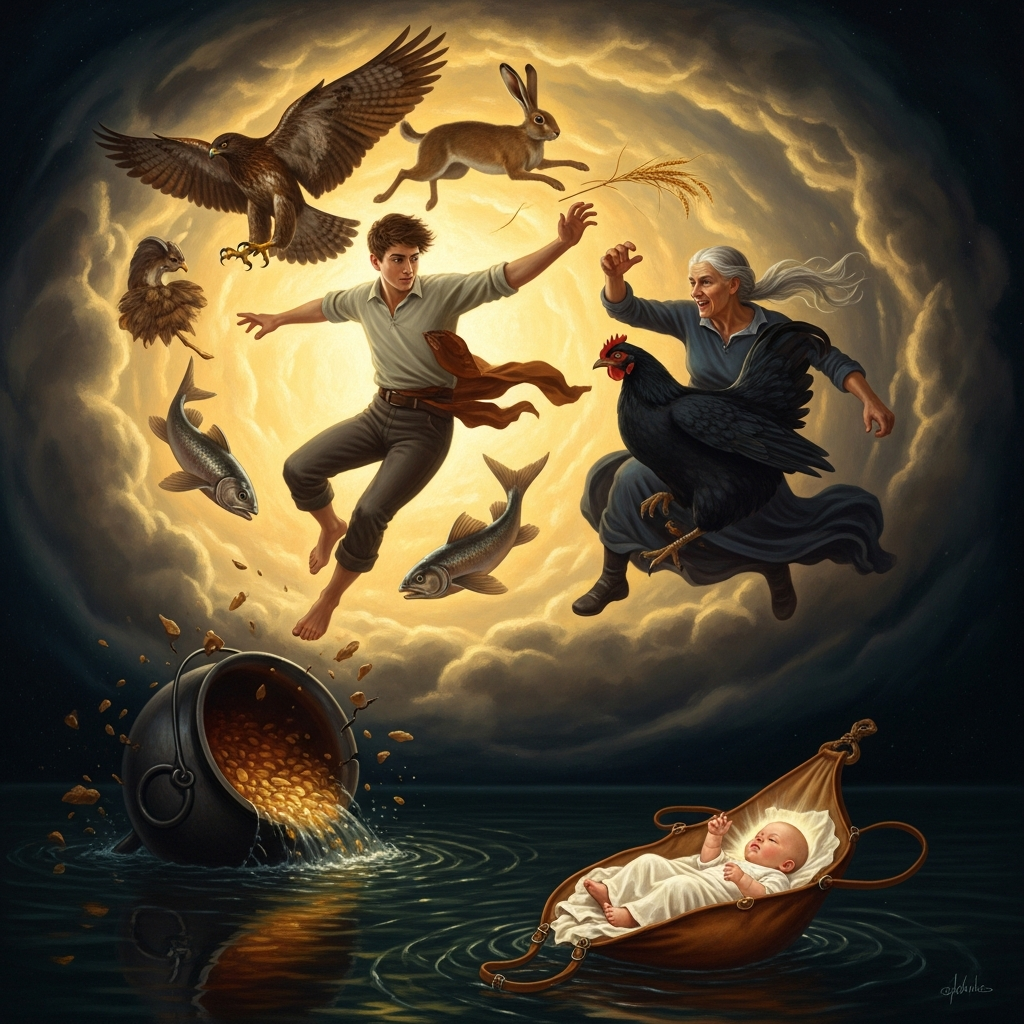
The brew runs for three hundred and sixty-five days. On the three hundred and sixty-sixth day, three drops fly out of the cauldron.
They land on Gwion Bach’s thumb.
He puts his thumb in his mouth.
The year’s work is gone. The all-knowledge she intended for Morfran is in a boy who was hired to stir. The rest of the cauldron turns to poison and breaks the cauldron and runs into the stream, where it kills Tegid’s horses.
She knows immediately what has happened. Gwion Bach knows immediately that she knows. He runs.
What follows is the chase that creates the world’s greatest poet. She pursues him through every shape, and in the shapes she is faster and stronger and older than anything he can become, until the grain of wheat and the black hen, and she eats him, and the all-knowledge she brewed for her ugly son spends nine months inside her instead of inside the cauldron.
She gives birth to a boy of radiant face on the first of May and cannot kill him. She wraps him and throws him into the water.
The water takes him. The water gives him to Elphin. Elphin names him Taliesin.
What Ceridwen set out to make was a gift for her son. What she made was the greatest bard in Britain. Her recipe was perfect, her method was precise, her year of work was the most disciplined act of love in the Welsh tradition.
The three drops fell on the wrong thumb. The best-laid plans of the most careful practitioners contain this possibility: that the thing you made with everything you had will go where it is needed rather than where you intended.
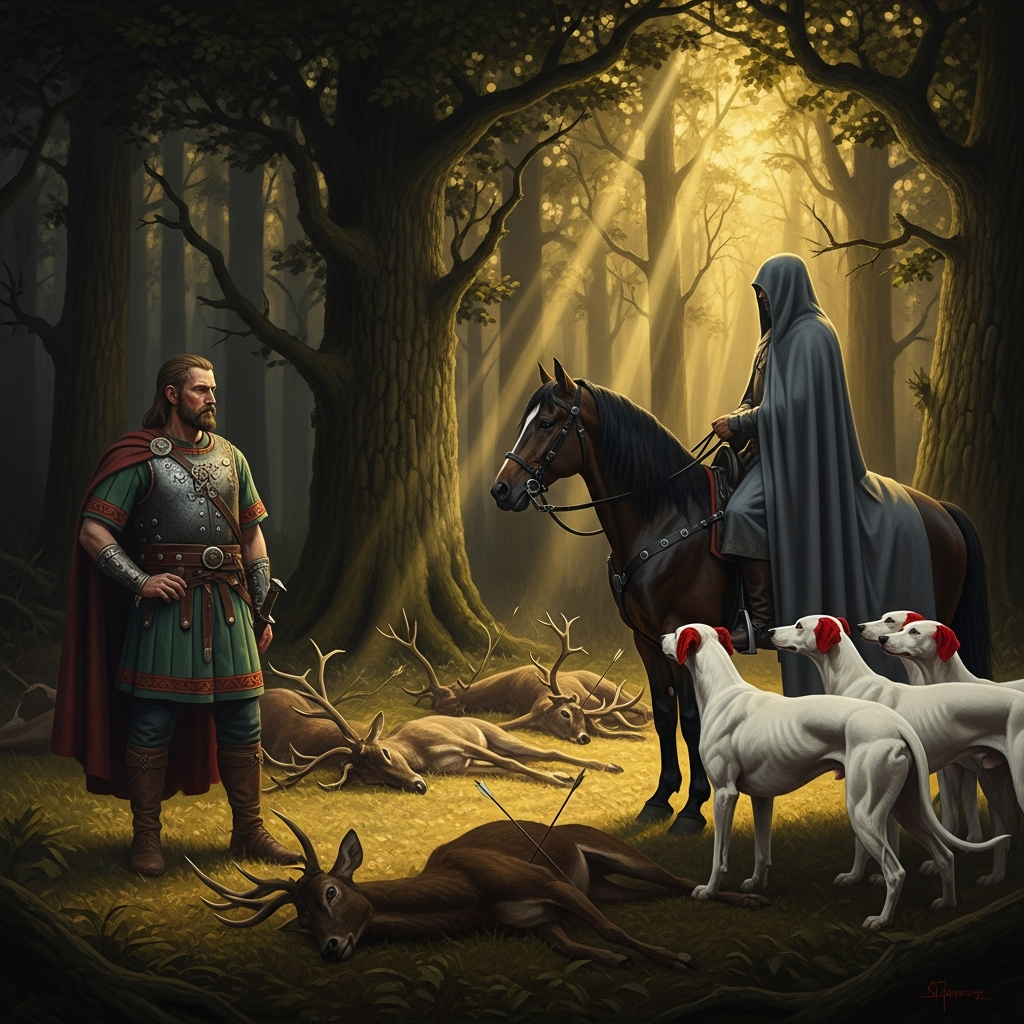
Morfran goes to the Battle of Camlann where Arthur falls. He survives — the sources say no one struck him, because everyone assumed his terrible face meant he was a devil. The ugly son lives. The beautiful bard exists. Ceridwen on the lake-shore knows both outcomes and does not comment.
Echoes Across Traditions
Entities
- Ceridwen
- Morfran
- Gwion Bach
- Taliesin
- Tegid Foel
Sources
- Patrick Ford, trans., *The Mabinogi and Other Medieval Welsh Tales* (University of California Press, 1977)
- Lady Charlotte Guest, trans., *The Mabinogion* (Longman, 1838-49)
- Marged Haycock, *Legendary Poems from the Book of Taliesin* (CMCS Publications, 2007)