The Enchanted Feast of the Otherworld
circa 500-700 CE — the mythic age of the Mabinogion · A hall in the forest of Glyn Cuch, at the boundary of Annwfn, Wales
Contents
When Pwyll and his hunting companions discover a magnificent, inexplicably empty hall in the forest where a feast is laid but no host appears, they must decide whether to eat without permission — and the choice reveals everything about the ethics of the threshold.
- When
- circa 500-700 CE — the mythic age of the Mabinogion
- Where
- A hall in the forest of Glyn Cuch, at the boundary of Annwfn, Wales
The hall stands in the forest where no hall should be.
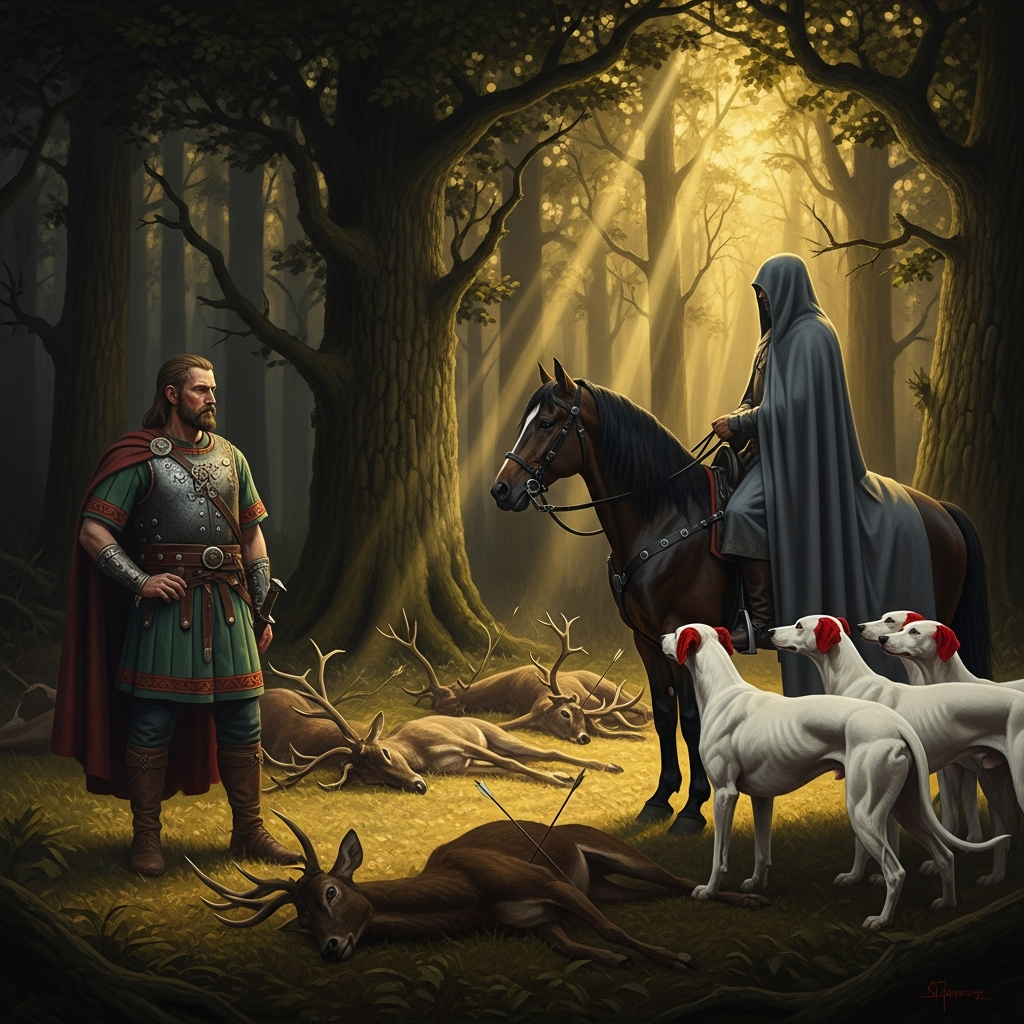
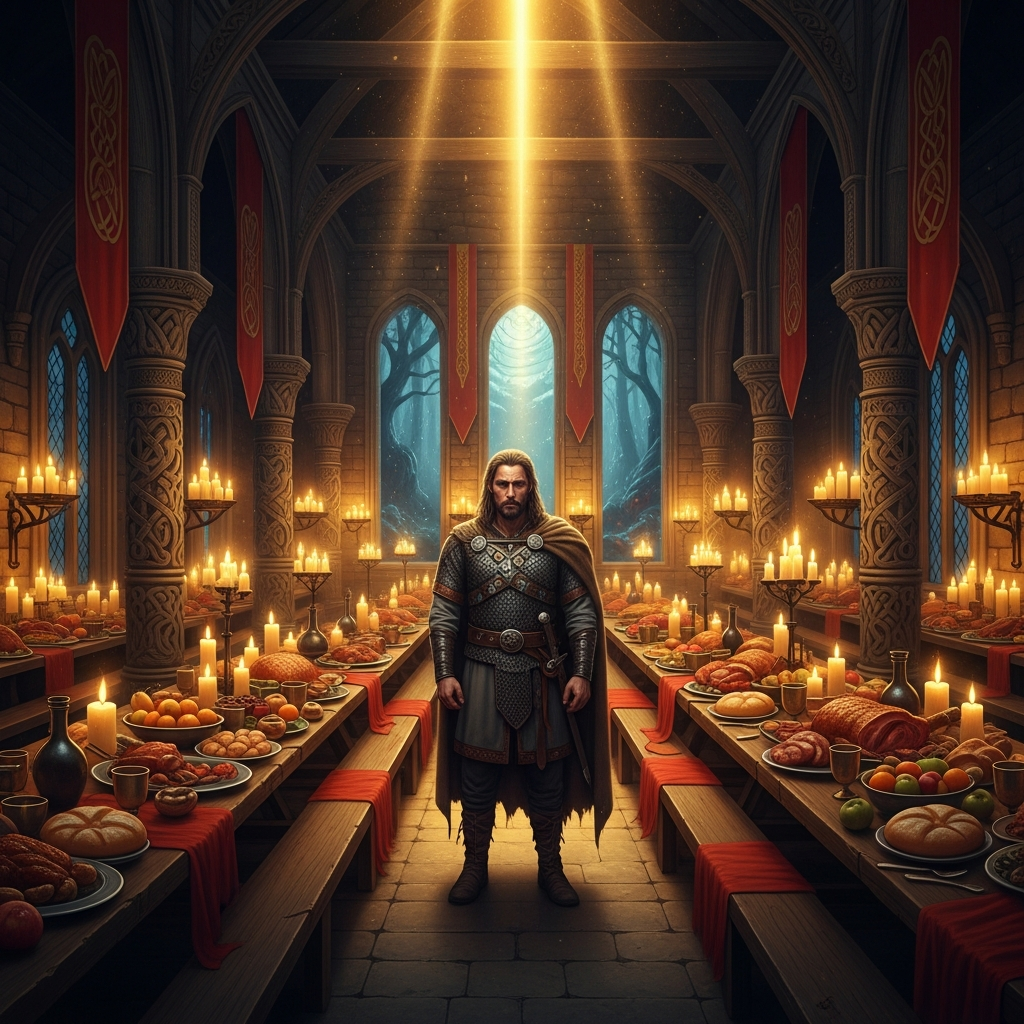
It is evening in Glyn Cuch and Pwyll of Dyfed is hunting, and the hall appears between the trees with the particular quality of things that were always there and simply weren’t visible before. It is large, a lord’s hall, with the fires going inside and the smell of roasting meat coming through the open doors. The white hounds with red ears have led him here and now stand at the threshold, which is another way of saying: Otherworld boundary, proceed with awareness.
The interior, when Pwyll enters, is impeccable. Tables set with the feast’s full preparation: the roasted meats, the bread, the mead-cups filled. Every candle lit. Every vessel in its place. No servants. No lord at the high seat. No person anywhere in the hall.
The feast waits. The hall waits.
Pwyll understands the choice being presented without anyone presenting it: to eat is to accept hospitality from whoever prepared this. Accepting hospitality in a hall of unknown lordship is a significant act — it creates an obligation, it positions him as a guest rather than a traveler, it claims a relationship with the owner he has not yet met.
He chooses to wait.
He stands in the hall for some time without touching anything. This is the correct answer to the test, and the host, when he arrives — the lord of this hall who has been watching from somewhere the hall’s magic provides — recognizes it immediately.
The lord is Arawn. This is the same meeting that begins the First Branch of the Mabinogi — Pwyll at the ford where he drives off the Otherworld hounds, the encounter that leads to the year-long exchange — but beneath the narrative of the wrongdoing and the amends is this elemental scene: a man standing in a supernatural feast-hall, the food before him, not touching it.
The honor of the threshold. The refusal to consume what isn’t offered. The discipline of waiting to understand whose house you are in before you eat their bread.
Arawn arrives. The obligation is correctly established through introduction rather than consumption. The relationship between Pwyll and the king of Annwfn is made through speech and acknowledgment rather than through eating, which means it is a relationship between principals rather than a guest-bond made in ignorance.
Everything that follows — the year in each other’s forms, the battle at the ford, the long friendship between Dyfed and Annwfn — follows from this moment of a man standing in an empty feast-hall with both hands at his sides.
The Otherworld feast-hall appears throughout Welsh and Irish tradition as the supreme test of character. It is always a version of the same question: what do you do when you have the opportunity and no one is watching? Do you eat first and ask later? Do you wait to understand what you are accepting?
The answer determines what kind of person you are in the Otherworld, which turns out to be the same as what kind of person you are in any world.
The fires burn. The mead-cups are full. A man stands in the light with his hands at his sides.
Echoes Across Traditions
Entities
- Pwyll
- Arawn
- The Otherworld court
- The white hounds with red ears
Sources
- Jeffrey Gantz, trans., *The Mabinogion* (Penguin, 1976)
- Sioned Davies, trans., *The Mabinogion* (Oxford World's Classics, 2007)
- Alwyn Rees and Brinley Rees, *Celtic Heritage: Ancient Tradition in Ireland and Wales* (Thames and Hudson, 1961)