The Monkey King Becomes a Pilgrim
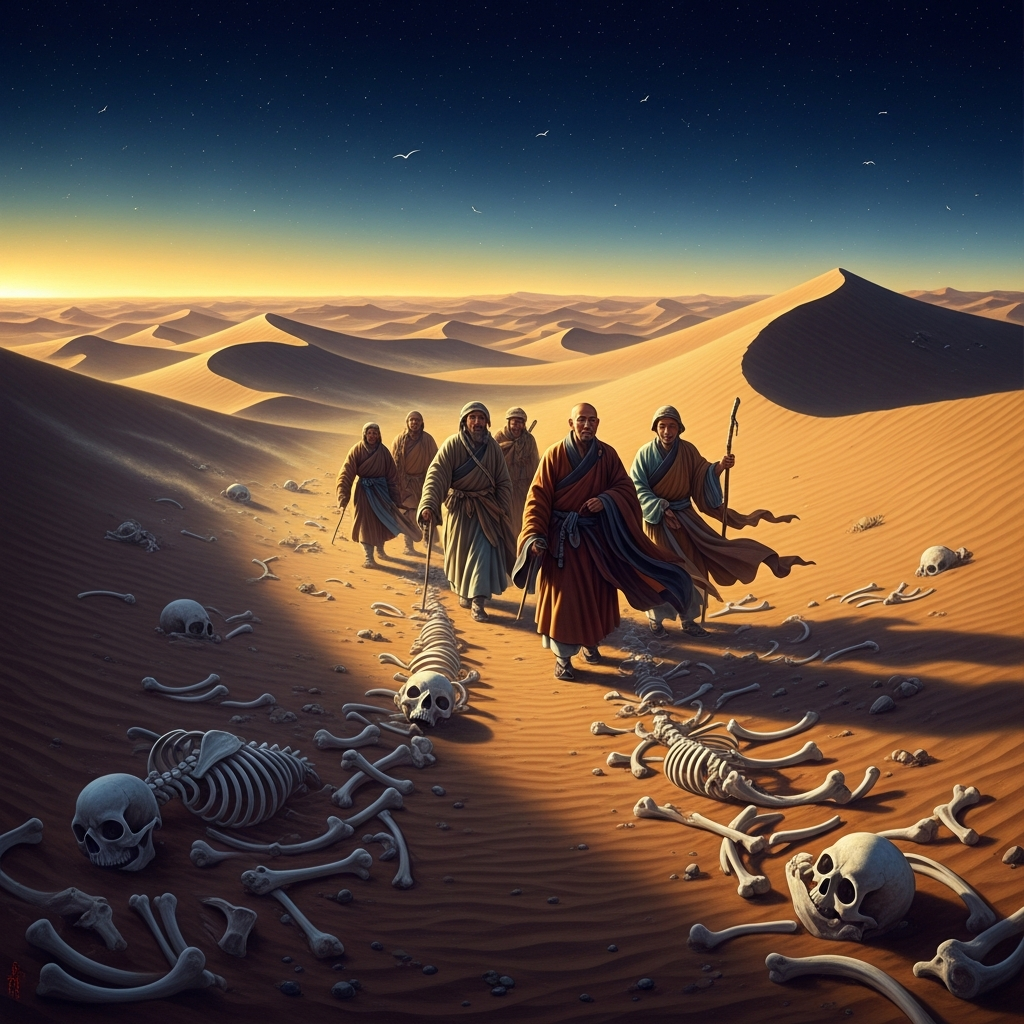
Tang dynasty, c. 629-645 CE — the historical Xuanzang's journey, mythologized · The road from Chang'an to India — through deserts, mountains, seas, and kingdoms of demons
Contents
After five hundred years under Five Elements Mountain, the Monkey King is freed by the monk Tripitaka and becomes his protector on the journey west to retrieve the Buddhist scriptures — becoming, despite himself, a bodhisattva.
- When
- Tang dynasty, c. 629-645 CE — the historical Xuanzang's journey, mythologized
- Where
- The road from Chang'an to India — through deserts, mountains, seas, and kingdoms of demons
Five hundred years is a long time to think about what you did wrong.
The Monkey King has been under Five Elements Mountain since the Buddha pressed his palm down over the clouds and turned it into stone. He can see out through the stone. He can eat the iron balls that the demon wardens bring him — iron balls and copper juice, the diet of the indefinitely imprisoned. He cannot move. He can think, which is perhaps the harshest part of the sentence, because he has always moved first and thought afterward, and now there is nothing to do but think.
When Guanyin comes to inspect the mountain on the way to finding the scriptures’ future carrier, he shouts at her through the stone. He has not lost his voice. He tells her he has repented. She tells him nothing yet, but notes him in the register of possibilities.
Xuanzang comes down the road twenty years later, the monk from Tang China who has been commissioned in a dream by the Tang Emperor to travel to India to retrieve the Buddhist scriptures that will save the Chinese people from their ignorance. He is a gentle man, a studious man, a man of absolute moral seriousness who is, in military terms, completely helpless. He cannot fight. He cannot transform. He cannot repel demons. He is traveling to India alone on a horse.
He passes Five Elements Mountain.
Sun Wukong calls out from the stone. Xuanzang investigates. There is a hand sticking out of the mountainside — the red-haired hand of the Monkey King, the only part of him that has been above ground for five centuries. Xuanzang reads the talisman on the mountain’s peak and removes it, and Five Elements Mountain folds itself back into its constituent elements, and Sun Wukong stands up from the rubble brushing five centuries of stone dust from his fur.
He kneels to Xuanzang. It is the first time he has knelt to anyone.
Guanyin has arranged the terms of his release in advance: he will protect the monk on the journey west, and at the journey’s end he will receive his reward. She has also arranged, for those moments when the Monkey King’s obedience fails — which she knows it will — a golden headband that Xuanzang can cinch tighter with a spell, a headband that produces a headache proportional to the Monkey King’s insubordination.
He does not like the headband. He endures it.
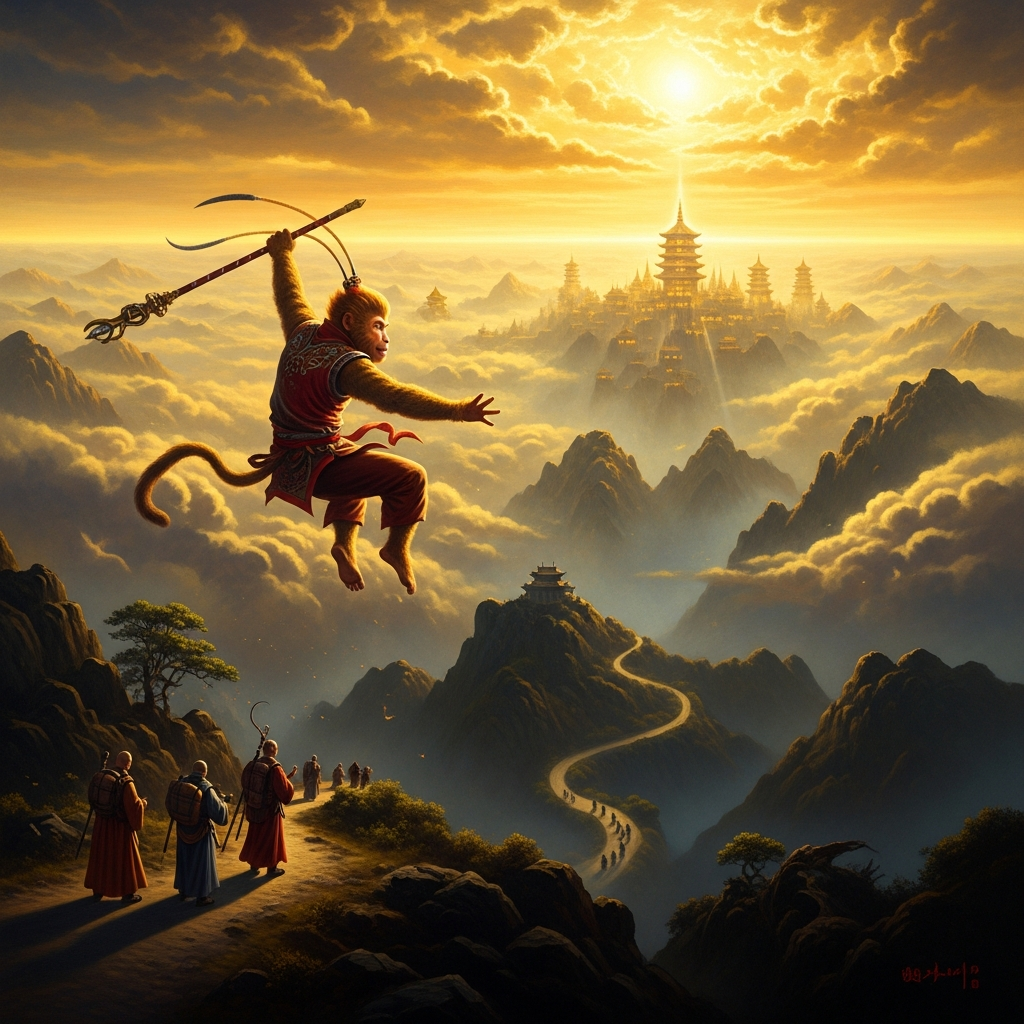
What he discovers over the course of the journey — the eighty-one tribulations, the demon kings in their caves, the kingdoms that want to eat the monk’s immortality-conferring flesh, the rivers of shifting sand and mountains of fire — is that protecting something changes you. He has spent his entire existence fighting for himself. He is now fighting for a person who cannot fight, a person whose value is not in what he can do but in what he carries and what he is going toward.
The journey takes fourteen years in some accounts, a decade in others. They pass through forty-seven kingdoms. They face eighty-one disasters. Sun Wukong defeats most of the demons — the staff extending and retracting, the hairs blown into armies, the seventy-two transformations deployed as diagnostic and tactical tools. He is still the Monkey King. He is still magnificently capable. He is still occasionally arrogant enough to need the headband.
But at the end, when they reach the Western Heaven and the Buddha acknowledges them and distributes the scriptures, Sun Wukong receives a title: Victorious Fighting Buddha. Not Great Sage Equal to Heaven — not the horizontal equality he demanded, but a vertical achievement, the realized bodhisattva nature that was always his but needed the journey to be uncovered. He receives it without argument. The monkey who would not accept any title that fell short of heaven has discovered, through ten thousand miles of desert and mountain and demon-infested water, what heaven actually is.
Echoes Across Traditions
Entities
- Sun Wukong
- Xuanzang (Tripitaka)
- Zhu Bajie (Pigsy)
- Sha Wujing (Sandy)
- Guanyin
- the Buddha


Sources
- Journey to the West (西遊記), Wu Cheng'en, c. 1592
- Anthony Yu, trans., *The Journey to the West*, 4 vols. (University of Chicago, 1977-1983)
- Thomas Lam Yee-Man, *The Characters of Journey to the West* (Chinese University Press, 2012)
- Historical records of Xuanzang's actual journey in *Da Tang Xiyu Ji* (Great Tang Records on the Western Regions)