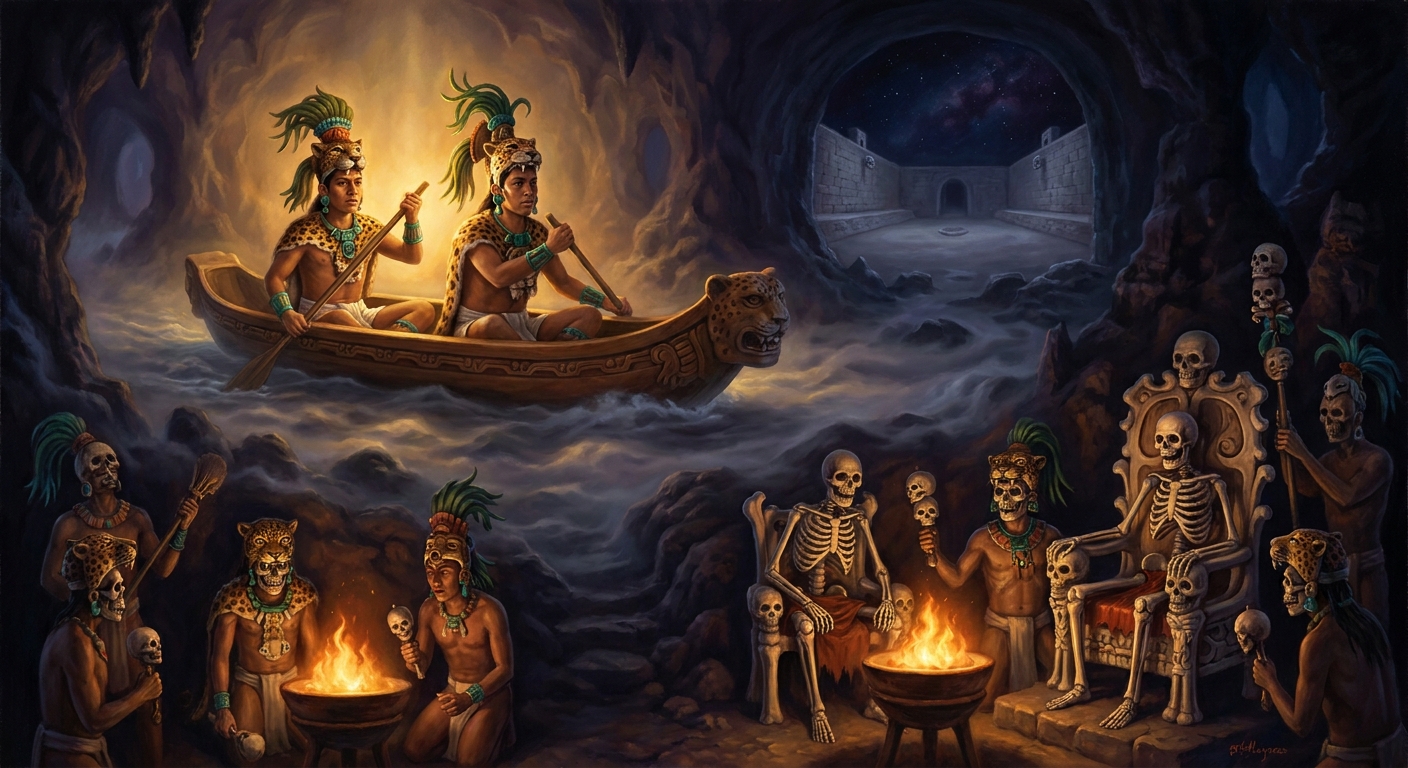
The Rubber Ball Game: A Battle Between Sun and Darkness
c. 1400 BCE — earliest rubber balls at El Manatí; ball courts ubiquitous through Classic Maya period c. 300-900 CE · Maya ball courts throughout Mesoamerica — Chichén Itzá, Copán, Monte Albán, Uxmal, hundreds of sites
Contents
The Maya ulama ball game — played with a heavy rubber ball on a stone court with sloped walls — was not sport but cosmic reenactment: the ball was the sun, the court was the underworld passage, and the game decided whether the sun would rise again.
- When
- c. 1400 BCE — earliest rubber balls at El Manatí; ball courts ubiquitous through Classic Maya period c. 300-900 CE
- Where
- Maya ball courts throughout Mesoamerica — Chichén Itzá, Copán, Monte Albán, Uxmal, hundreds of sites
The ball is the sun.
This is the first thing to understand about the Maya ball game: the heavy rubber ball — weighing several kilograms, made from processed latex tapped from rubber trees in the tropical lowlands — is not a metaphor for the sun. It is the sun, moving through the court the way the sun moves through the underworld passage each night. The sloped walls of the court are the walls of that passage. The stone rings mounted at the court’s midsection are the portals through which the sun must pass to rise again.
The game does not represent the sun’s journey. It is the sun’s journey.
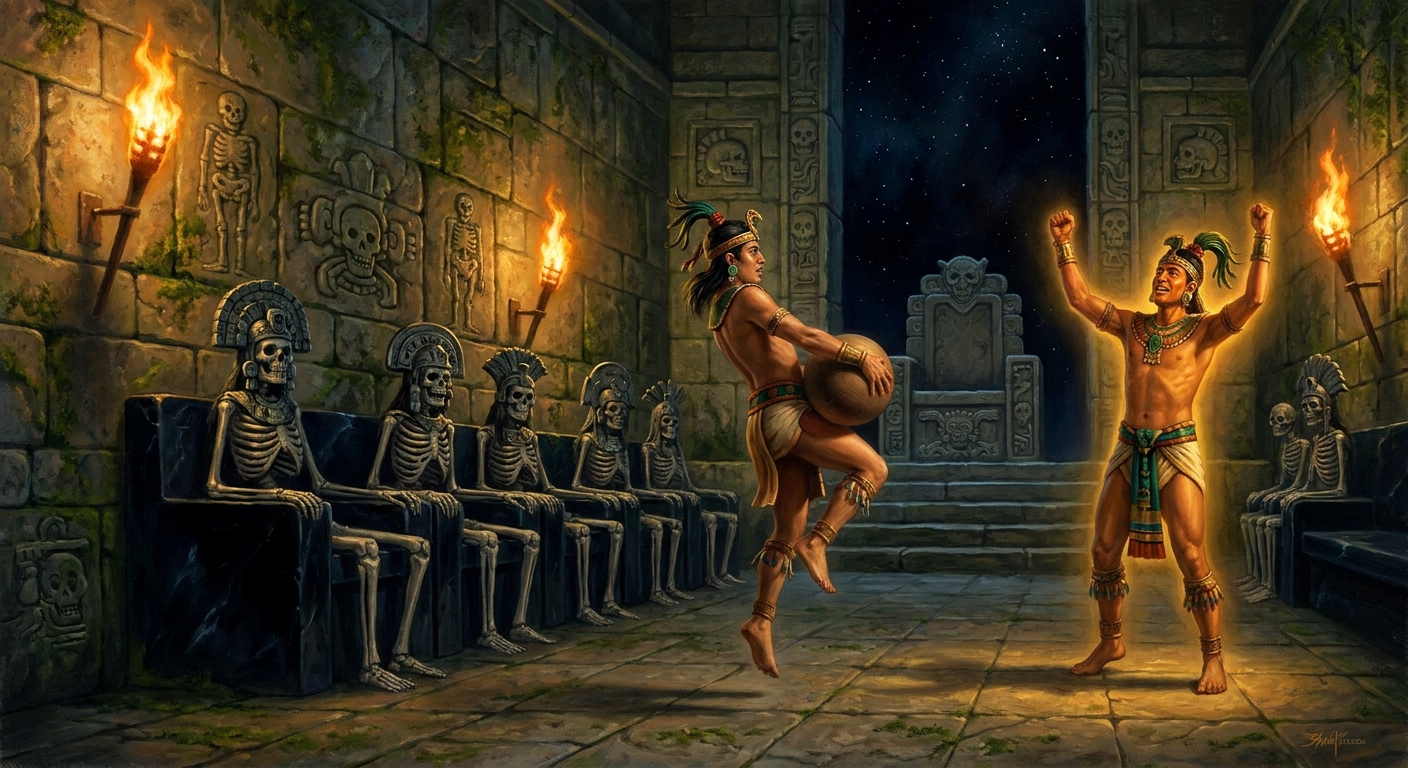
When the ballplayers step onto the court, they are entering the mythological space of the underworld. They are playing the same game that Hun Hunahpú and Vucub Hunahpú played before the lords of Xibalbá summoned them. They are playing the game the Hero Twins played in Xibalbá after surviving the houses of death. Every match reenacts the cosmological narrative: will the sun survive the night? Will it rise?
The ball cannot touch the ground.
The rules of the game, as best as scholars can reconstruct them, required keeping the heavy ball in motion using the hips, elbows, and knees — not the hands, not the feet, not the head. The restriction to the central body is theologically significant: the body’s center, the core, the hips, are the seat of the creative principle. The sun is moved by the body’s creative force, not its extremities.
The stone rings mounted vertically on the side walls of the court — not horizontal like basketball hoops but vertical, perpendicular to the court — are small enough that passing the ball through them would be extraordinary. Scholars debate whether scoring a ring was the primary victory condition or whether it was a rare and spectacularly decisive event, like a sudden death goal. What is agreed is that making the ring was associated with the solar passage, the moment the sun cleared the horizon, and that a player who achieved it could be entitled to claim the jewelry and clothing of the spectators.
The court at Chichén Itzá — the largest in Mesoamerica, 166 meters long — has carved stone panels along its walls showing decapitated ballplayers. Seven serpents emerge from the decapitated neck. The cut neck sprouts vegetation. The ballplayer is the Maize God in the moment of his death and transformation, the decapitation that generates new growth.
Whether players were sacrificed after the game, and if so which players, is among the most debated questions in Mesoamerican archaeology.
The colonial-era sources, written after the Spanish conquest by people who were describing what they were told or what they witnessed, mention sacrifice in connection with the ball game but differ in whether the winner or the loser was sacrificed. The carved panels at Chichén Itzá show sacrifice but do not clearly indicate victory or defeat as the condition.
The logic of both possibilities makes sense within the game’s cosmological framework. If the ball game reenacts the sun’s battle for survival, then the loser is the force of death and darkness that temporarily stopped the sun — sacrifice as punishment. But if the game is a sacrificial mechanism for feeding the sun, then the winner — the person who most fully embodied the solar force — is the most appropriate offering.
The Hero Twins themselves cooperated in their own death and came back.
Voluntary sacrifice and resurrection are the deep logic of the game. The player who enters the court enters the underworld. Whether or not they die on the court, they participate in the movement of the ball through the dark passage, the heavy rubber sun moving through stone and shadow, waiting to pass through the ring and rise.
Every sunrise is the ball game won again.
The ball still moving, the sun still clearing the horizon, the lords of Xibalbá still trying and the living still playing.
Echoes Across Traditions
Entities
- the ballplayers
- Hunahpú
- Xbalanqué
- Hun Hunahpú
- One Death
Sources
- Michael D. Coe, *The Ball Game in Mesoamerica* (Sport and Society in Latin America, Greenwood, 1988)
- David Freidel, Linda Schele, and Joy Parker, *Maya Cosmos* (William Morrow, 1993)
- Karl Taube, *Aztec and Maya Myths* (University of Texas Press, 1993)