Contents
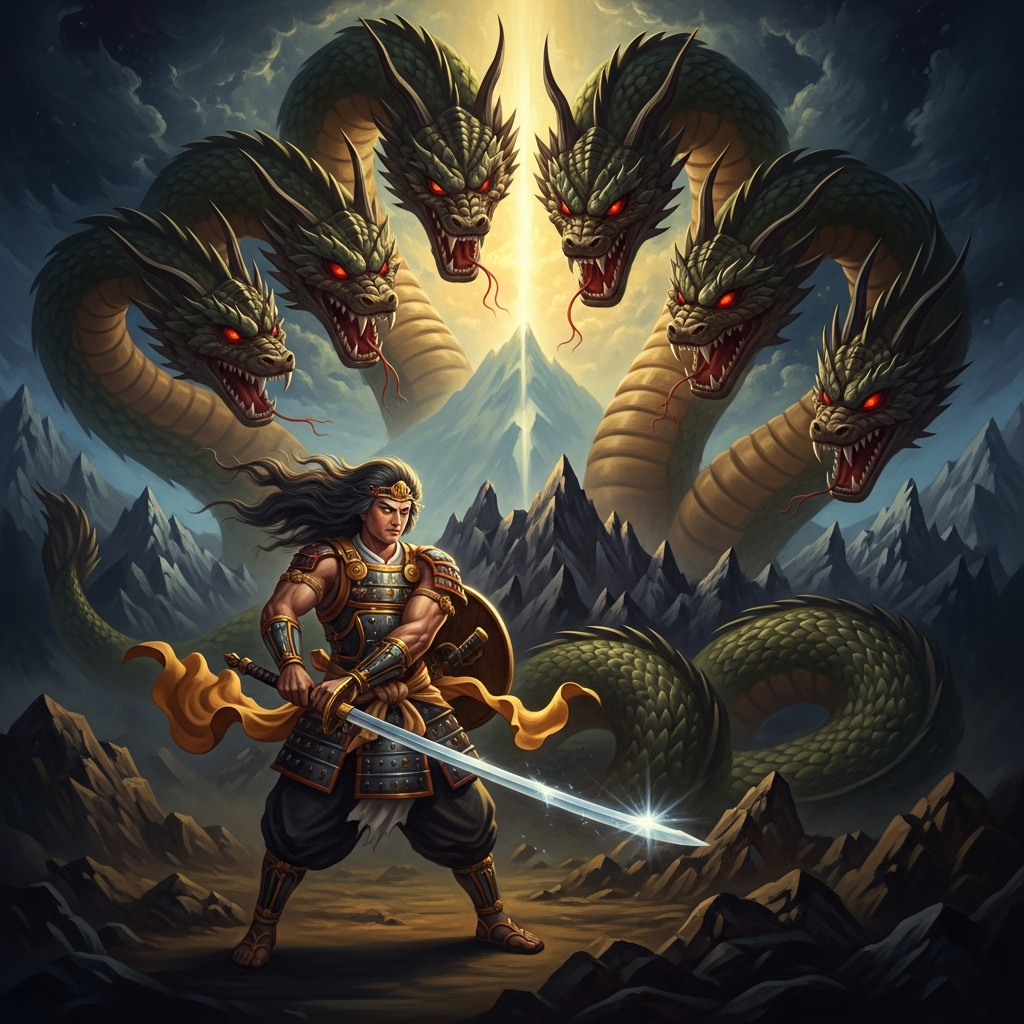
Amaterasu's grandson Ninigi descends from heaven to rule the earth, wrapped in divine radiance and carrying the Three Imperial Regalia — mirror, sword, and jewel — that will define Japan's emperors forever.
- When
- Age of the Gods — the descent era, Kojiki Book II
- Where
- The peak of Takachiho in Hyuga Province (modern Miyazaki Prefecture, Kyushu)
The earth has been yielded.
Ōkuninushi has surrendered the land to the heavenly claim, and the heavens must now send someone to rule it. The choice falls on Ninigi — Ame-no-Oshihomimi’s son, Amaterasu’s grandson, the young deity whose name means something like the rice-ear’s abundant radiance. He is chosen to be the link between the divine world above and the physical world below.
Amaterasu prepares him.
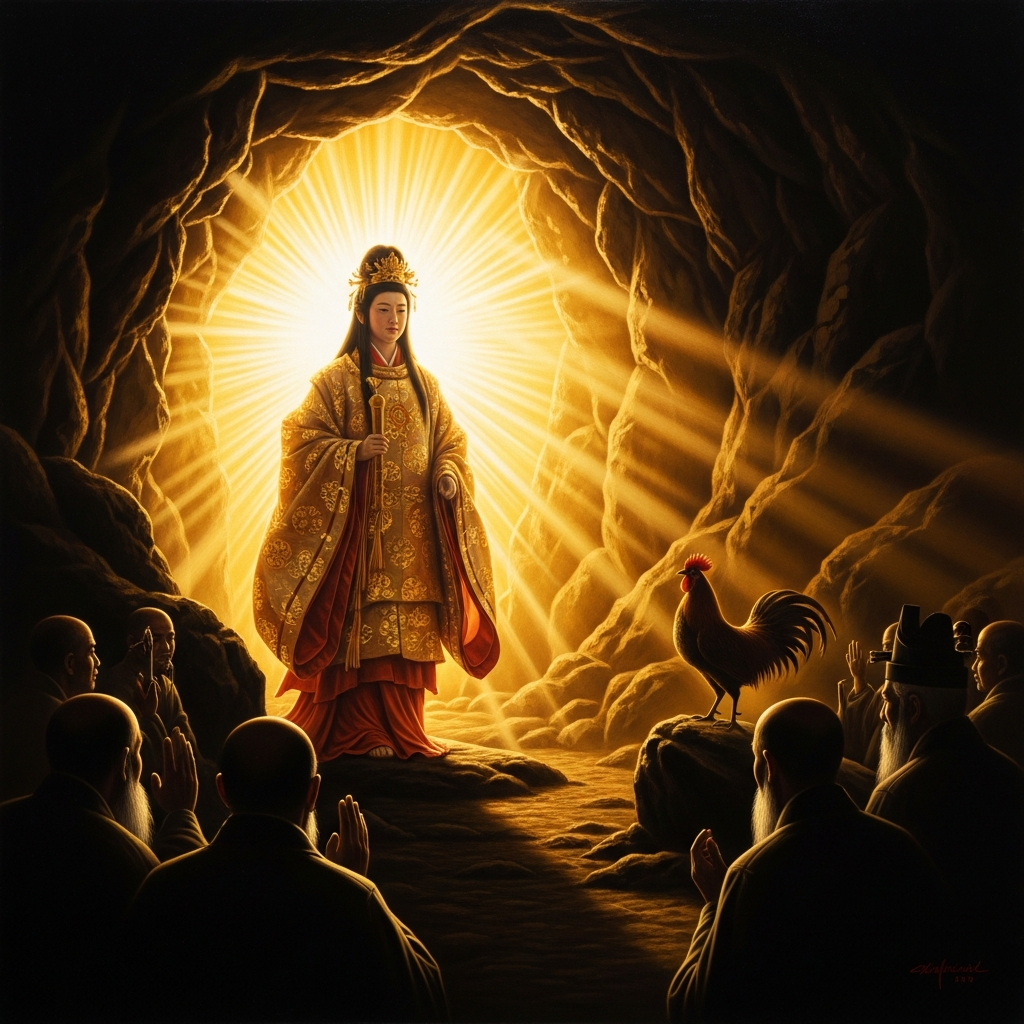
She gives him the mirror — the Yata no Kagami, the Eight-Hand Mirror, the polished bronze that reflected her own face and lured her from the cave. She says: Regard this mirror as my spirit. Worship it as you would worship me. She gives him the jewel, the curved magatama of abundant clouds. She gives him the sword — Kusanagi, the Grass-Cutting Sword that Susanoo found inside the dragon. These are the Three Imperial Regalia, and they are given with an instruction that will govern every Japanese emperor who carries them: rule gently, rule wisely, and do not confuse your own self with the divine objects you carry.
A procession of great deities accompanies Ninigi down.
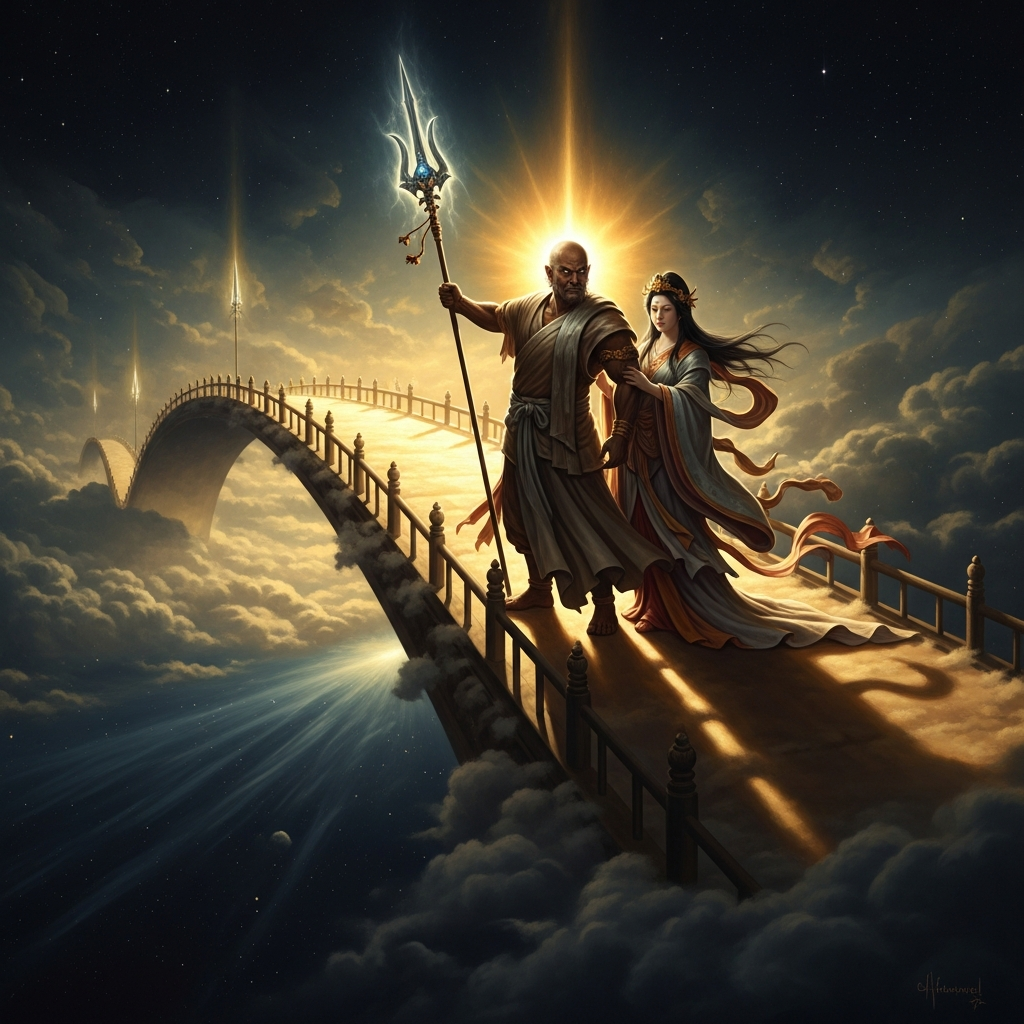
The procession crosses the Floating Bridge of Heaven — the same bridge where Izanagi and Izanami once stood with their jeweled spear, looking down at the formless ocean. But now the descent is not to formless water but to a specific mountain: Takachiho, the peak in Hyuga Province on the southern island of Kyushu, a real mountain in the real world that is still pointed to today.
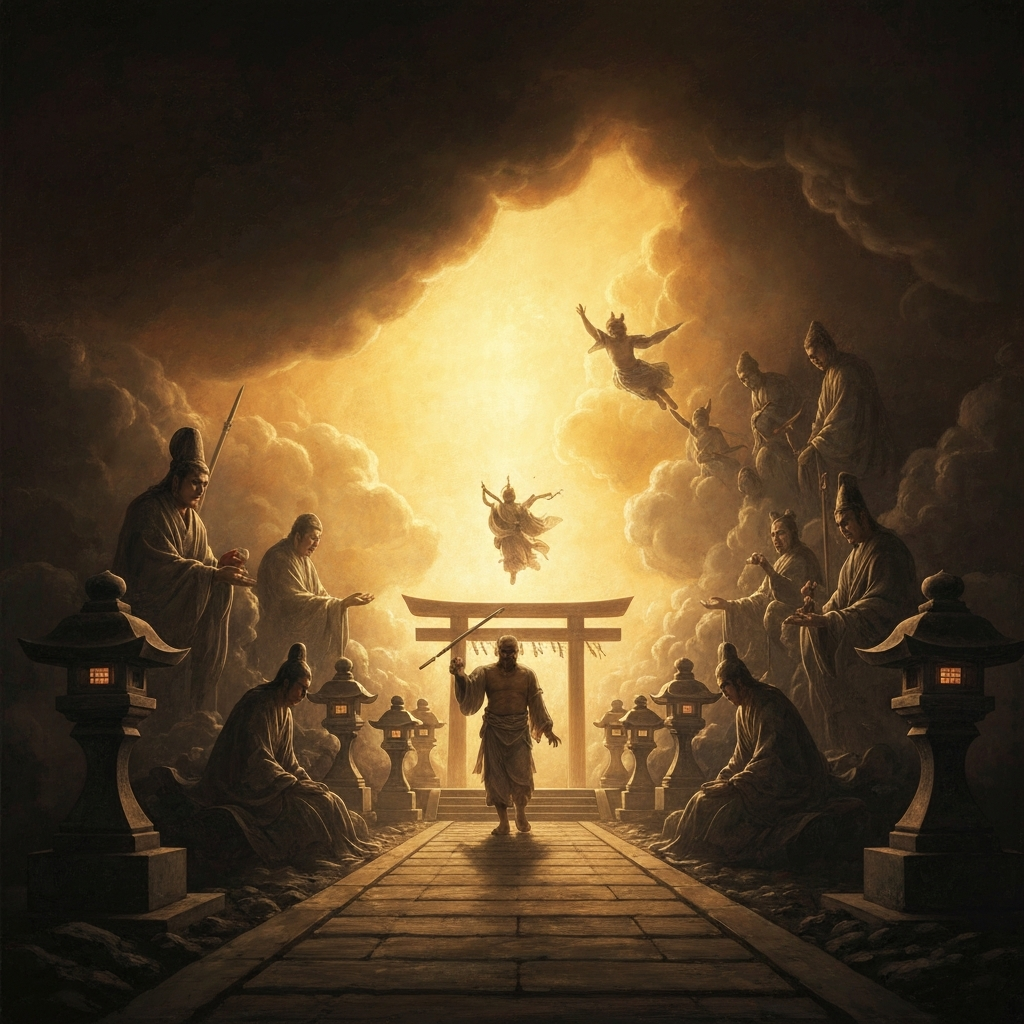
At the crossing between heaven and earth, Ninigi encounters a deity standing at the eight-way intersection of the paths — a figure so radiant that it cannot be looked at directly. The procession stops. Ame-no-Uzume, the Dawn Dancer who brought Amaterasu from the cave with her wild performance, steps forward. She confronts the glowing figure, her robe open, her manner confrontational.
She asks who it is.
It is Saruta-hiko, the Earth-Kami, the deity of earthly crossroads, and he has come not to obstruct but to guide. He has been waiting at the crossing to lead the heavenly procession safely down to the mountain. He leads them. Ninigi descends.
He lands on the peak of Takachiho wrapped in mattresses of clouds pushed aside by the eight-fold breath of heaven, and he says, surveying the land: This is a good place.
The land he surveys is Japan. The mountain is real. The people who will live below the mountain and who will be ruled by his descendants are real people — they will one day be called Japanese, and the story of how their emperors came to rule will begin at this mountain on a day before history when a young deity landed on a peak with three objects in his hands and a mandate from his grandmother who is the sun.
He builds a palace. He lives there. He marries a daughter of a mountain-god and has children who will eventually produce the first emperor.
The mirror is placed in what will become Ise Shrine, where it is worshipped as the body of Amaterasu herself. The sword will pass through the hands of heroes and emperors and eventually come to rest at Atsuta Shrine in Nagoya. The jewel lives in the Imperial Palace in Tokyo, in a chamber where only the emperor may go.
On the morning of every Japanese imperial enthronement, the new emperor receives the regalia.
A young god landed on a mountain a very long time ago. The objects he carried are still being handed down.
Echoes Across Traditions
Entities
- Ninigi
- Amaterasu
- Takamimusubi
- Ame-no-Koyane
- Saruta-hiko

Sources
- Kojiki (Record of Ancient Matters), compiled 712 CE, Book II, Sections 1-4
- Nihon Shoki (Chronicles of Japan), compiled 720 CE
- Sakamoto Taro, *The Six National Histories of Japan* (University of Tokyo Press, 1991)
- Ben-Ami Shillony, *The Imperial House of Japan* (Brill, 2005)