Guru Angad and the Letters That Made a People
Guru Angad's guruship 1539–1552 CE; Gurmukhi script formalized and promoted during this period · Khadur Sahib, Punjab, India — the village where Guru Angad established his seat after Guru Nanak named him successor
Contents
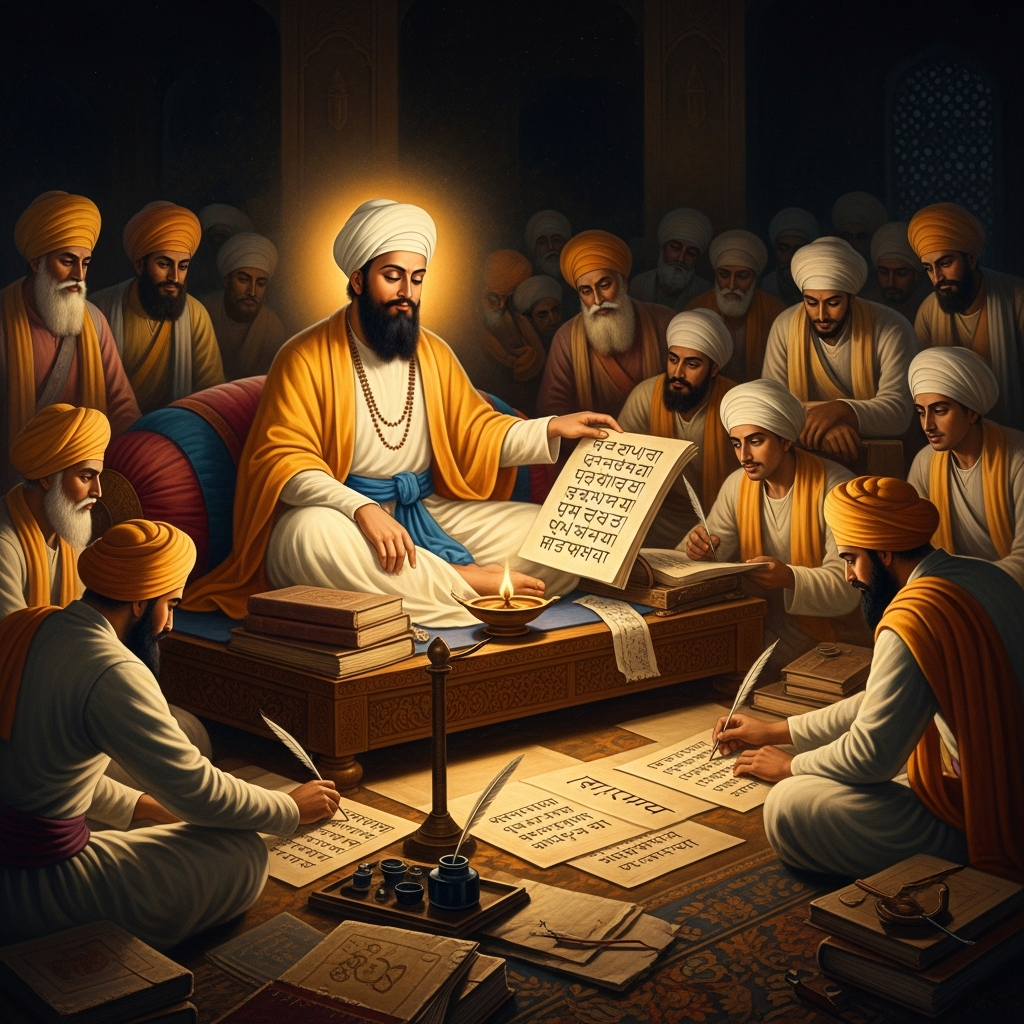
Guru Angad Dev Ji, the second Sikh Guru, standardized and promoted the Gurmukhi script — the alphabet in which the Guru Granth Sahib would eventually be written. Before Angad, Punjabi had no standard written form. By creating a script that was neither Sanskrit (the Brahmin priestly language) nor Persian (the Mughal court language), Angad gave Sikhs a way to transmit the Guru's teachings that bypassed both elite gatekeepers. Writing systems are always political.
- When
- Guru Angad's guruship 1539–1552 CE; Gurmukhi script formalized and promoted during this period
- Where
- Khadur Sahib, Punjab, India — the village where Guru Angad established his seat after Guru Nanak named him successor
Guru Nanak chose him, which itself requires explanation.
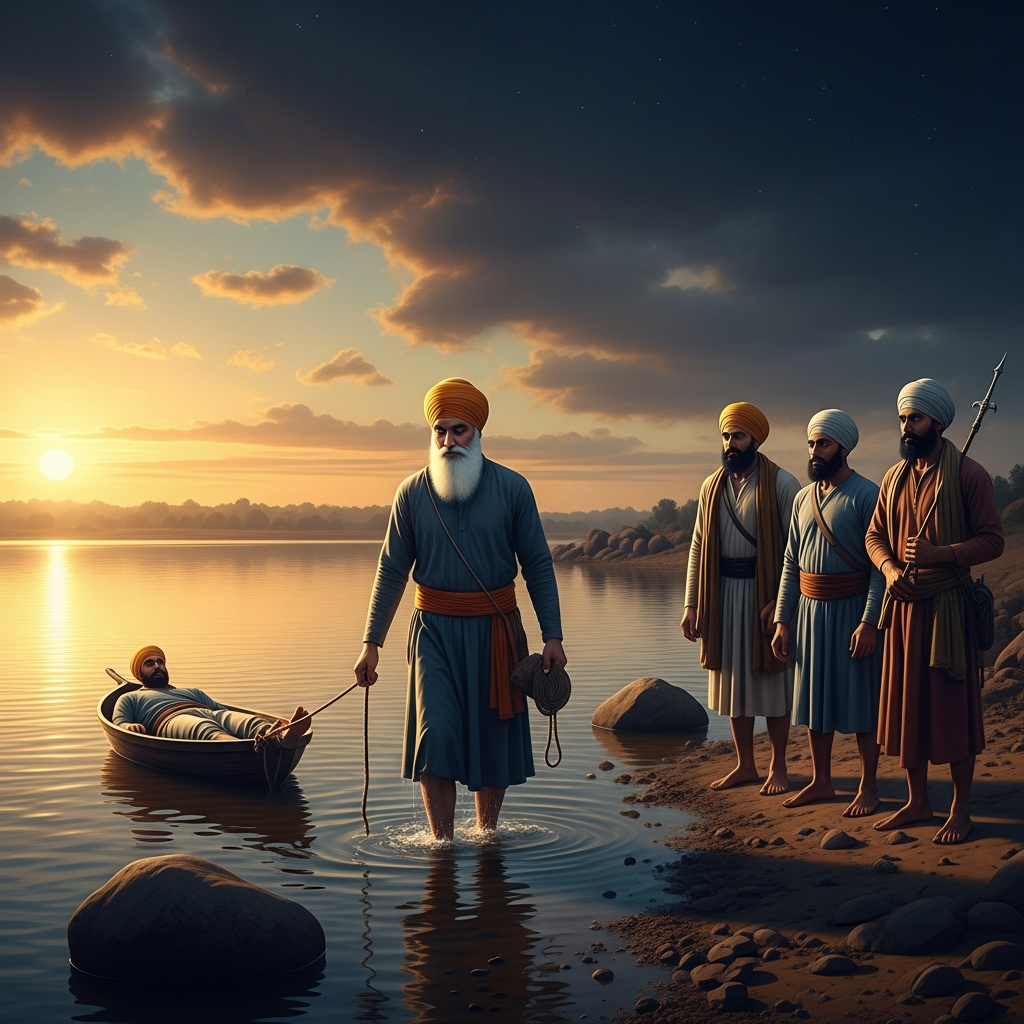
Lehna — the young man who would become Guru Angad — was not Nanak’s biological son. He was not from Nanak’s family or even his village. He had been, until his late twenties, a devoted Brahminical Hindu, a worshipper of the goddess Durga who organized annual pilgrimages to her shrine at Jawaddi. He encountered Nanak’s teachings, then encountered Nanak himself at Kartarpur, and stayed. He stayed the way people stay when they have found the thing they did not know they were looking for: quietly, permanently, without drama.
What he demonstrated, over the years at Kartarpur, was something the texts describe consistently: perfect service, without ego. The hagiographical accounts are full of stories designed to establish this quality — Angad carrying Nanak’s shoes in the heat, Angad not flinching when Nanak tests his equanimity in progressively more demanding ways. These stories follow the pattern of all succession narratives: the new leader proven worthy by the demands of the old. What matters is the conclusion Nanak draws from them.
He had two biological sons. He named neither of them his successor.
He named Lehna, renaming him Angad — “one who is a part of me, of my body” — and handed him the guruship.
The inheritance Angad received was not a throne. It was a community with no written language.
This requires unpacking. Punjabi — the language that Guru Nanak had used for his poetry, the language of the Japji and the Asa di Var and the great morning and evening hymns that were already being sung across the Punjab — had no standardized script. Written Punjabi before the Sikh period was rendered in a variety of regional scripts: Landa, Takri, Sharda, none of them standardized, none of them teachable to ordinary people in a systematic way. Sanskrit was the language of Brahminical learning; Persian and Arabic were the languages of the Mughal administration and Islamic scholarship. A Punjabi speaker who wanted access to any written tradition had to learn someone else’s language and someone else’s script.
Nanak’s poetry was being transmitted orally, in the way that poetry without a written home is always transmitted: accurately in the short term, drifting in the long term, subject to the memory of the singer and the interests of whoever controls the singing.
Angad understood this problem the way a builder understands the difference between a structure with a foundation and a structure without one.
The script he standardized is called Gurmukhi — “from the mouth of the Guru.”
It was not invented from nothing. Gurmukhi draws on existing scripts of the Punjab region, particularly the Landa mercantile script used by traders for accounts. What Angad did was the kind of work that looks simple after it is done and is nearly impossible before: he chose, regularized, and fixed. He decided which letters would represent which sounds. He established the letterforms. He created a system simple enough to be taught to children and precise enough to capture the phonetics of Punjabi poetry without ambiguity.
Then he taught it.
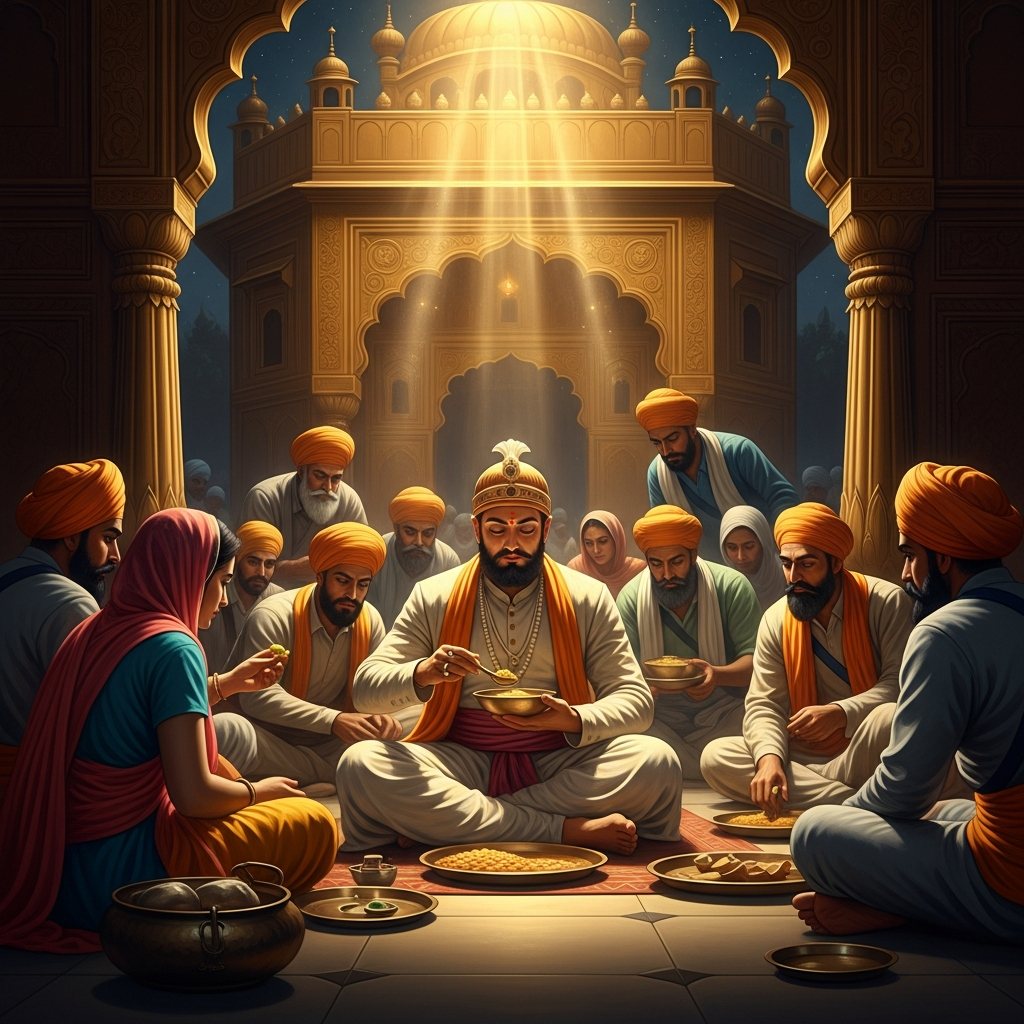
He established a school at Khadur Sahib. He taught children — the children of farmers and merchants and artisans, the children of people who had no access to Sanskrit learning and no connection to Persian scholarship. He sat on a mat in the morning and taught letters. He organized the langar — the community kitchen that fed everyone who came, reinforcing the principle that learning and eating were equally available to all — and in the afternoon he taught more letters.
He also composed. He added sixty-two hymns to Nanak’s existing corpus, writing them in Gurmukhi, in the same meter and form as Nanak’s compositions, establishing the pattern that would continue through the ten Gurus: each successor adding to the accumulated body of the teaching, in the same script, in the same forms, building a unified textual tradition across a century and a half.
His daughter Bibi Amro was a teacher.
The hagiographical accounts record that it was Bibi Amro who brought the third Guru to Sikhism. Amar Das — a devout Vaishnavite Hindu in his late sixties who had spent his life on pilgrimages and devotional practices — heard Bibi Amro singing her father’s hymns. He heard them as Punjabi farmers sometimes heard Nanak’s hymns: with the sudden recognition of something he had been searching for in the wrong places. He asked to meet the Guru. Bibi Amro brought him to Khadur Sahib.
Amar Das became the third Guru. The lineage passed through the ears that heard the daughter singing in a language that was now, because of her father’s work, fully writable and fully teachable.
This is how scripts propagate: not through scholars but through daughters singing in kitchens.
The political dimension of Angad’s work becomes clearest when you consider what the alternatives were.
The Mughals administered Punjab in Persian. Their tax rolls, their legal documents, their court communications — all Persian. The Brahminical establishment maintained its religious authority in Sanskrit. Both languages were the property of trained specialists who spent years acquiring them, who derived social and economic status from that acquisition, and who had structural incentives to keep the acquisition difficult. A writing system that anyone could learn in weeks was, in this context, not just an educational tool. It was a challenge to the entire architecture of cultural authority.
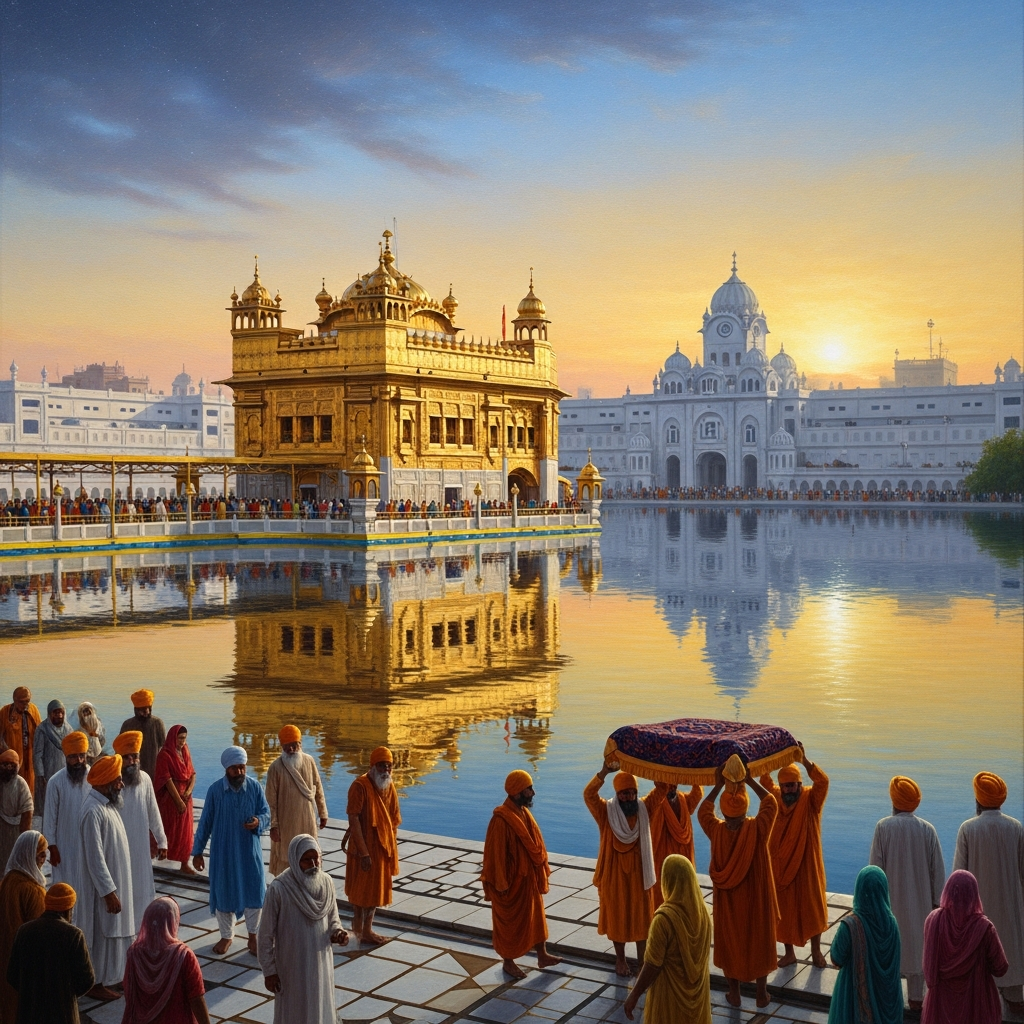
The Guru Granth Sahib — when Guru Arjan finally compiles it in 1604 — will be composed in Gurmukhi, which means it will be accessible to anyone Angad’s schools have taught. No Brahmin intermediary. No Persian-trained scribe. No specialized training required beyond what a village child can learn from a teacher on a mat. The text of the sacred will be readable by the people the text addresses.
Angad did not write a political manifesto. He taught letters to children in a village in the Punjab. The manifesto took fifty years to become visible and will remain legible for as long as anyone reads the Guru Granth Sahib, which is to say: indefinitely.
The thirty-five letters of the Gurmukhi alphabet — plus the diacritical marks for vowels that are added below and above and around the consonants — are still taught in the same order Angad established. Every Sikh child who learns to read learns this order. Every morning prayer recited from the Guru Granth Sahib is recited in the script Angad regularized from the scripts of Punjabi merchants who kept their accounts in a hand no one had thought to teach to farmers.
The Landa script that Angad drew on was a tradesman’s shorthand, efficient and functional but not sacred. The transformation Angad performed was not the invention of new letterforms but the decision that these letterforms — already in use for commerce — were worthy to carry the Guru’s words. The sacred does not require a special script invented for it. It requires the decision that the ordinary script, perfected, is enough.
He taught this to children on a mat.
Echoes Across Traditions
Entities
- Guru Angad Dev Ji
- Guru Nanak
- Bhai Bala
- the Gurmukhi script
- Bibi Amro (Guru Angad's daughter, who spread the script)

Sources
- *Janam Sakhis* (hagiographical accounts of Guru Nanak, recorded 17th century)
- *Sri Guru Granth Sahib* — written entirely in Gurmukhi script
- W. H. McLeod, *The Evolution of the Sikh Community* (Oxford, 1976), ch. 3
- Pashaura Singh & Louis Fenech (eds.), *The Oxford Handbook of Sikh Studies* (Oxford, 2014)
- Khushwant Singh, *A History of the Sikhs, Vol. I: 1469-1839* (Princeton, 1963), ch. 3
- Christopher Shackle, *A Guru Nanak Glossary* (Heritage Publishers, 2nd ed. 1995)