The Book That Became the Guru
October 7, 1708 CE — the declaration of the Guru Granth Sahib as eternal Guru; Nanded, Maharashtra · Hazur Sahib (Sachkhand Sri Hazur Sahib), Nanded, Maharashtra, India — the site of Guru Gobind Singh's death and the declaration
Contents
Before Guru Gobind Singh died in 1708, he performed the last Sikh succession. He did not name a human successor. He placed the Guru Granth Sahib — the sacred scripture compiled over generations — on a throne, bowed to it, and declared it the eternal Guru. The line of human teachers ended. The word became the teacher. The Guru Granth Sahib is treated as a living being: given a room to rest at night, fanned during ceremonies, carried on the head, never placed on the floor. It is the only religion in which the living teacher is a book.
- When
- October 7, 1708 CE — the declaration of the Guru Granth Sahib as eternal Guru; Nanded, Maharashtra
- Where
- Hazur Sahib (Sachkhand Sri Hazur Sahib), Nanded, Maharashtra, India — the site of Guru Gobind Singh's death and the declaration
He had been stabbed two months before and he knew the wound was not healing.
Guru Gobind Singh was forty-one years old in October 1708, and dying in Nanded by the wound of a Pathan assassin — a man named Jamshed Khan, sent by Wazir Khan of Sirhind in a last act of revenge from a governor who was already dead, killed by Banda Singh Bahadur at the Battle of Chappar Chiri two months earlier. The wound had seemed to close and then opened again. The Guru had been in correspondence with the Mughal Emperor Bahadur Shah I, whose forces he had accompanied south to the Deccan. Now the Emperor was moving north and the Guru was staying in Nanded and understanding what the staying meant.
He had survived his four sons. Two died fighting the Mughal army at Chamkaur. Two — ages seven and nine — were bricked alive into a wall at Sirhind for refusing to convert, on the orders of the same Wazir Khan whose assassin had opened this wound. His mother had died of grief. His wife Mata Sundri was alive, in Delhi, at a distance too great to bridge before the end.
He had, to settle: the question of succession.
There had been a human Guru since the beginning.
Nanak had named Angad. Angad had named Amar Das. Amar Das had named Ram Das. Ram Das had named his son Arjan, beginning the hereditary succession that would prove, under Gobind Singh’s father Tegh Bahadur, to produce a Guru willing to die for a principle. Every succession had been a potential fracture: there were always claimants, always distant relatives with grievances, always people who felt the guruship had been promised or owed. The masands — the administrative representatives of the Gurus across the Punjab — had grown corrupt during the succession gap between Tegh Bahadur and Gobind Singh, collecting fees and keeping them. The human succession had worked, but it had been expensive.
More importantly: every human Guru was mortal and therefore killable.
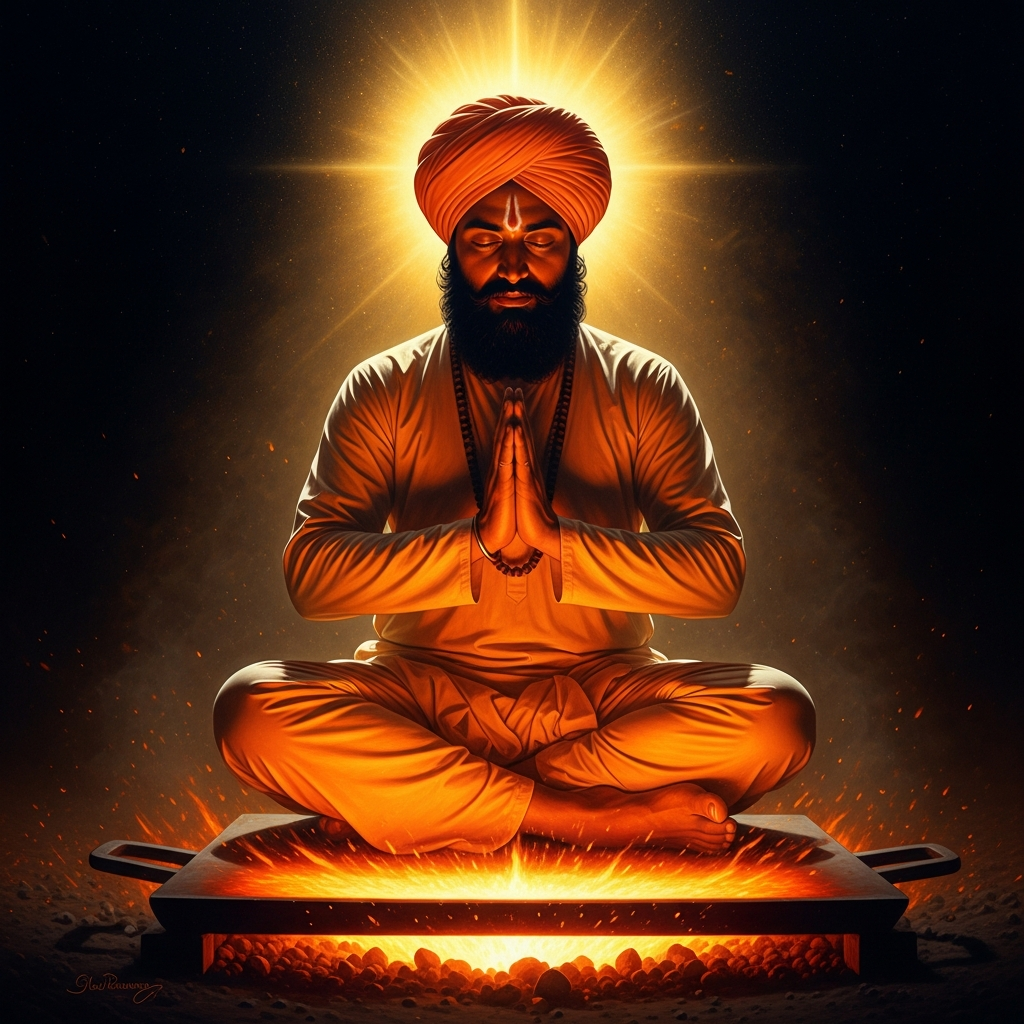
Three Gurus had been executed or tortured to death by imperial power. Arjan had been tortured on a hot iron plate in Lahore. Tegh Bahadur had been beheaded at Chandni Chowk. Gobind Singh himself would die of an assassin’s wound in the Deccan. The Mughal strategy of targeting the Guru — the singular human point of authority — had worked three times in living memory. It would work again if the succession continued as it had.
The book could not be killed.
The formal version of the declaration exists in several accounts that do not differ substantially in their core.
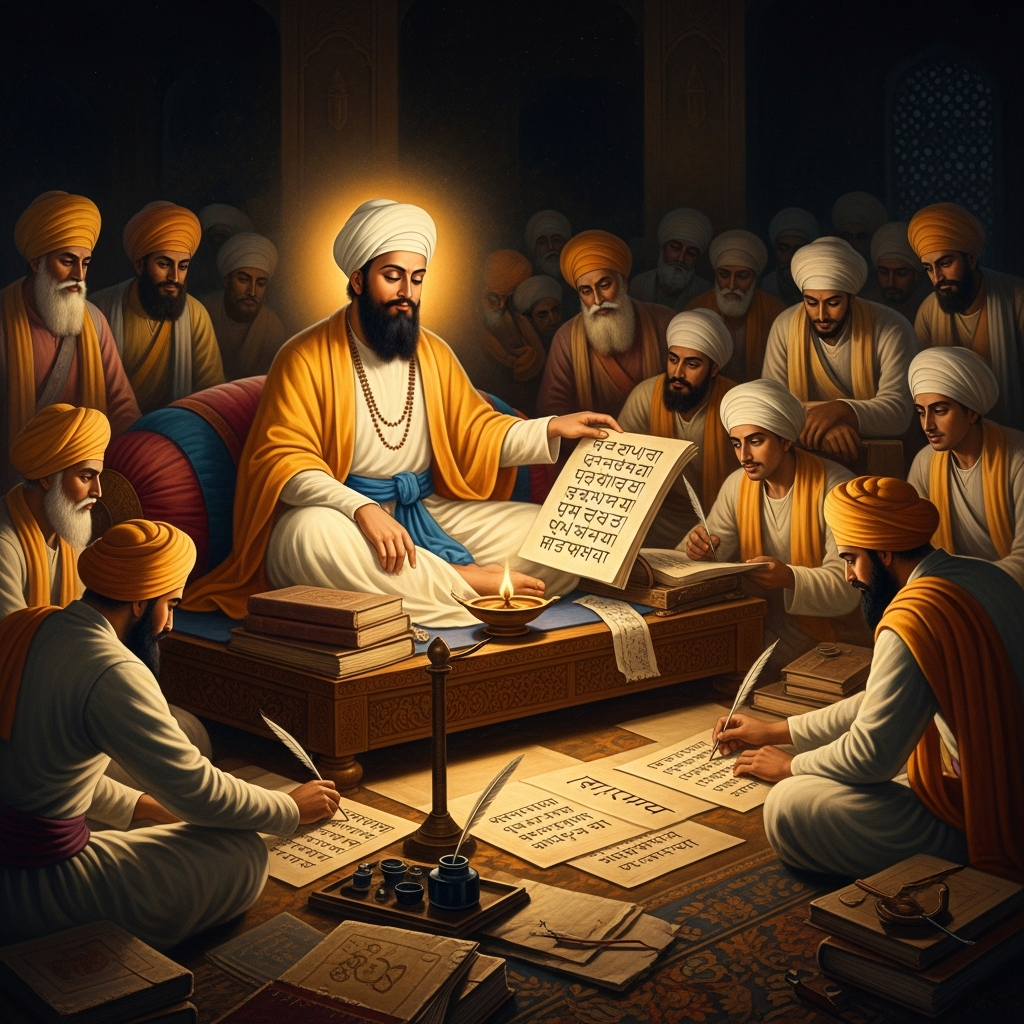
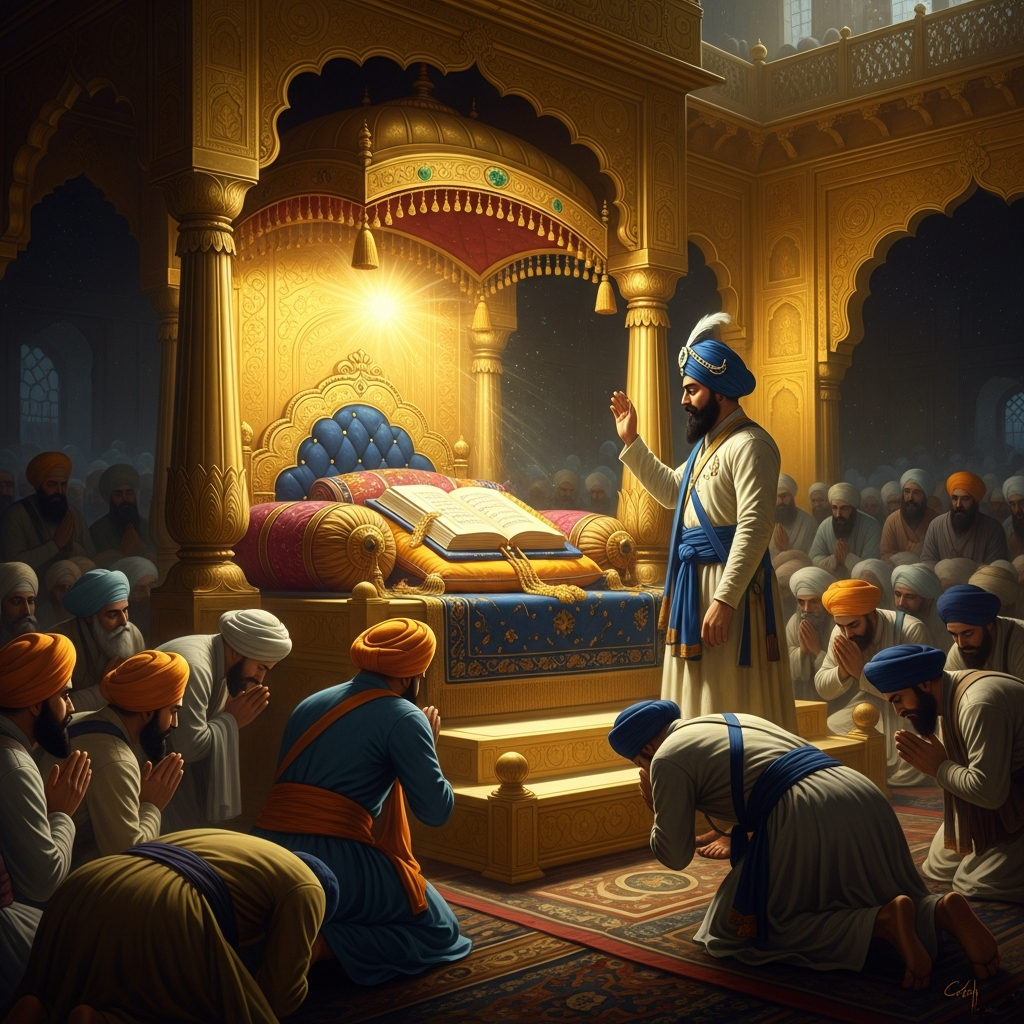
Guru Gobind Singh called together the Sangat at Nanded. He called for the Granth — the scripture that Guru Arjan had compiled in 1604, that he himself had expanded with the compositions of his father Tegh Bahadur and with additional material, producing the final version known as the Kartarpur Bir. He had the Granth placed on a throne — the same elevated seat, the same manji sahib, on which human Gurus had been placed for audiences. He circumambulated it, bowing.
He said, in the words the tradition has preserved: The Khalsa shall henceforth regard the Granth Sahib as the Guru. Wherever five Khalsa Sikhs sit with the Granth Sahib, that is the Guru’s presence.
He said: Guru Maneyo Granth. Regard the Granth as the Guru.
He said the line the tradition identifies as the formal declaration: Sab Sikhan ko hukam hai, Guru Maneyo Granth. All Sikhs are hereby commanded: regard the Granth as the Guru.
He died five days later. He was the last human Guru.
The protocols that followed from the declaration are the most elaborate treatment of a book as a living being in any religious tradition.
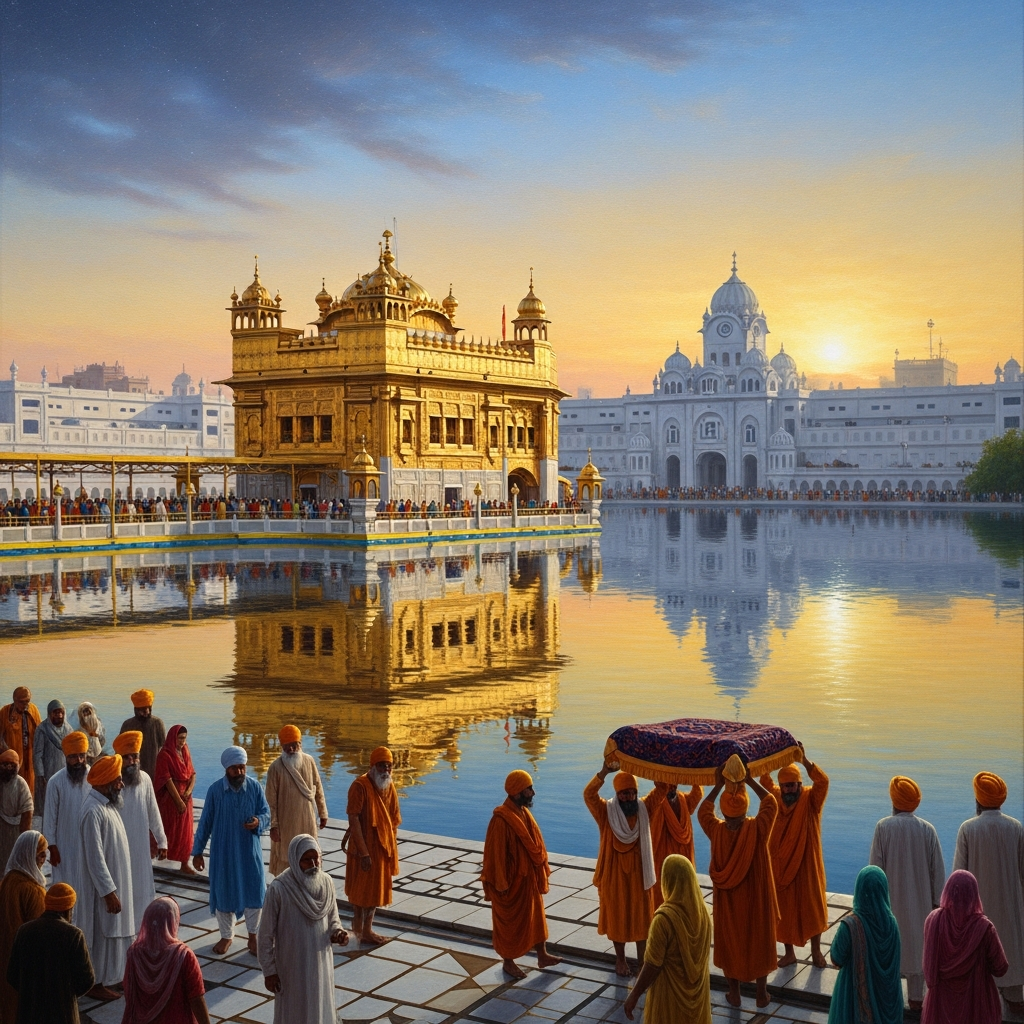
The Guru Granth Sahib is given a room of its own — the palki sahib, the palanquin room — in every gurdwara, and is ceremonially put to bed at night after being wrapped in silk and laid on a cushioned platform. It is woken in the morning with hymns. During the day it sits on a throne in the main hall, elevated above the congregation, under a chaur sahib — a whisk fan made of yak hair, carried by an attendant, continuously moved over the scripture. The chaur sahib is the traditional symbol of royalty in Punjab: you fan the king with it. The Granth is the King.
No one turns their back on the Guru Granth Sahib. No one sits with their feet pointing toward it. When it is carried from room to room, it is carried on the head, never tucked under the arm. When a copy wears out — the pages too thin, the binding too damaged — it is not thrown away or recycled. It is cremated, with the same ceremonies used for a human body.
These are not performances of reverence for a symbolic object. They are the behaviors of a community that has genuinely made the conceptual transition Gobind Singh asked for: the book is alive, and the behavior around it is the behavior of people who believe this.
The canon closed with the declaration.
No new material can be added to the Guru Granth Sahib. No subsequent teacher’s compositions are included. The Dasam Granth — the scripture attributed to Gobind Singh himself, containing his own compositions — is venerated but is not the Guru. It is secondary. The Guru is the book that Arjan compiled and Gobind Singh completed and declared eternal.
This creates a specific theological situation: the Guru is accessible to anyone who can read Gurmukhi, but the Guru’s words were fixed in 1708 and cannot be updated. The interpretive tradition — the katha and vichar, the explanatory and commentarial practice — is how the Sangat engages with the text’s application to new circumstances, but the text itself does not change. This is simultaneously the most democratic access to the sacred of any major religion — no priest stands between the Sikh and the Guru — and the most conservative, in the sense that the conversation partner cannot be questioned and cannot respond to a question in new words.
The Guru says what it says. You bring the question.
The Hazur Sahib gurdwara at Nanded — the site of the declaration and Gobind Singh’s death — is one of the five takhts, the five seats of Sikh authority. It is in Maharashtra, far from Punjab, because that is where the Tenth Guru died, and the tradition does not relocate the sacred.
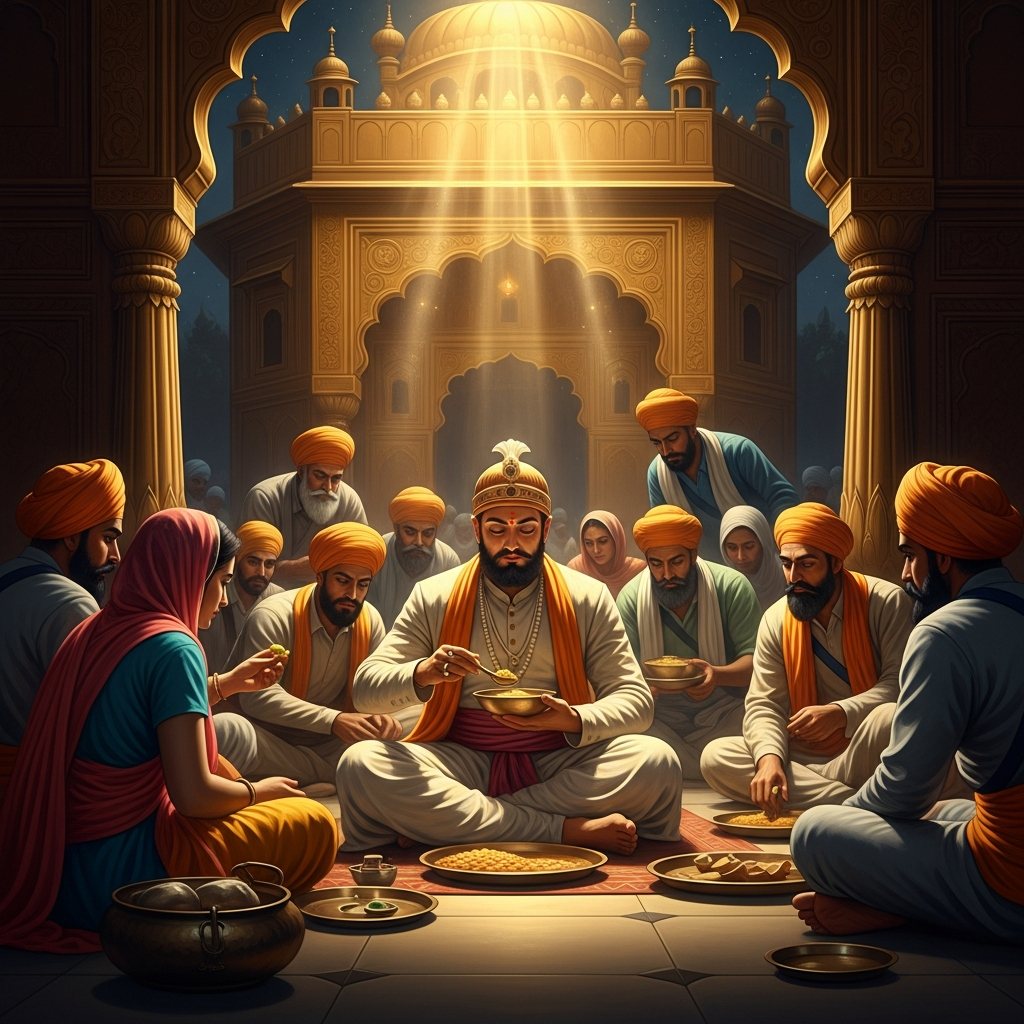
A copy of the Guru Granth Sahib — properly wrapped, enthroned, and attended — is present in every gurdwara in the world. There are gurdwaras in every continent. The langar is always running. The chaur sahib is always being moved over the text.
Guru Gobind Singh named a book his successor and the book has not left the throne since.
The line of human Gurus ended in 1708. The Guru has not been absent for a single day.
Echoes Across Traditions
Entities
- Guru Gobind Singh
- the Guru Granth Sahib
- Bhai Mani Singh (who compiled the final version)
- the Panj Pyare (Five Beloved)
- Baba Banda Singh Bahadur

Sources
- Guru Gobind Singh, *Bachittar Natak* (autobiographical verse, c. 1696)
- Guru Gobind Singh, *Sarbloh Granth* (attributed)
- W. H. McLeod, *Textual Sources for the Study of Sikhism* (Manchester, 1984)
- Pashaura Singh, *The Guru Granth Sahib: Canon, Meaning and Authority* (Oxford, 2000)
- Pashaura Singh & Louis Fenech (eds.), *The Oxford Handbook of Sikh Studies* (Oxford, 2014)
- Khushwant Singh, *A History of the Sikhs, Vol. I: 1469-1839* (Princeton, 1963), ch. 5