Camlann: The Battle That Should Not Have Been
First mentioned in the *Annales Cambriae*, c. 970 CE; developed through Malory, 1485 CE · The field of Camlann, in the west of Britain — a flat plain between two armies, the morning grass wet with autumn
Contents
The final battle of Arthurian legend begins with a snake. During the parley between Arthur and Mordred, a knight draws his sword at a snake in the grass — and two armies that had agreed to peace attack each other. Every major knight except Bedivere falls. Arthur strikes Mordred through and is struck through in return. It is the most absurd ending in all mythology: the world that was being built dissolves over a snake.
- When
- First mentioned in the *Annales Cambriae*, c. 970 CE; developed through Malory, 1485 CE
- Where
- The field of Camlann, in the west of Britain — a flat plain between two armies, the morning grass wet with autumn
The Annales Cambriae, written in Wales around 970, records it with the terseness that all annals prefer: The battle of Camlann, in which Arthur and Medraut fell. That is all. It does not say they were on opposite sides. It does not say how many fell with them. It does not say what the battle was about, where it was fought, or who was left standing when it ended.
For a century, every telling of Camlann has been an attempt to fill in what the annals left out.
What Malory built from these fragments is the ending the tradition canonized: the snake in the grass, the two armies, the father and son facing each other across a field neither of them wanted to be on.
The situation before the battle is almost hopeful.
The events that led to it — Lancelot’s flight, the siege of Joyous Gard, the war in France, Gawain’s wounding and death on the beach in Britain — have exhausted everyone. Mordred holds Britain. Arthur has landed on the coast to take it back. They have fought twice, at the beach and in the field, and both sides have taken losses no victory can compensate.
A parley is arranged. Arthur and Mordred will meet in the middle ground between the two armies. Terms will be discussed. Both sides have agreed, with the sincerity of men who are tired of their own purpose, that a settlement is preferable to another afternoon of killing.
Each army has been given the same instruction by its commanders: if you see a sword drawn, attack immediately. The instruction is a precaution, a defense against treachery, the standard provision for a parley in a world where treachery is routine. It makes sense. Any military officer of the period would have given the same order.
Arthur and Mordred stand in the middle ground.
They begin to talk.
The snake is a detail Malory preserves because it is too specific to be invented. It has the texture of something that actually happened or that someone very much wanted to believe actually happened — the kind of absurd pivot that real catastrophes sometimes hinge on, the kind of detail that a later generation would suppress in favor of something more dignified if they were making it up.
A knight in one of the armies is bitten or startled by an adder — the sources vary on whether the snake struck or was only seen — and the knight draws his sword reflexively, without thought, on an animal that presents no threat to anyone but himself.
The other army sees the blade.
The instruction kicks in before anyone can think. The horns blow. The cavalry moves. The foot soldiers close. Two armies that had agreed to peace are at each other before either commander can ride back from the middle ground to countermand the order, and by the time they do the battle has its own momentum and countermanding is not possible.
The battle at Camlann lasts most of the day.
When it is over, almost everyone is dead.
Malory is meticulous about this in the way he is meticulous about the things that matter to him. He names the living: Bedivere, and Lucan who will die shortly of his wounds from the effort of helping Arthur to safety. Those are the survivors. Everyone else — the Round Table as it was and as it had been, the knights who made the thing that the legend was built to describe — is in the grass.
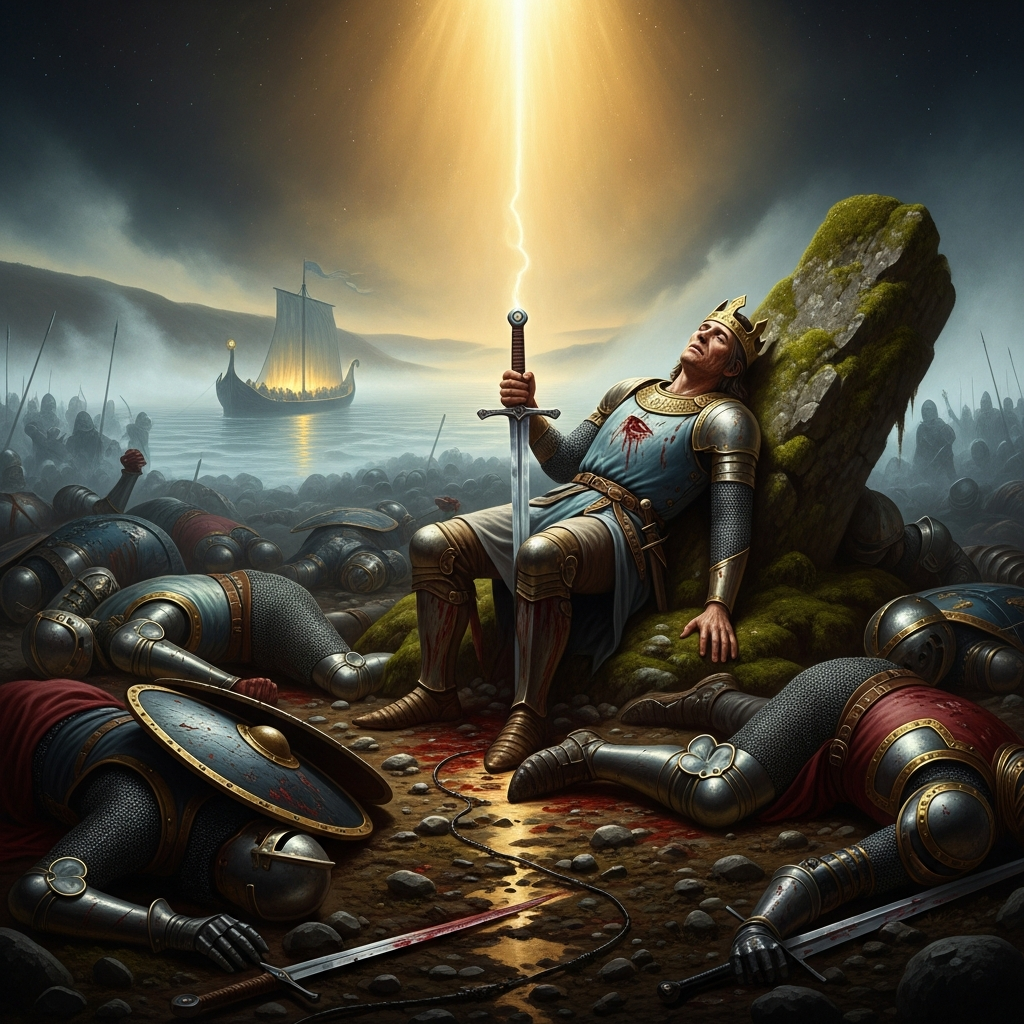
Arthur finds Mordred.
He finds him among the dead and the wounded, somewhere on the field, propped against something. The exact circumstance varies. The essential fact does not: Arthur drives his spear through Mordred and Mordred, dying, reaches up with the last of what he has and strikes Arthur in the head. Both men fall.
The blow that lands on Arthur is described in Malory as going through the helmet and into the skull, and Malory is not in the habit of understating injuries. The king who had been building the world for thirty years — or however many years the tradition assigns, the sources disagree on this too — lies on the field with a wound that no surgeon of the period would have promised to treat.
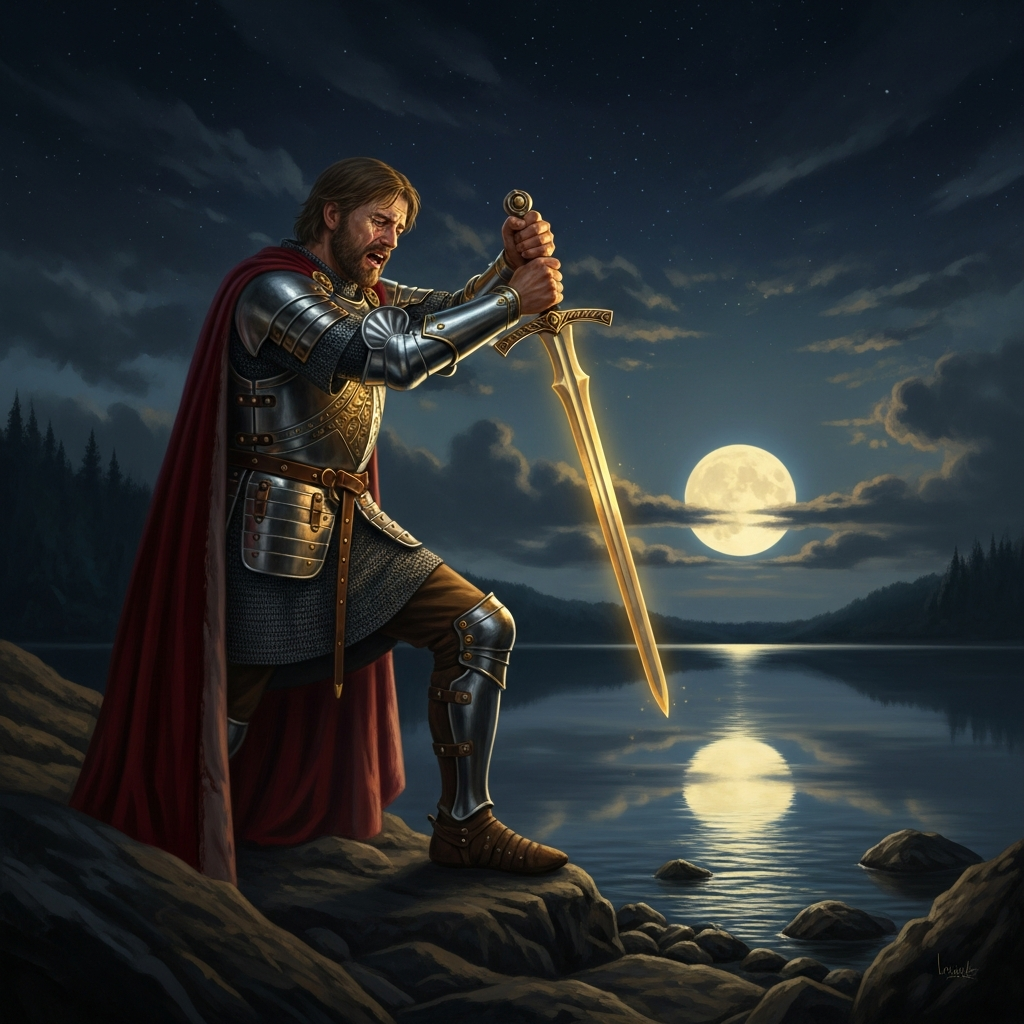
What Arthur says to Bedivere on the field is worth recording: I have taken my death’s wound. Take me to the water.
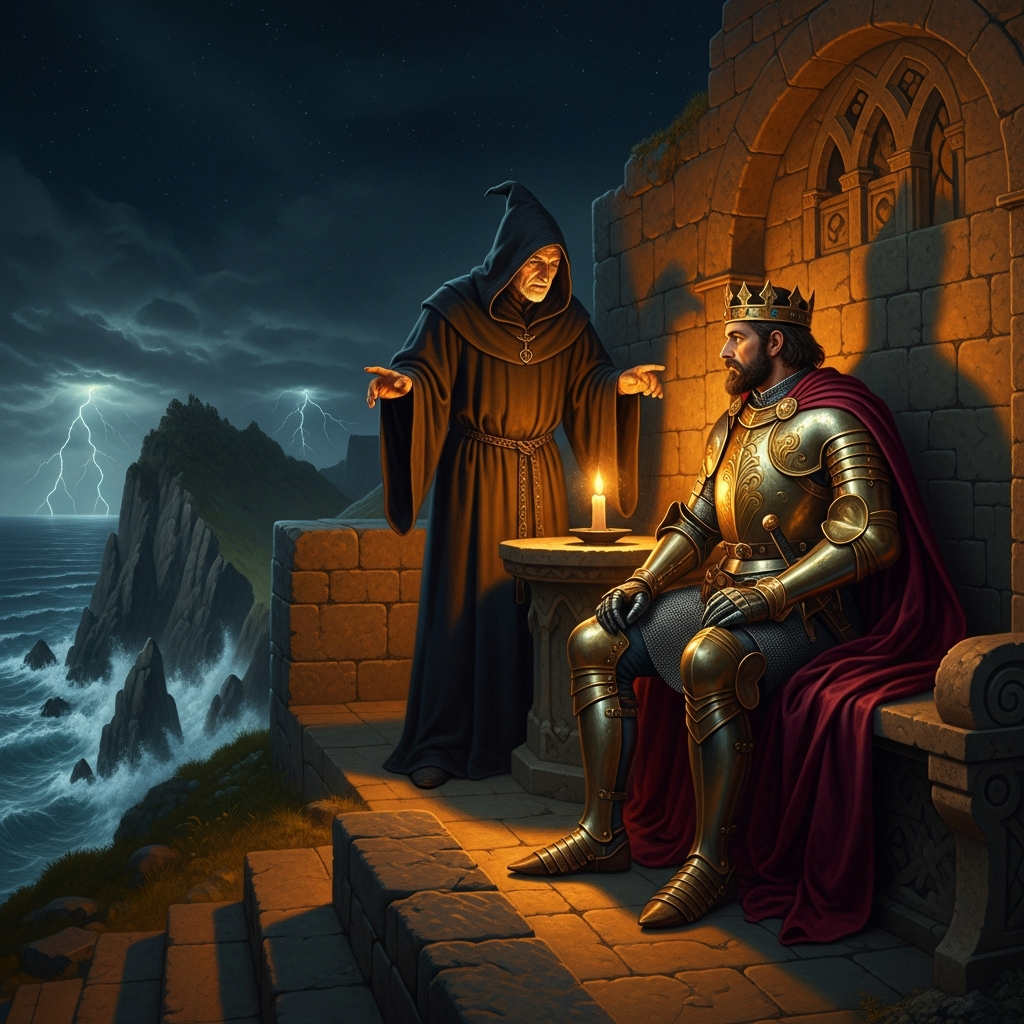
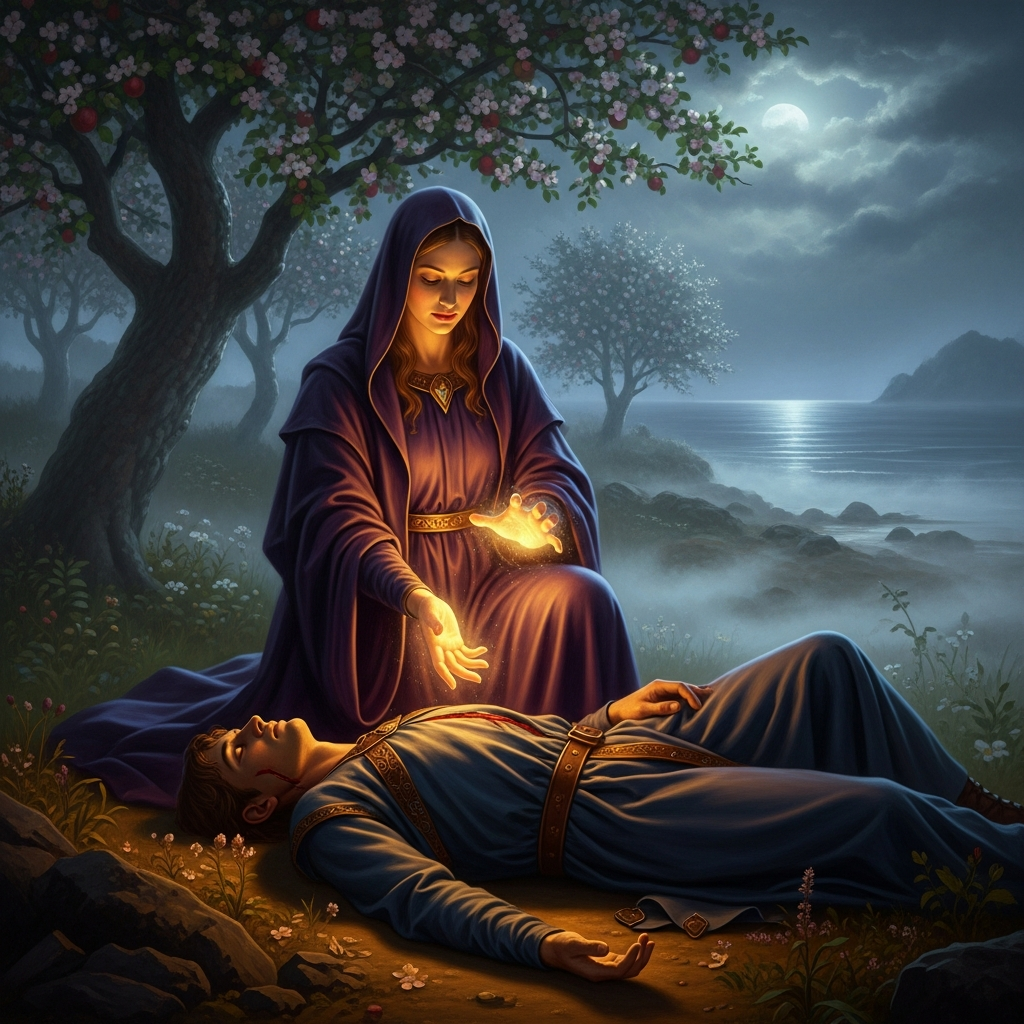
He does not despair. He does not rage. He does not curse Mordred or the snake or the knight who drew his sword. He makes a logistical request, calm and specific — take me to the water — because he knows where the barge will be, because he was told once, because whatever Merlin showed him or the Lady of the Lake implied, he has known for a long time that the ending was the island.
The historiographers who attempt to find a historical Camlann locate it in the late fifth or early sixth century — 537 is the date the Annales suggest — in a Britain that was fragmenting in the aftermath of Roman withdrawal, full of local warlords and contested territories and alliances that lasted as long as convenience and no longer.
Whether there was a real battle there, with a real commander whose memory the legend preserved, is a question that produces passionate professional disagreement and is finally unanswerable.
What is answerable is why the legend chose to end this way.
It could have chosen a different ending. The material was available: Mordred could have been a deliberate traitor, the battle a straightforward reckoning between good and evil, the ending earned in a way that felt proportionate to the beginning. The tradition had all of this at its disposal and chose instead the snake — chose the accidental, the mechanical, the reflexive response of frightened soldiers following an order that made perfect sense in every context but this one.
The choice is a statement about how great things end.
Not through the failure of the dream but through the failure of the moment. The Round Table’s ethics held for decades against real opposition. They failed in the second it took a spooked knight to pull a sword from a scabbard on a morning in autumn, and the failure was nobody’s fault in the sense that the word is usually used, and that is exactly what the tradition wants you to sit with.
The great ages end over nothing.
And the question the tradition leaves open, written into the rex quondam, rex futurus carved on the tomb, is whether nothing is ever really final — whether what was built there is sleeping somewhere, waiting for the conditions that would allow it to try again.
Echoes Across Traditions
Entities


Sources
- *Annales Cambriae* (Annals of Wales), c. 970 CE
- Geoffrey of Monmouth, *Historia Regum Britanniae*, c. 1138 CE
- Sir Thomas Malory, *Le Morte d'Arthur*, Book XXI, 1485 CE
- John Morris, *The Age of Arthur* (Weidenfeld and Nicolson, 1973)
- N.J. Higham, *King Arthur: Myth-Making and History* (Routledge, 2002)
- Guy Halsall, *Worlds of Arthur: Facts and Fictions of the Dark Ages* (Oxford, 2013)