Contents
A giantess marches into Asgard in full armor demanding compensation for her father's death. The gods offer her a husband — but she must choose him by his feet alone, with the rest hidden behind a curtain. She picks the most beautiful pair, certain they belong to Baldr. They belong to Njord, god of the sea, and the marriage cannot survive the disagreement about where to live.
- When
- c. 1220 CE (Prose Edda recorded; mythic time)
- Where
- Asgard — the great hall where the gods assemble; Thrymheim, Skadi's mountain home; Nóatún, Njord's harbor by the sea
It begins with a stolen apple.
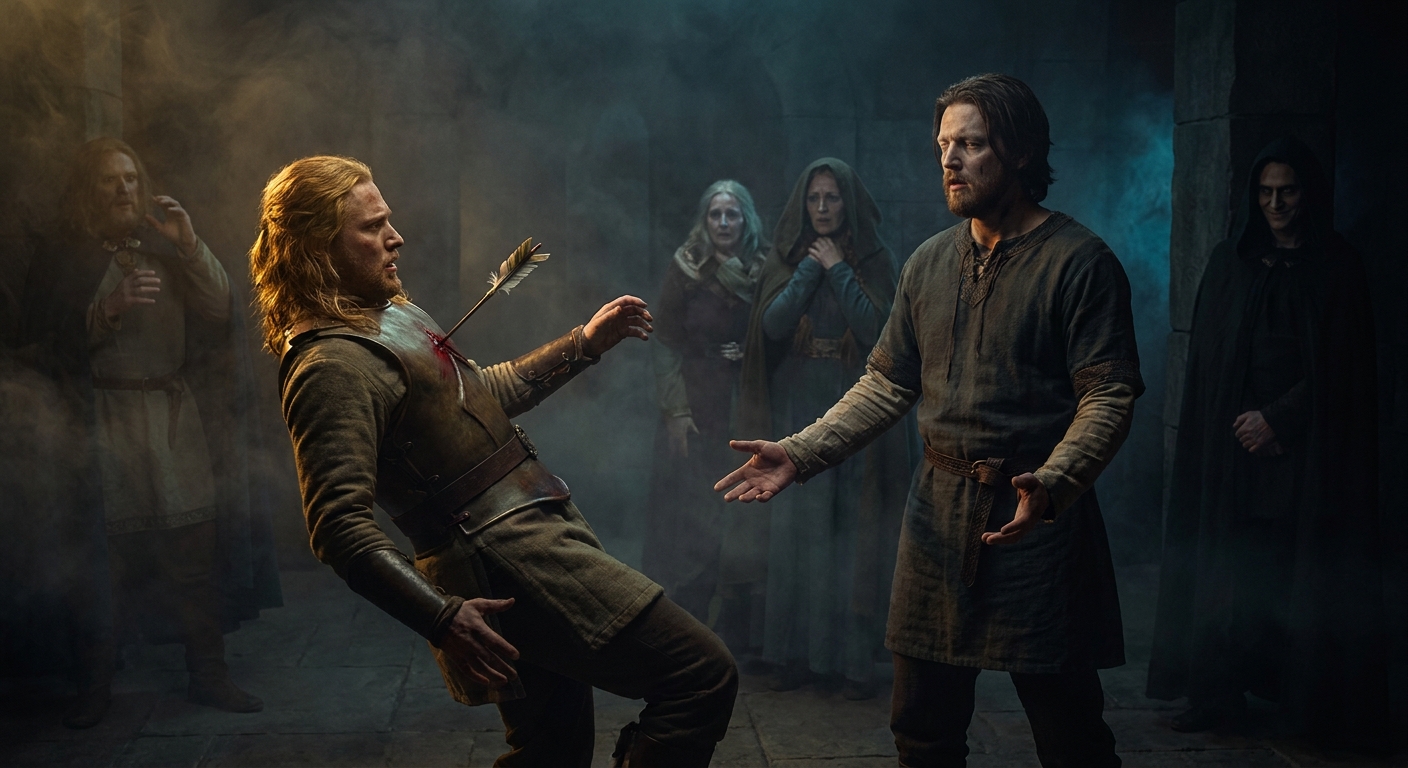
Idun, who keeps the golden apples that hold back the gods’ aging, has been kidnapped by the giant Thjazi — a story for another day — and the gods, panicking at the first wrinkles to crease their faces, force Loki to bring her back. Loki does, in eagle-feathered haste, and Thjazi gives chase. The giant flies after them across the sky and is shot down at the gates of Asgard. He falls into the courtyard and burns. The gods, relieved, gather his bones and put them aside.
That should be the end of it.
It is not. Thjazi has a daughter, and her name is Skadi, and she lives alone in a mountain hall called Thrymheim where the wolves howl and the snow lasts the year. When the news of her father’s death reaches her, she does not weep. She puts on her father’s mail. She takes her spear. She straps on her skis and her bow and she walks down the long glaciers and out across the high passes and into Asgard, and she stands in the doorway of the gods’ great hall and demands weregild.
The gods know the law. A death must be paid for. They offer gold; she refuses. They offer treasures; she refuses. She wants something stranger.
She wants a husband. From among them. And she wants to be made to laugh — because, she says, she has not laughed since her father died, and she does not believe she ever will again, and she wants the gods to prove that joy is still possible in a world that took him.
The gods confer.
A marriage is dangerous; a giantess in the family is dangerous. But the alternative is war, and Skadi has not come alone — behind her, in the high country, are kin. They agree. But they impose one condition of their own: she may have her pick of the gods, but she must choose him by his feet alone. The rest of him will be hidden behind a curtain. The marriage will be made by what walks beneath.
She agrees, because she has already decided.
She has decided that she will choose Baldr — Baldr the beautiful, Baldr the shining, the most beloved of all the Aesir, the one she has heard of even in her mountain hall. She is certain his feet will be the most beautiful feet in the line.
The curtain is drawn. The gods stand behind it in a row, their feet visible beneath the hem. Skadi walks down the line slowly. She studies each pair. There is one pair so clean and well-shaped, so perfectly arched, that no other foot in the line compares. She points.
The curtain is pulled back.
It is not Baldr.
It is Njord — god of the sea, of the harbors, of the ships and the winds that carry them. His feet are beautiful because he has spent his life in salt water and on the smoothing sand. He looks at her and bows. Skadi looks at him and accepts; she will not break her word. The marriage is sealed.
Now the laughter.
The gods try. They tell jokes; Skadi does not smile. They wrestle; she does not smile. Finally, Loki — who has caused more trouble in this whole affair than anyone — takes a length of rope. He ties one end of the rope to the beard of a goat. He ties the other end of the rope around his own testicles. Then he and the goat begin to pull against each other, both squealing, both yanking back and forth across the courtyard, until Loki collapses in agony into Skadi’s lap.
She laughs.
The settlement is complete. To finish it, Odin takes Thjazi’s eyes from the bag of bones and throws them into the night sky, where they become two stars that shine forever — a father turned into light, watching his daughter from above.
The marriage begins.
It does not last.
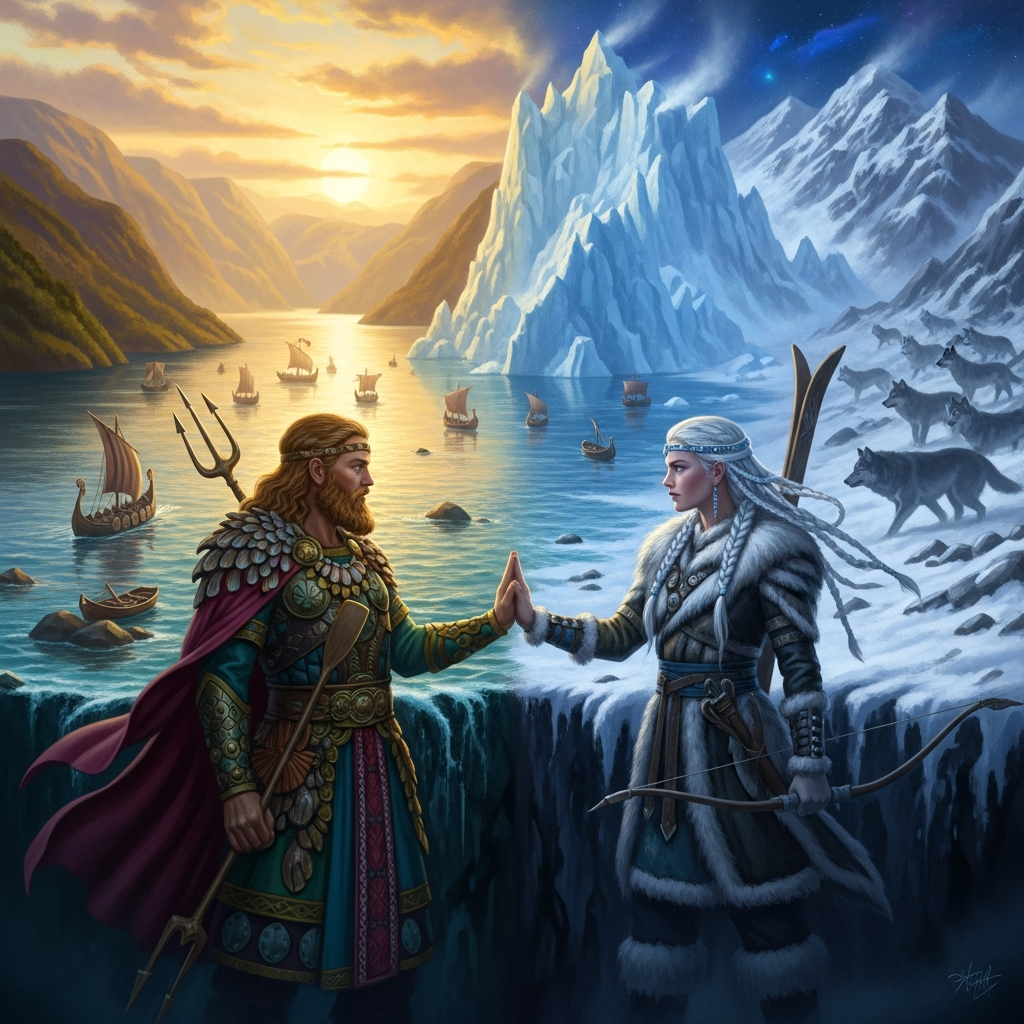
Skadi loves the mountains. She loves the cold, the silence, the wolves, the long winter nights. Njord loves the sea. He loves the cry of gulls, the slap of waves, the warm wind off the harbor.
They try compromise. They spend nine nights in Thrymheim — nine nights in the high country, where the wind howls and the wolves sing and Njord cannot sleep for the noise. Then nine nights at Nóatún by the sea, where the gulls scream and the surf pounds and Skadi cannot sleep for the noise.
After one cycle, they give up.
Njord goes back to the harbor. Skadi goes back to the mountains. They part without bitterness. He keeps his ships; she straps on her skis and her bow and goes hunting, and she is the patron, ever after, of those who travel the snow on bone runners with arrows strapped to their backs. Each is whole again, in the place where they belong.
The myth ends without grief. It is one of the kindest stories the Eddas tell — a marriage that simply could not be, parted with grace. The gods do not need every story to end in love. Sometimes love is choosing to live in your own weather, even after you have walked the curtain to the other side.
Scenes
Skadi storms into Asgard in full mail and helmet, spear in hand, demanding weregild for her father Thjazi's death
Behind a long woven curtain, the gods stand in a row with only their feet visible
Loki ties one end of a rope to a goat and the other end to himself, then pulls and squeals until even Skadi cannot keep from laughing — the final condition of her settlement fulfilled
Echoes Across Traditions
Entities


Sources
- Snorri Sturluson, *Prose Edda* (Skáldskaparmál, c. 1220 CE)
- *Poetic Edda* — Grímnismál stanza 11
- Carolyne Larrington (trans.), *The Poetic Edda* (1996)
- Anthony Faulkes (trans.), *Edda* (1995)