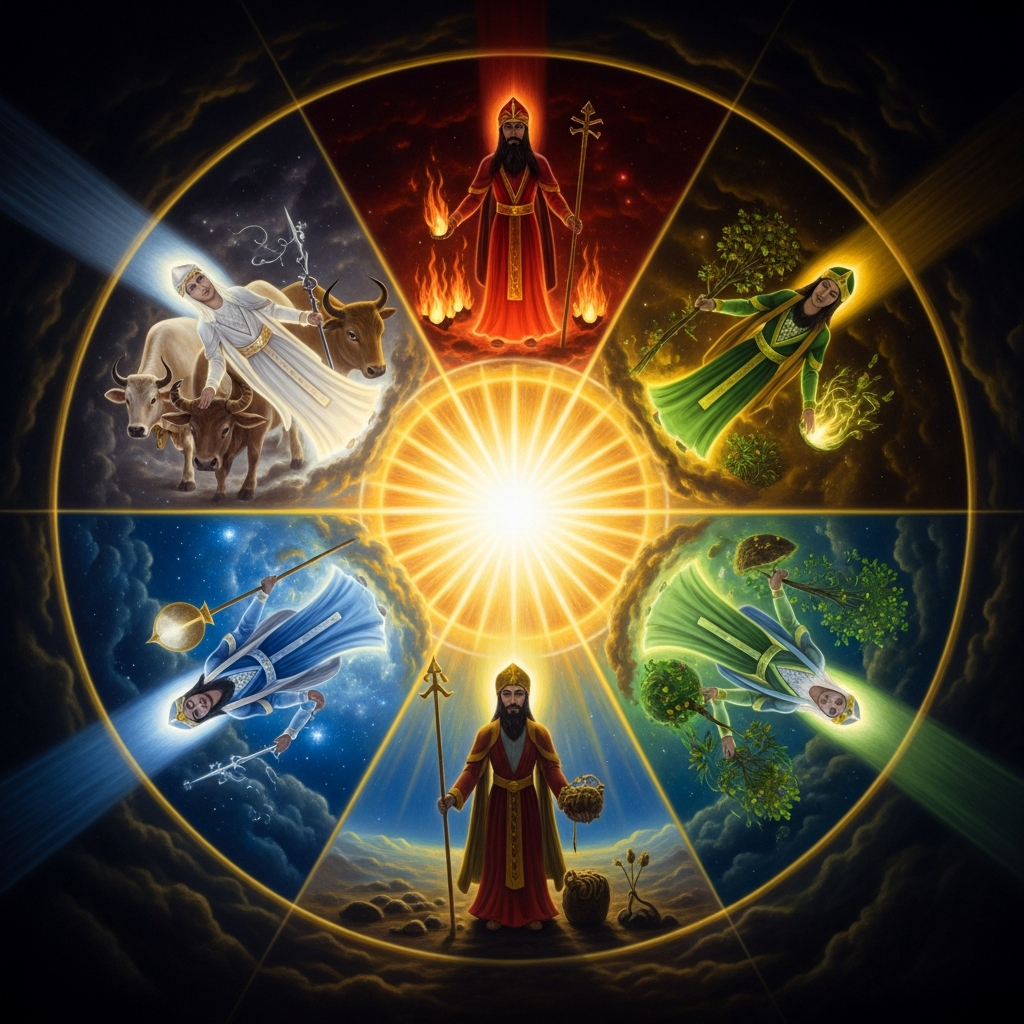
Ngai Lives on the Top of Mount Kenya
The beginning of the Kikuyu people — when Ngai called the first couple to the mountain · Mount Kenya (Kirinyaga, 'the mountain of brightness') — the highest peak in Kenya, perpetually snow-capped
Contents
The supreme creator-god of the Kikuyu people lives on the snow peaks of Mount Kenya and descends occasionally to inspect the earth — when the mountain is clear, Ngai is present; when clouds cover the peak, he has returned to the sky.
- When
- The beginning of the Kikuyu people — when Ngai called the first couple to the mountain
- Where
- Mount Kenya (Kirinyaga, 'the mountain of brightness') — the highest peak in Kenya, perpetually snow-capped
The mountain is the house of God.
This is not a figure of speech. The Kikuyu do not say the mountain is like a house of God, or represents the divine, or serves as a symbol pointing to something invisible. They say Ngai lives there — specifically, on the snow peaks of Kirinyaga, which Europeans named Mount Kenya, the highest point in the country, permanently capped with glaciers that look from the plains below like a crown of ice on the mountain’s dark head.
Every Kikuyu house is built with its entrance facing the mountain. When you pray, you turn toward the mountain. When you eat, the mountain is in the direction of the food. When you lay out the dead for burial, their faces are turned toward Kirinyaga. The mountain is the organizing principle of sacred space in the Kikuyu world — every domestic and ritual orientation derives from its location.
When the peak is clear, Ngai is at home. When clouds shroud the summit, he is visiting the sky. These are not metaphors. They are descriptions of the deity’s known movements.
Ngai is the owner of everything.
Ngai means, in Kikuyu, both God and rain. This is not two different meanings of the same word but one meaning: the divine is the rain, the power that makes the land fertile, the force that determines whether the highland farms of central Kenya produce enough to eat. For an agricultural people living on the equatorial highlands, rain is not a meteorological event — it is the regular expression of divine generosity or divine concern.
When Ngai withholds rain, the community must examine itself: what has been done to offend? What obligation has been neglected? What relationship requires repair? The drought is a diagnostic. The ritual response to drought — which involves the Kikuyu elders going to the sacred fig tree at Mukurwe wa Nyagathanga, the founding tree of the Kikuyu people, and offering sacrifice — is a community-wide examination of conscience and a renegotiation of the divine covenant.
Ngai owns the land. The Kikuyu have it on loan. The terms of the loan require right conduct, proper sacrifice, the maintenance of the covenant with the supreme being who gave them Kirinyaga as their address.
The sacred fig tree is the meeting point.
When Ngai descended from Kirinyaga to speak directly to the first humans, he descended to a fig tree — the mugumo tree — which became the Kikuyu’s sacred tree, the species planted at every important gathering and shrine, the tree under which elders judge and priests pray and the community assembles for its most important decisions.
The fig tree is not merely symbolic of the divine encounter. It is the continuing point of divine-human contact. The mugumo at Mukurwe wa Nyagathanga is the specific tree at which Ngai gave Gikuyu and Mumbi their nine daughters and established the Kikuyu people. Other mugumo trees throughout Kikuyuland are extensions of that founding encounter, places where the divine presence is thickened, where communication is possible, where the ordinary air carries something extra.
When the British colonizers cut down sacred mugumo trees — sometimes deliberately, to demonstrate the impotence of Kikuyu religion — the Kikuyu understood what was being attacked. Not merely a tree. Not merely a symbol. The actual point of contact between the human world and the mountain-god.
The trees grew back. The mountain was still there.
Jomo Kenyatta was named for this.
The man who would lead Kenya to independence in 1963 was born Kamau wa Ngengi, but took the name Jomo Kenyatta. Kenyatta derives from kinyata, a Maasai word for a beaded belt, but the association with Kenya, the colonial name derived from Kirinyaga, was deliberate. His foundational text, Facing Mount Kenya, written in 1938 while studying anthropology under Bronisław Malinowski in London, is simultaneously an ethnographic study of Kikuyu life and a political manifesto: the knowledge of who the Kikuyu are, encoded in the religious system centered on the mountain, is the foundation of the argument that the Kikuyu belong to this land.
To face Mount Kenya is to know where you come from and where you stand.
Ngai has always been there, at the top, watching the highlands he gave the Kikuyu people, through the clouds and clear days both.
The mountain still faces you.
Face it back.
Echoes Across Traditions
Entities
- Ngai
- Gikuyu
- Mumbi
- The fig tree
Sources
- Kenyatta, Jomo, *Facing Mount Kenya: The Tribal Life of the Gikuyu* (Secker and Warburg, 1938)
- Muriuki, Godfrey, *A History of the Kikuyu, 1500-1900* (Oxford University Press, 1974)
- Mbiti, John S., *African Religions and Philosophy* (Heinemann, 1969)
- Cagnolo, C., *The Akikuyu* (Catholic Mission Press, 1933)