The Sun Dance: Pain as Prayer
Annual ceremony — traditional Lakota practice documented through the 19th century, suppressed 1883–1934, revived · The Sun Dance grounds — a sacred circle of arbor poles around the central cottonwood tree, Great Plains
Contents
A warrior pierces his chest, ties the cord to the sacred tree, and dances in the sun for three days until the flesh tears free — offering his body as the only thing that is entirely his own to give.
- When
- Annual ceremony — traditional Lakota practice documented through the 19th century, suppressed 1883–1934, revived
- Where
- The Sun Dance grounds — a sacred circle of arbor poles around the central cottonwood tree, Great Plains
The cottonwood tree is chosen weeks before the dance begins.
It is chosen carefully — a particular tree, tall and forked in a specific way, standing in a place where the earth is right. When it is found, it is treated as a sacred being, not a piece of wood. Songs are sung to it. It is asked for its life. When it is cut, it is caught before it touches the ground, because if a sacred thing falls to the earth unprepared the ceremony cannot proceed. The tree is carried to the dance ground and raised at the center of the arbor, and it becomes the axis of the world for those four days: the pole that joins sky to earth, the place where the prayer travels up.
The dancers have been preparing for a year.
They enter the arbor at dawn on the first day. They have fasted since the evening before. They will not eat or drink for the duration of the dance, though the ceremony allows small amounts of water in some bands’ traditions. They wear sage wreaths on their heads and wrists, and their bodies are painted — red for the living energy, blue for the sky, yellow for the sun.
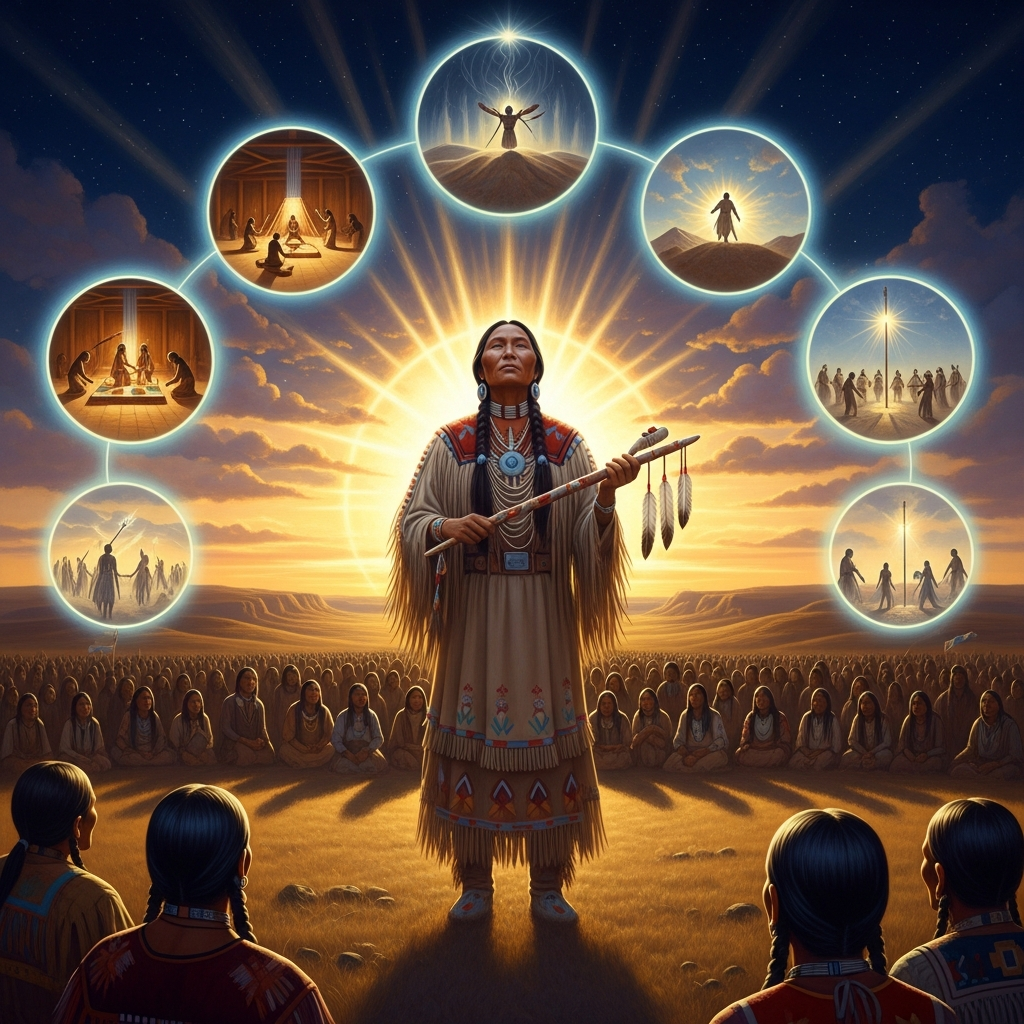
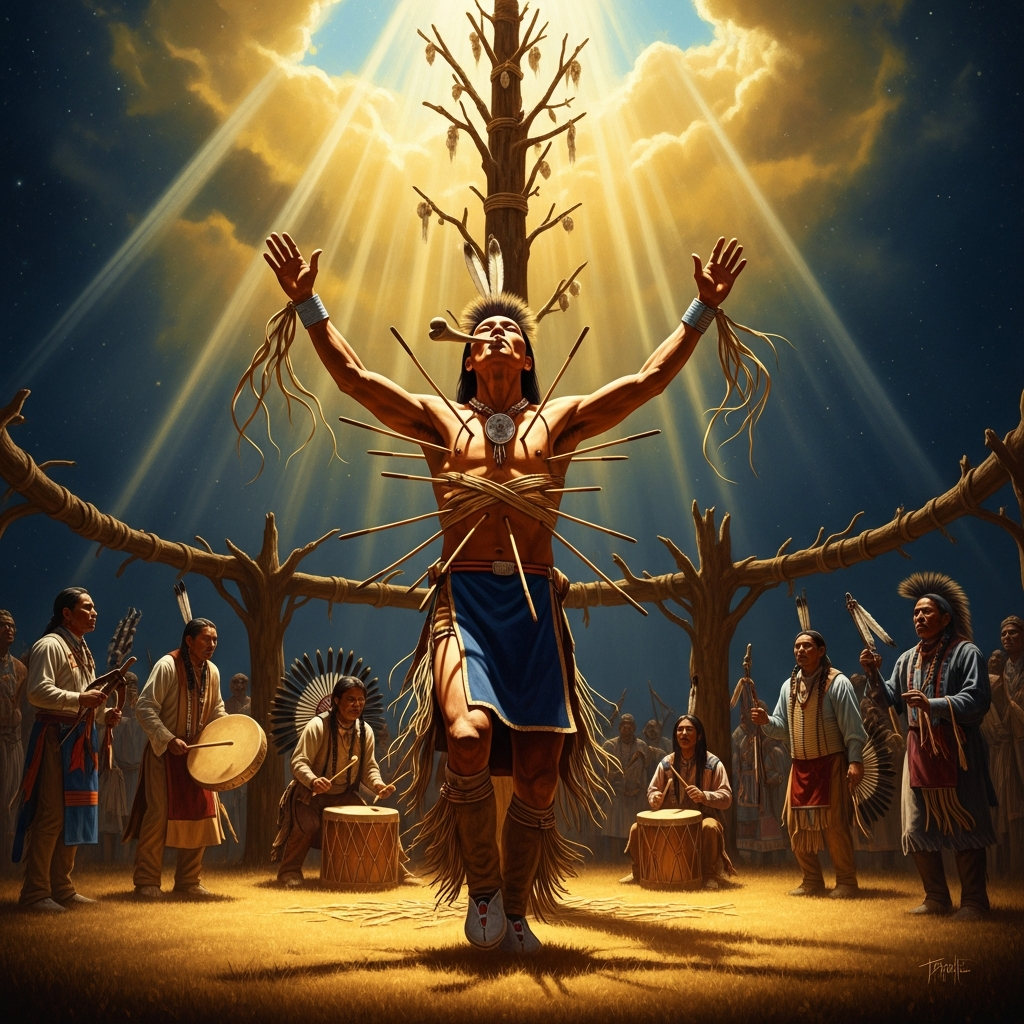
The intercessor — the ceremony leader who stands between the human and the sacred — speaks the prayers and directs the piercing. An elder takes a fold of skin from the dancer’s chest, pinches it between his fingers, and inserts two wooden skewers through the skin. Cords tied to the central cottonwood tree are attached to the skewers. The dancer leans back until the cords are taut and the skewers are pulling, and then he dances.
He dances toward the sun and away from the sun, blowing a bone whistle in rhythm with the drum, keeping his eyes on the light. He dances until the sweat comes and the pain goes past pain into something else — a clarity that people who have done it describe differently. Some say they see visions at the moment of piercing. Some say the visions come later, in the leaning back. Some say the vision is not a seeing but a knowing, a direct transmission from Wakan Tanka that cannot be put into English.
He dances until the skewers tear free.
This is the gift given and received.
The dancer has offered the only thing he owns absolutely, the only thing that cannot be loaned or traded or legislated — his own body, his own suffering, his own willingness to endure what is hard on behalf of the people who are watching. Every dancer in the arbor dances for someone else. For the grandmother who is sick. For the child who needs protection. For the nation whose land is gone. The pain is not self-punishment; it is currency in a system of sacred exchange where the most valuable thing is the most personal thing.
The watchers around the arbor sing. The drum does not stop.
When the flesh tears, the dancer does not cry out. He raises his arms. Some dancers report that the moment of tearing is not the hardest moment — the hardest moment is the first day, the moment before the skewers go in, when the mind knows what is coming and the body is still intact. After that, something has been decided that cannot be undecided, and the dancing is simply the fulfillment of a commitment made to Wakan Tanka and to the people who are watching.
The US government banned the ceremony in 1883. It was practiced in secret for fifty years on remote reservations, carried by the people who knew it would be needed again. When the American Indian Religious Freedom Act restored the right to ceremony in 1978, the Sun Dance came back immediately, as if it had only been waiting.
The cottonwood tree at the center had never stopped growing.
Echoes Across Traditions
Entities
- Wakan Tanka (the Great Mystery)
- the intercessor (ceremony leader)
- the sun dancers
- the sacred cottonwood tree
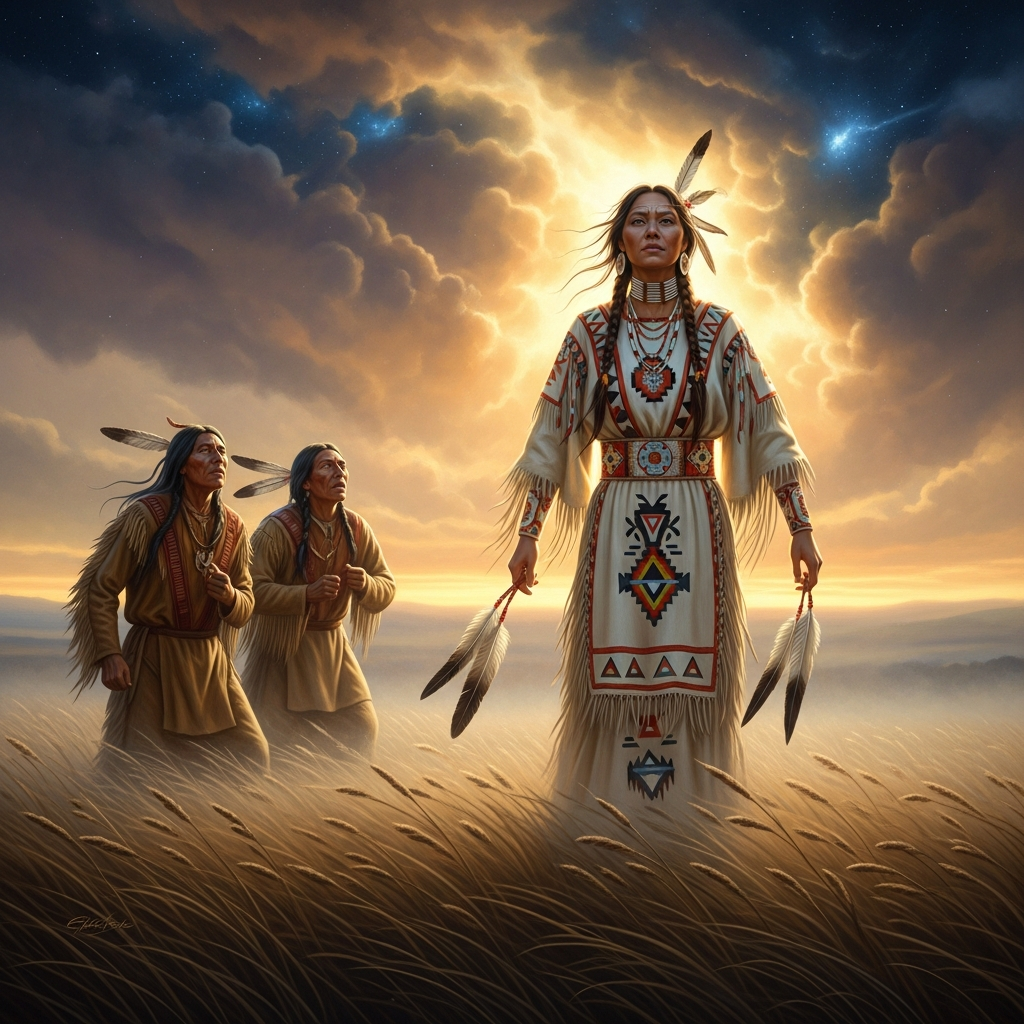
- White Buffalo Calf Woman

Sources
- Black Elk, *The Sacred Pipe*, recorded by Joseph Epes Brown (University of Oklahoma Press, 1953)
- Joseph G. Jorgensen, *The Sun Dance Religion* (University of Chicago Press, 1972)
- Clyde Holler, *Black Elk's Religion: The Sun Dance and Lakota Catholicism* (Syracuse University Press, 1995)
- Vine Deloria Jr. and Clifford Lytle, *American Indians, American Justice* (University of Texas Press, 1983)