The Okipa: Four Days at the Center Pole
Annual summer ceremony — practiced until the smallpox epidemic of 1837 nearly destroyed the Mandan people; revived · The Mandan earth-lodge villages on the upper Missouri River — present-day North Dakota
Contents
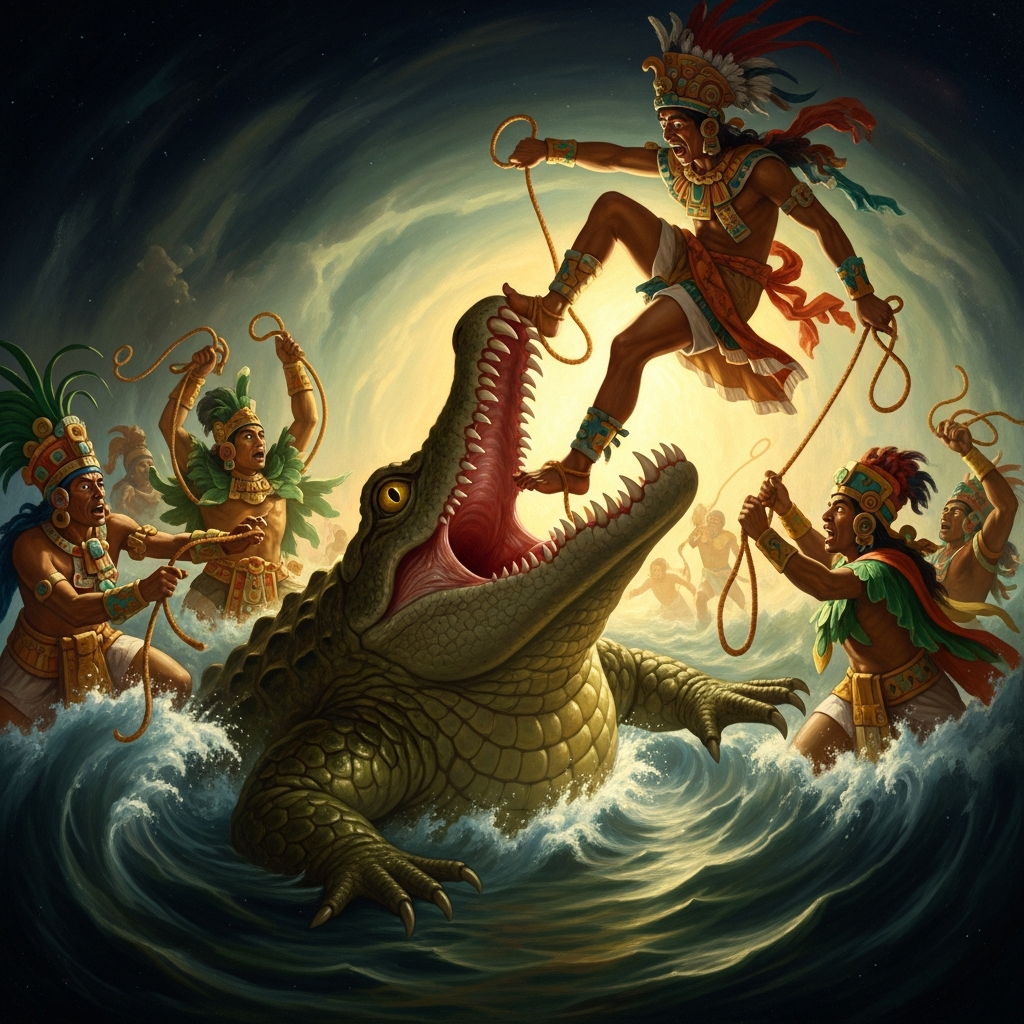
Every summer on the upper Missouri River, the Mandan people reenacted the creation of the world in four days of ceremony — the flooding, the rescue, the dances of the animals — and young men hung from the center pole to make the buffalo come.
- When
- Annual summer ceremony — practiced until the smallpox epidemic of 1837 nearly destroyed the Mandan people; revived
- Where
- The Mandan earth-lodge villages on the upper Missouri River — present-day North Dakota
On the first day, a man appears at the gate of the village.
He is painted entirely white — his face, his body, his arms — and he carries a large cedar post. He is Lone Man, the co-creator of the world, the being who was present at the beginning when the water covered everything and the animals were the only living things. His appearance signals the beginning of the Okipa, and the whole village knows what four days of ceremony are beginning.
Lone Man’s cedar post is planted in the center of the ceremonial plaza. It is the center of the world.
The first day: the creation.
Lone Man tells the story as he walks through the village — the story of how the world was made, how the water covered everything, how the animals dived to find the earth, how the land was formed. The people who have heard this story all their lives hear it again as if for the first time, because the ceremony makes the story present rather than past. This is not historical narrative; this is the creation happening again.
The second day: the animals come.
Men in elaborate costumes representing the buffalo, the eagle, the bear, the beaver, the wolves — every animal that sustains the people — dance through the village for hours. They are not humans performing animals. They are the animals’ own presence manifesting through the humans who wear their forms. The ceremony is the invitation; the animals have accepted. The buffalo dances of the Okipa were understood as directly connected to the abundance of the hunt: when the buffalo danced correctly in the ceremony, the buffalo herds came.
The third day: the ordeal.
Young men who have prepared for this moment come forward. They are pierced through the skin of their backs and chests with wooden skewers, and cords connected to the center pole are attached to the skewers. They are lifted from the ground, hanging from the pole by their own flesh, turning slowly as they are raised.
They hang until they lose consciousness or until the flesh tears free.
Their sacrifice is the gift that brings the buffalo — the same logic as the Sun Dance, the same theology of the body as the only thing entirely one’s own, offered to the powers that sustain the people’s life.
The fourth day: the resolution.
The disruptive figure — the Foolish One, the entity of chaos who appears on the third day and threatens to destroy the ceremony — is driven from the village. This expulsion is theatrical and sacred simultaneously: the community comes together to drive out the force of disorder, to assert collectively that the world is worth maintaining, that the ceremony will be completed, that the buffalo will come.
Then the ceremony ends and the feasting begins.
In 1837, smallpox moved through the Mandan villages and killed roughly 90% of the people. An estimated 1,800 people reduced to 100 to 150 survivors. The Okipa ceremony, which required many participants and a functioning social structure, could not be fully performed. The knowledge holders who carried the specific ceremonies were nearly all gone.
Nearly all.
The ceremony was not completely lost. What remained was rebuilt. The Mandan people, absorbed into the Three Affiliated Tribes at Fort Berthold, carried the memory forward, and in the twentieth century the Okipa began to be revived. The center pole is still planted.
Lone Man still appears at the gate, white-painted, carrying his cedar post.
Echoes Across Traditions
Entities
- Lone Man (Numak-Mahana)
- the Foolish One (the disruptive force)
- the bull dancers
- the young men who hung from the center pole
- O-kee-hee-de (the evil spirit)
Sources
- George Catlin, *O-Kee-Pa: A Religious Ceremony and Other Customs of the Mandans* (Lippincott, 1867)
- Alfred Bowers, *Mandan Social and Ceremonial Organization* (University of Chicago Press, 1950)
- W. Raymond Wood and Thomas Thiessen, *Early Fur Trade on the Northern Plains* (University of Oklahoma Press, 1985)