Contents
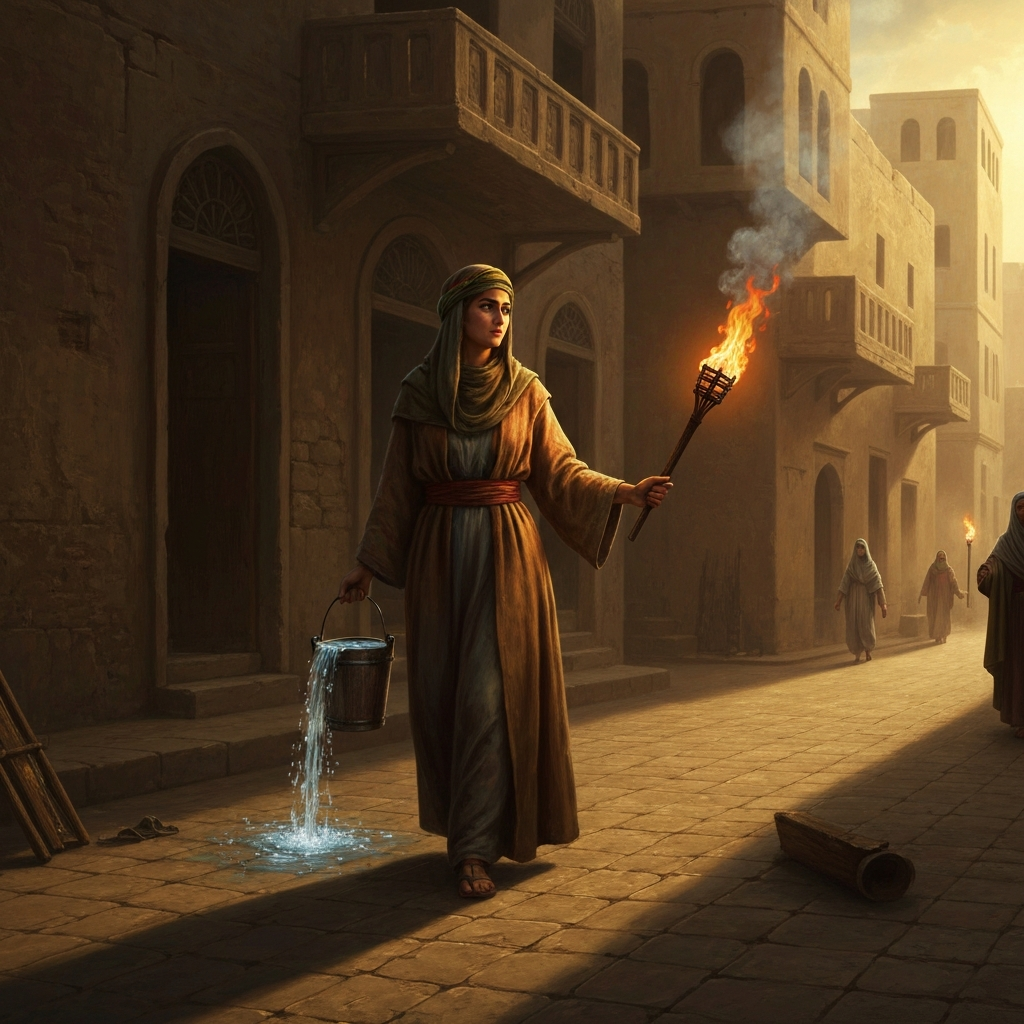
A meditation on the Sufi metaphor of the burning heart — the qalb that is on fire with divine love, that cannot cool, that consumes the self that holds it — and the masters who used this image to describe the interior state that is Sufism's essential territory.
- When
- 9th–13th century CE — the formative and classical period of Sufi poetry and doctrine
- Where
- Baghdad, Konya, Nishapur — the cities of Sufi thought and poetry
The image is everywhere because the image is accurate.
Before there was a Sufi tradition, before there were orders and khanqahs and silsilas and manuals of stations, there were people who reported a burning. Not metaphorically — though it became metaphor. Not poetically — though it generated the greatest poetry in any Islamic language. They reported something happening in the chest that they could not explain in other terms: a heat, a pressure, a fire that did not destroy but transformed, that was painful in the way that growth is painful and not in the way that damage is painful.
They reached for the image of fire because fire is the only thing in the physical world that transforms rather than merely changes. A stone dropped into water becomes a wet stone. A stone placed in fire becomes ash, which is not stone. The fire reveals the true constituency of what is burned: carbon, heat, light. What was opaque becomes transparent in the moment of combustion. What was dense becomes energy.
This is what they were describing.
Al-Hallāj, in the prison poems, approaches the image most directly:
I have seen my Lord with the eye of the heart.
I said: who are you? He said: you.
The burning in this formulation is not the burning of a separate self being warmed by a separate divine source. It is the burning of the distinction between the two. The heart that truly burns does not burn in God’s presence. It burns because it is discovering that it is God’s presence. The fire is the meeting of what was artificially separated returning to what it always was.
Rumi, six centuries after Hallāj, returns to the image in the Masnavi with the same precision:
The heart is not a house for lions.
The lion came and burned the house.
The house is gone. The lion remains.
The house is the personal self — the constructed identity, the habits of self-definition, the collection of opinions and fears and desires that constitute the ordinary person. The lion is the divine love that arrives when the heart is genuinely open. The arrival burns the house. What is left is not the person minus the house. It is something different: the lion, which is what was always behind the person.
The masters warn against two errors on both sides of the fire.
The first error is avoiding it. The person who maintains their religious practice at a comfortable temperature, who never allows the love to become large enough to threaten their settled identity, who uses spirituality to become a better version of themselves rather than a different thing entirely. The fire is the teacher. Avoiding the fire means avoiding the transformation the fire brings. Most people, even most religious people, avoid the fire their entire lives.
The second error is dramatizing it. The person who performs the burning, who describes their interior fire in elaborate detail, who wears the evidence of spiritual intensity as a credential. The genuine fire does not need to be described. The person whose heart is truly burning has less to say, not more — the fire is consuming the words along with everything else.
Junayd’s criterion applies here as much as anywhere: after the fire, look at what remains. If what remains is a more impressive version of the person who went in, the fire was theater. If what remains is something unrecognizable as the person who went in, you are looking at ash — and at what ash becomes.
The image of the burning heart runs through Sufi poetry as a constant because the experience it describes is constant.
Hallāj had it. Rumi had it. Hafez had it and described it in verse that makes it impossible to tell whether he was describing actual bodily sensation or the metaphor’s vehicle. The Persian tradition generally refuses to adjudicate this question: the metaphor and the reality are the same thing. The poem that makes your chest ache when you read it is producing in miniature what the masters experienced in full.
The heart is burning.
The fire that burns it is love.
The love is God’s, which is to say it is also yours, which is to say the distinction was what was burning all along.
Echoes Across Traditions
Entities
- Al-Hallāj
- Rumi
- Junayd al-Baghdadi
- unnamed dervishes of the tradition
Sources
- Rumi, *Masnavi*, Book I — the opening's metaphor of fire and burning
- Al-Hallāj, prison poems, in Louis Massignon, *The Passion of al-Hallaj* (Princeton, 1982)
- Annemarie Schimmel, *As Through a Veil: Mystical Poetry in Islam* (Columbia, 1982)
- Michael Sells, *Mystical Languages of Unsaying* (Chicago, 1994)