Combat Profile
Crossing the River
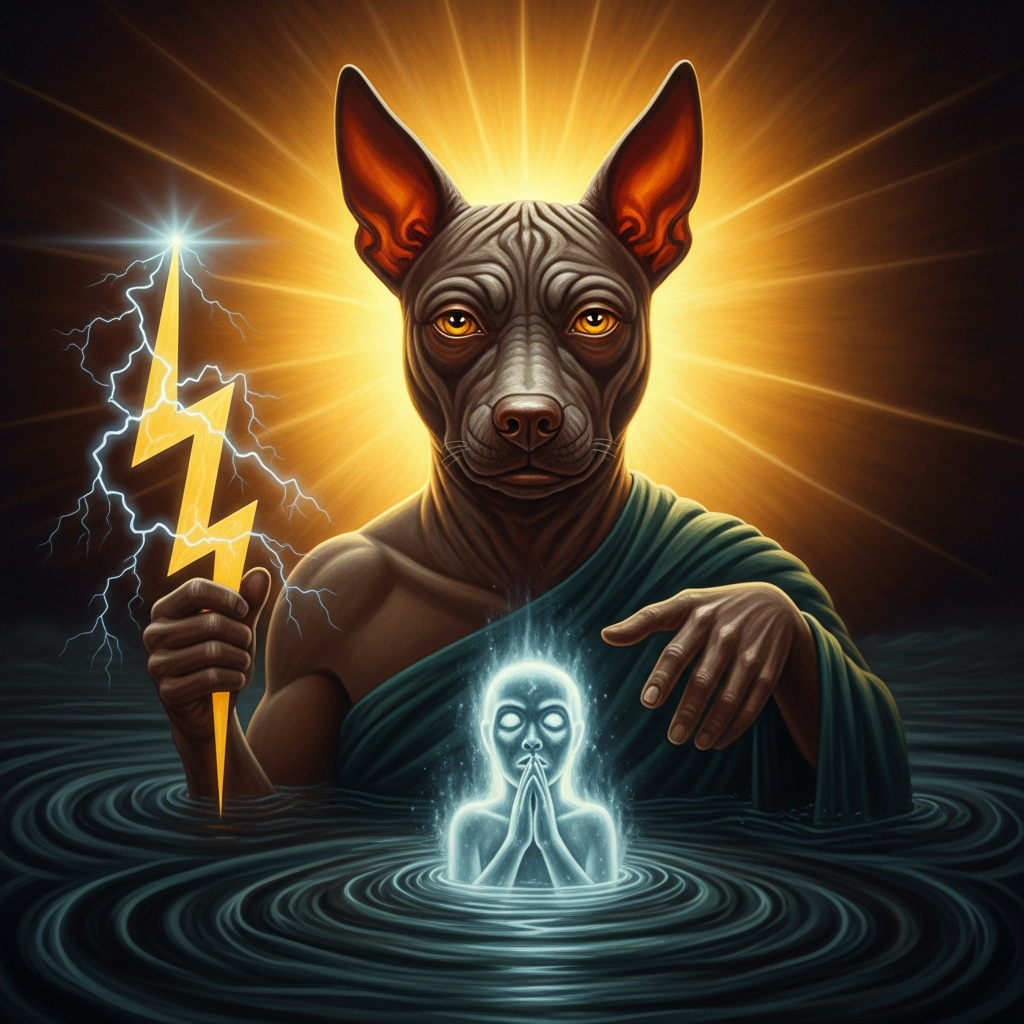
Xolotl carries the soul across the underworld river on his back; without his presence, the dead cannot reach the second layer of Mictlan.
Twin of the Twin
Xolotl is everything Quetzalcoatl is not: deformed where the feathered serpent is beautiful, descending where Quetzalcoatl rises, weeping where the bright twin laughs; together they make the whole.
Xolotl is the twin of Quetzalcoatl — his dark counterpart, his shadow, his other face. While Quetzalcoatl rises as the morning star (Venus before dawn), Xolotl is Venus as the evening star, descending into the underworld each night. He is depicted as a dog-headed god, sometimes as a deformed or monstrous figure. The Mexica considered all deformities his sign — twins, the lame, those born with extra digits or missing limbs. Some sources said Xolotl was so afraid of dying that he transformed himself into the axolotl (the salamander that retains its juvenile form throughout life — and which still lives in the lakes around Mexico City, named for him). His name means “twin,” “double,” and also “monster” — the reverse of the polished god.
Xolotl’s primary role is psychopomp — guide of the dead through the trials of Mictlan. The dog accompanies the soul on the four-year underworld journey. The Mexica buried small dogs (or images of dogs) with their dead for this reason: the dog crosses the river of the underworld with the soul on its back. He is also the patron of the tlachtli (the ritual ballgame), and his role in the creation of the Fifth Sun is critical: when the gods at Teotihuacan demanded that someone leap into the sacrificial fire to become the new sun, Tonatiuh leapt and became the sun, but the moon hesitated. Xolotl, weeping, fled the assembly — but the gods caught him and forced him into the fire. He is the god whose unwillingness becomes essential.
Biblical Parallels: Xolotl has elements of the Christian psychopomp tradition — the angel who guides the soul to judgment (Michael in Catholic tradition, escorting souls). His role as the dog-guide of the dead has no clean biblical parallel; the Hebrew Bible regards dogs as unclean, though they appear in psalmic imagery. His weeping unwillingness to be sacrificed and forced participation parallels Christ in Gethsemane — “Father, if it is possible, let this cup pass from me; nevertheless not my will but thine” (Matthew 26:39) — the god who shrinks from the necessary sacrifice.
Cross-Tradition: Xolotl is the most obvious Mesoamerican parallel to the Egyptian Anubis — the jackal-headed god who guides souls through the underworld and weighs the heart. He parallels the Greek Cerberus and the Persian Sraosha (the dog-faced spirit who guards the Chinvat bridge). His twin-relationship with Quetzalcoatl parallels Castor and Pollux of Greek myth, and the Vedic Ashvins. The axolotl salamander he becomes parallels Indo-European water-serpent transformations.
2 min read