Combat Profile
First Day
Cipactli's body is the cosmos; his dismemberment by Quetzalcoatl and Tezcatlipoca is the founding sacrifice from which all subsequent reality is built.
Ce Cipactli
The first day of the sacred 260-day calendar is named for him; every cycle of time begins with the crocodile's name spoken aloud, acknowledging the debt.
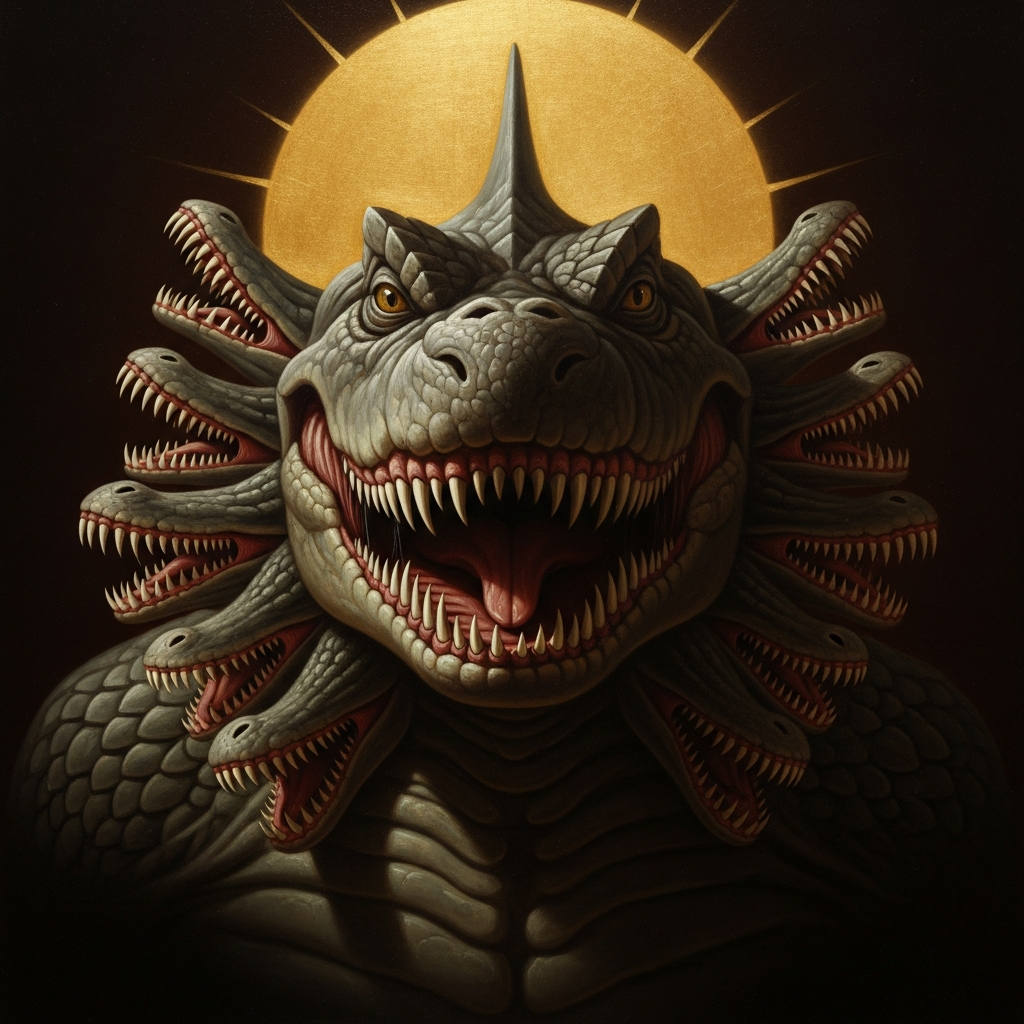
Cipactli is the primordial sea-crocodile, the first being of the Mexica cosmogony, the creature from whose body Quetzalcoatl and Tezcatlipoca tore the cosmos. In some sources Cipactli and Tlaltecuhtli are the same being; in others they are distinct primordial monsters of the same generation. Cipactli is more clearly crocodilian — the toothed beast of the swamps, half-fish, half-saurian, the model of the cipactli day-sign that opens the Mexica 260-day calendar. The first day of the Tonalpohualli is Ce Cipactli — One Crocodile — the day of cosmic beginning. Every diviner who consulted the calendar began with this animal.
The myth of Cipactli’s dismemberment is the Mexica answer to the question “why does anything exist?” The two creator-gods, swimming in the sea of the time-before-time, found the great crocodile and tore him apart to make a place to live. His back became the earth’s crust. His tail became the heavens. His teeth became the mountains, his many eyes became the springs and caves. He is the architecture of existence — and he is also the lurking primordial chaos that the architecture barely contains. The Mexica saw in every flooded river, every cave, every crocodile-shaped reflection in still water, a trace of the original Cipactli, still half-living, watching from beneath the world.
Biblical Parallels: Cipactli parallels the Leviathan of Job 41 and Psalm 74:14 — the great sea-monster who is both feared and, in some readings, is the raw material of creation that God subdues. He parallels Rahab in the Hebrew Bible (Job 26:12, Isaiah 51:9) — the chaos-monster of the deep whom YHWH crushed at creation, an echo of the older Mesopotamian Tiamat myth. The watery chaos of Genesis 1:2 (the tehom over which the Spirit hovered) is the dim Hebrew memory of Cipactli’s role in older Near Eastern cosmogonies — domesticated into formless waters in Genesis but visible as a personified monster in the older substrata.
Cross-Tradition: Cipactli parallels Mesopotamian Tiamat (the dragon-of-the-sea split to make heaven and earth — the closest Old World parallel), Egyptian Apep (the cosmic serpent of chaos), Norse Ymir and Jormungandr (the world-encircling serpent), Hindu Vritra (the dragon Indra slays to release the waters), and Chinese Gong Gong. The primordial water-monster split or slain to make the cosmos is among the most universal of all creation-myths.
2 min read