Combat Profile
Tlaloque's Pots
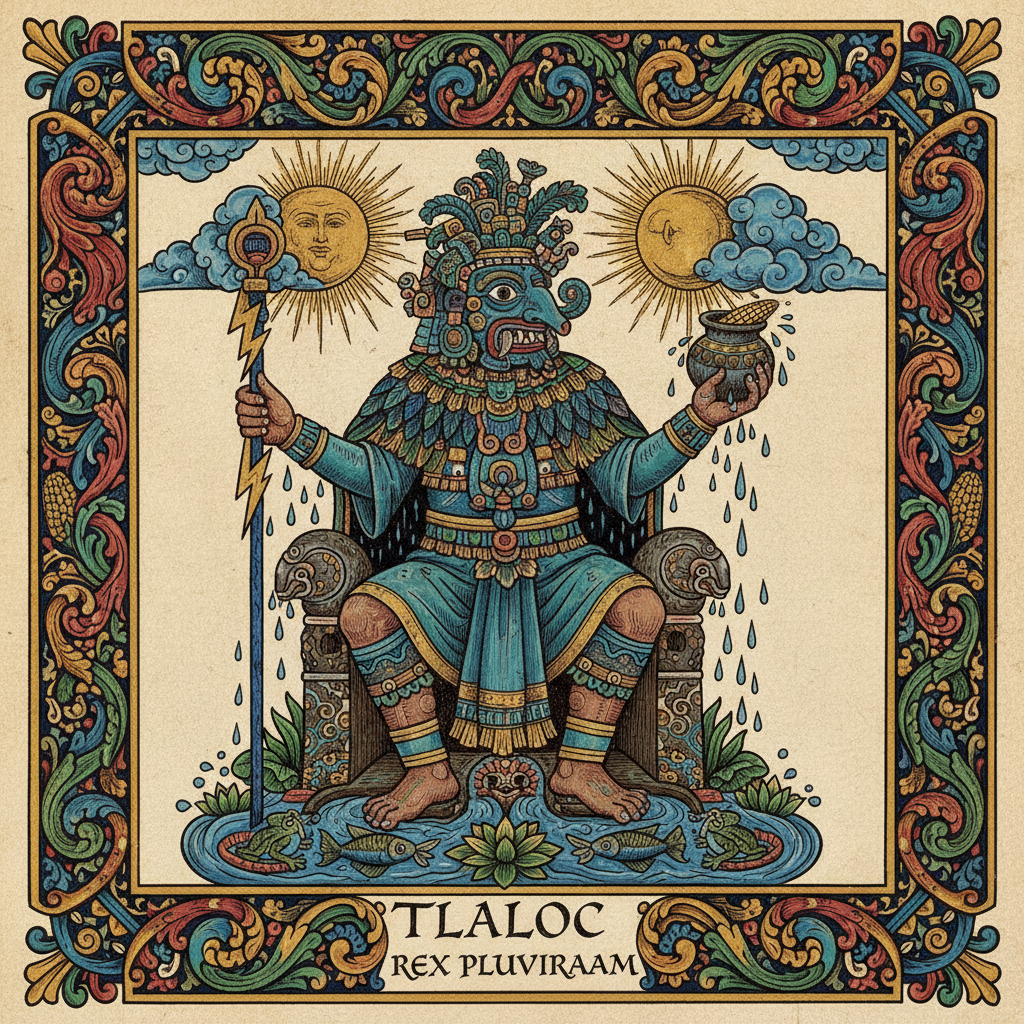
Tlaloc commands the four rain-jars of the cardinal directions, pouring abundance, drought, hail, or flood as the cosmic accounts demand.
Tlalocan's Welcome
Those who die by water, lightning, or wasting disease bypass Mictlan and enter Tlaloc's eternal springtime; his domain is the only paradise that costs nothing in moral merit.
Tlaloc (“He Who Makes Things Sprout,” or “Earth-Lying”) is among the oldest gods in Mesoamerica — his iconography (goggle eyes, fanged mouth, water-drop forehead) is recognizable from Teotihuacan, Olmec sites, and across two thousand years of Mesoamerican religion. He is the rain god, the lightning god, the lord of mountain springs and storm clouds. The Mexica gave him equal billing with Huitzilopochtli at the Templo Mayor: the twin pyramids of the sacred precinct were dedicated half to the war-sun, half to the rain. War feeds the empire; rain feeds the empire. They were not rivals but cosmic colleagues.
Tlaloc dwells in Tlalocan — the paradise of those who die in his domain: drowning, lightning-strike, leprosy, certain water-diseases. Tlalocan is verdant, eternally springtime, full of song and the delight of growing things. To die in Tlaloc’s way was to skip the four-year journey through Mictlan and go directly to paradise. He commands four assistants — the Tlaloque, who pour rain from clay pots in the four directions and break them open with thunder. He demands the most heartbreaking sacrifices: children. Mexica priests selected weeping children for spring rain ceremonies, on the theory that their tears summoned the clouds. The skeletons of these children have been excavated at the Templo Mayor. The cost of Mexica rain was paid in the smallest bodies.
Biblical Parallels: Tlaloc is a Mesoamerican Baal — the storm-god whose blessing is rain and whose anger is drought (compare 1 Kings 17-18, where Elijah confronts the Baal-prophets over rain). He parallels YHWH in his adon ha-shamayim aspect — the Lord who “sends rain on the just and the unjust” (Matthew 5:45). His paradise of springtime resembles the Eden of Genesis 2 — well-watered, flourishing, set apart. His demand for children’s tears as rain-medicine is the Mesoamerican echo of the Molech sacrifices the Hebrew prophets denounced (Jeremiah 32:35) — child sacrifice was a regional Bronze Age practice across multiple unrelated cultures.
Cross-Tradition: Tlaloc parallels Vedic Indra (rain and lightning), Canaanite Baal (storm), Norse Thor (thunder and rain), Yoruba Shango (thunder), and the Slavic Perun. Storm gods who command rain are perhaps the most widely attested of all divine archetypes — agriculture everywhere depends on the sky, and the sky everywhere is unpredictable.
2 min read