Combat Profile
The Fourth Flood
Chalchiuhtlicue raises the waters of the Fourth Sun, drowning a world; the survivors are turned to fish, and the Fifth Age inherits her quieter blessing.
First Washing
Every newborn passes through Chalchiuhtlicue's water before receiving a name; her hand is the first welcome the soul receives in this world, and her drowning is the last gate it can return through.
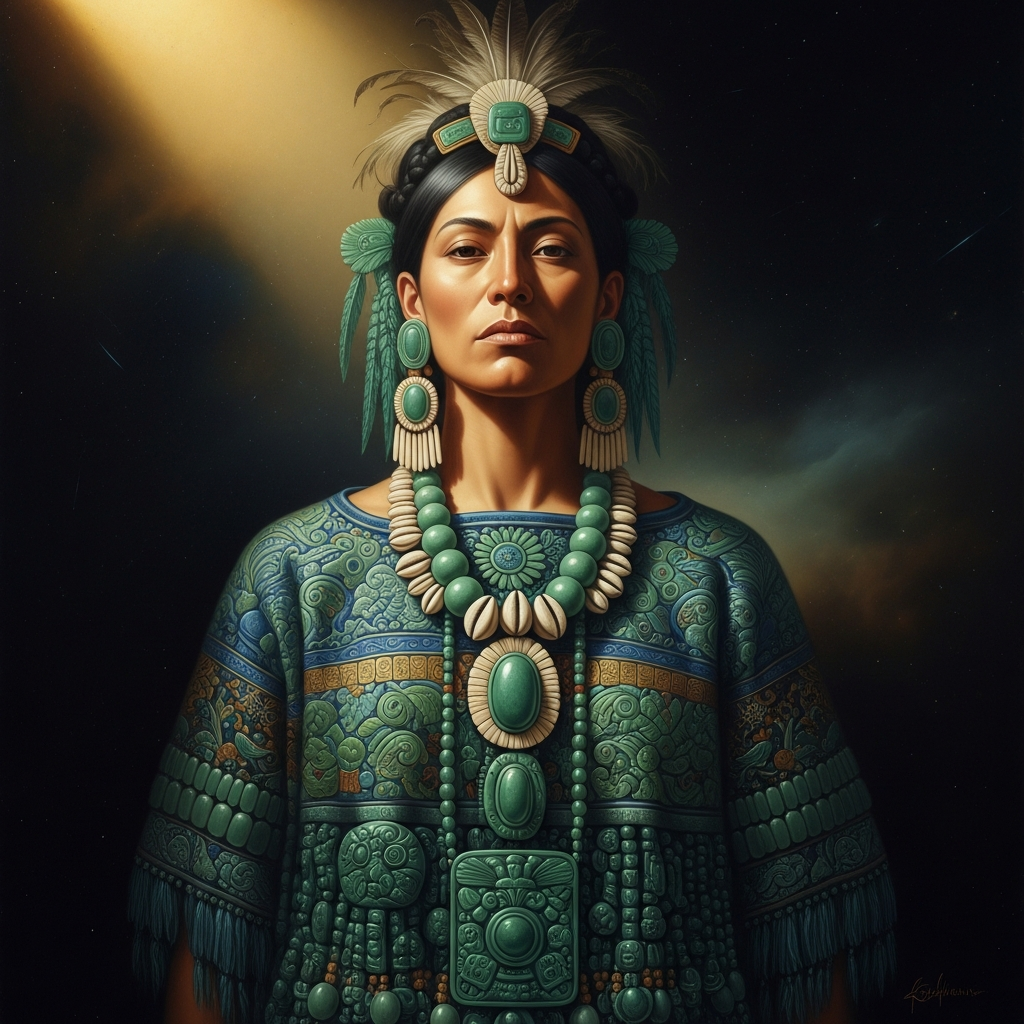
Chalchiuhtlicue (“She Whose Skirt Is Jade”) is the goddess of fresh water — rivers, lakes, springs, the Lake Texcoco that surrounded Tenochtitlan itself. She is the wife (or sister) of Tlaloc, and in some sources presided over the Fourth Sun (Nahui Atl, “Four Water”), which ended in the great flood that turned humanity into fish. The Mexica saw her as the patron goddess of newborns — water for the first ritual washing, the moment a child was named. She is the gentler face of the deluge: not the storm but the still water, not the raging river but the mountain spring.
In the New Year ceremonies, Chalchiuhtlicue received offerings to ensure the rivers and lakes would remain abundant. Her image was often shown with a jade skirt, her face painted with two horizontal lines, holding a stalk of corn. Her power was double-edged: she gives life through water, but she also drowns. Aztec mothers warned children to fear the lake — Chalchiuhtlicue would pull them under if they were careless. She is the necessary intimacy of the Mexica with their water-city: Tenochtitlan was an island, every causeway a bargain with her, every chinampa garden built on her permission.
Biblical Parallels: Chalchiuhtlicue corresponds to the waters of Genesis 1:2 — the tehom (deep) over which the Spirit of God hovered before creation. She parallels the Tiamat of Mesopotamian myth — the salt-water mother whose body becomes the cosmos. Her flood-myth parallels Noah’s flood (Genesis 6-9): a divine deluge that destroys a corrupted humanity and births a new age. Her role in baptism parallels Christian baptism — water as the gate of new life, the symbolic drowning that produces a reborn self.
Cross-Tradition: Chalchiuhtlicue parallels Greek Tethys (oceanic mother), Hindu Ganga (the river goddess descending from heaven), Yoruba Oshun (river goddess of love and fertility), and the Slavic Mokosh. Her role as goddess of the first ritual washing parallels the Nile personified in Egypt and the Ganges as purifier in India.
2 min read