Combat Profile
The Smoking Mirror
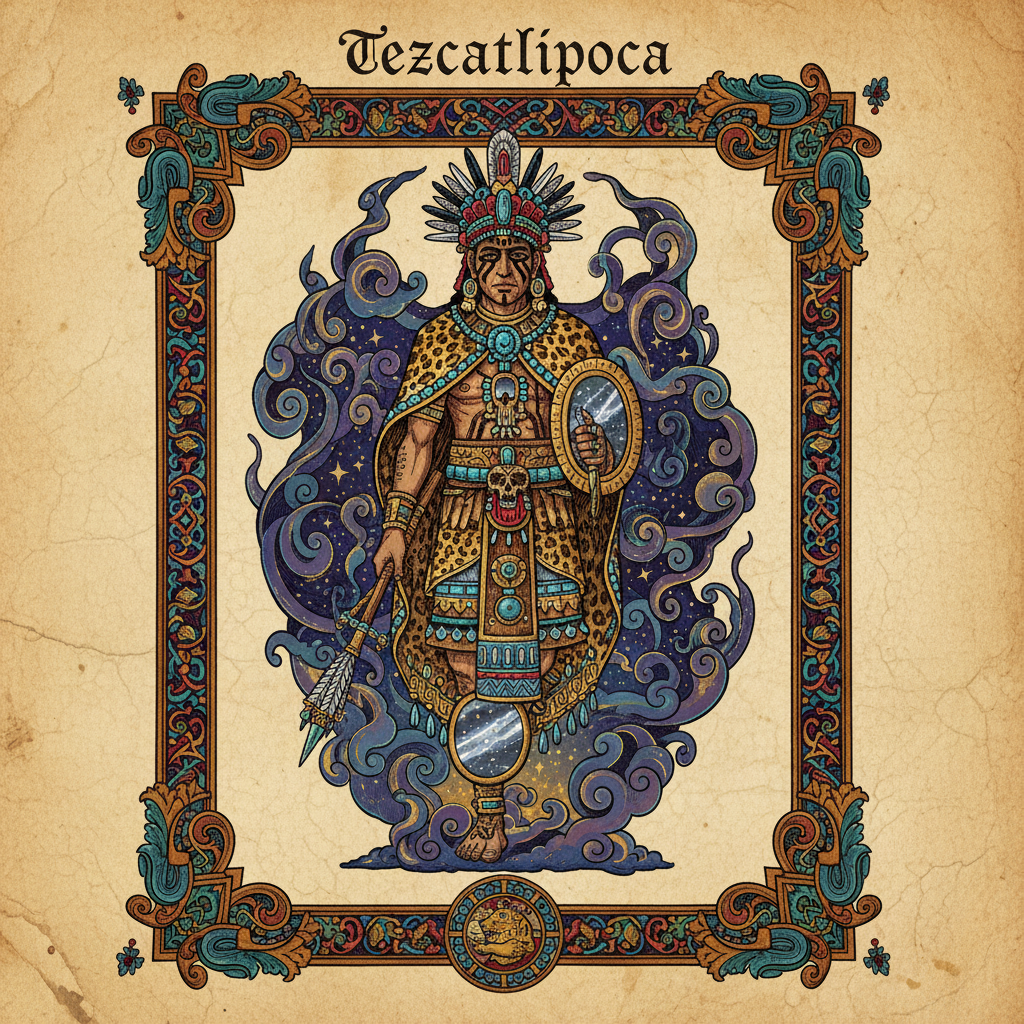
Tezcatlipoca holds the obsidian glass that reveals the true face of any ruler; what the mirror shows can never be unseen, and the seer's reign begins to crumble in the moment of self-recognition.
Night Wind
Tezcatlipoca walks the crossroads invisibly, hearing every whisper, knowing every secret, raising slaves to kings and casting kings into the dust according to his unaccountable will.
Tezcatlipoca (“Smoking Mirror”) is the dark twin of Quetzalcoatl, the god of the night sky, of sorcery, of jaguars, of strife, of obsidian. His name comes from the obsidian mirror used by Mesoamerican shamans for scrying — black volcanic glass that revealed truths and concealed them in equal measure. Tezcatlipoca is invisible, omnipresent, and fundamentally unaccountable — the wandering god who tests rulers, tempts the holy, and overturns prosperity at his whim. He has many forms: the warrior-jaguar of the night, the bringer of disease, the patron of slaves (whom he could elevate to kings), the wind-walker of crossroads.
In the cycle of the Five Suns, Tezcatlipoca was the First Sun himself — until Quetzalcoatl knocked him out of the sky with a club, and the world was devoured by jaguars. The two gods are eternally rivals. In Toltec myth, it was Tezcatlipoca who deposed the priest-king Quetzalcoatl by trickery. In the cosmic order, he represents what cannot be predicted, what cannot be propitiated, what must simply be endured. The Mexica had a special ritual for him: each year a beautiful young captive was chosen as his living image, treated as the god incarnate for one full year — given four wives, taught to play the flute, dressed in the god’s regalia — and at year’s end climbed the temple steps voluntarily, breaking his flutes one by one, and was sacrificed at the summit. The lesson: kingship is borrowed. Beauty is borrowed. All glory ends on the obsidian knife.
Biblical Parallels: Tezcatlipoca has no clean biblical parallel because no biblical figure combines his attributes. He has elements of ha-Satan — the adversary of the Book of Job who tests the faithful and walks “to and fro on the earth” (Job 1:7). He has elements of YHWH himself in his more terrifying aspects — the God who hardens Pharaoh’s heart, who tests Abraham, who is “a consuming fire” (Hebrews 12:29). His trickery against Quetzalcoatl parallels the Eden serpent’s trickery against Adam and Eve — the seducer who breaks the saint’s vow. His patronage of slaves who become kings echoes the biblical pattern of Joseph, David, and Christ himself — the lowly raised to glory.
Cross-Tradition: Tezcatlipoca parallels Norse Loki — the trickster who fathers monsters, deposes the bright god, and unmakes the world. He parallels Greek Hermes in his role as crossroads god and patron of thieves, but combined with the darker aspects of Hades. He parallels the Yoruba Eshu (Elegba) — trickster of crossroads, master of fate. His obsidian mirror parallels the Hindu maya — the cosmic illusion that reveals and conceals.
2 min read