Combat Profile
Womb of the Fifth Sun
Coatlicue conceives by a feather and births a fully-armed god; her body is the doorway through which the cosmos renews itself, and what she gives birth to cannot be unbirthed.
Skirt of Serpents
Coatlicue is simultaneously life and death; her flesh devours and births in the same gesture, and to look upon her is to see the unity of what most cosmologies hold apart.
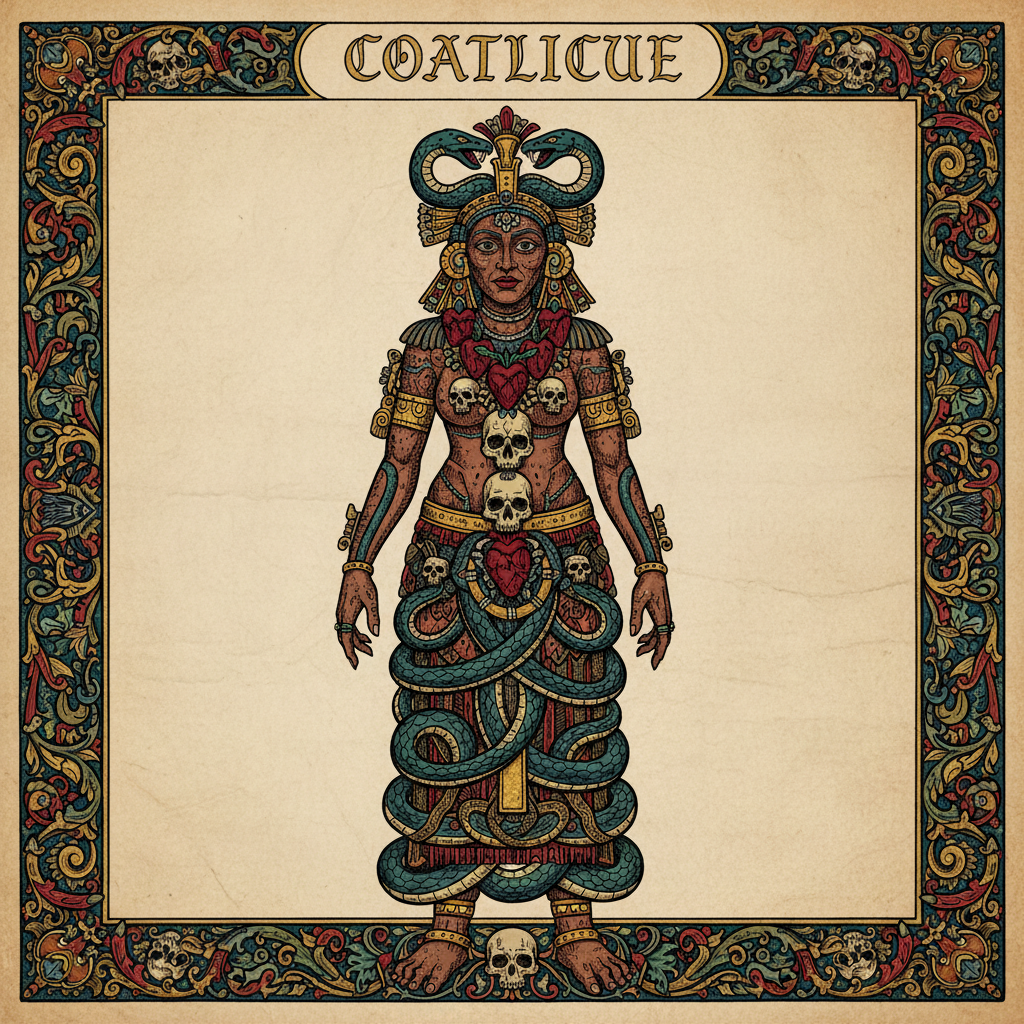
Coatlicue (“Serpent Skirt”) is the great earth-mother of the Mexica — the womb of the Fifth Sun, the mother of Huitzilopochtli, the goddess whose terrifying iconography (a skirt woven of writhing serpents, a necklace of human hearts and hands, a head replaced by two serpent-heads facing each other where her own decapitated neck spurts blood) makes her one of the most fearsome divine images in world art. The famous statue of Coatlicue, excavated in the Zócalo of Mexico City in 1790, was so disturbing that the Spanish initially reburied it. It now stands in the National Museum of Anthropology, and remains, pound for pound, one of the most psychologically loaded sculptures ever carved.
Her great myth: while sweeping the temple of Coatepec, Coatlicue caught a ball of feathers (a hummingbird’s plumage) and tucked it into her belt for safekeeping. She immediately conceived. Her existing daughter Coyolxauhqui (the moon) and her four hundred sons (the southern stars) declared this a disgrace and resolved to murder their mother. As they marched up Coatepec, the unborn child spoke from the womb. At the last moment, Huitzilopochtli was born fully armed, decapitated his sister, dismembered her, and scattered her body down the mountain — the founding violence of the Fifth Sun. Coatlicue herself contains everything: birth and death, growth and rot, the living earth and the grave that swallows it. She is womb and tomb in one body.
Biblical Parallels: Coatlicue has no exact biblical parallel — the Hebrew Bible deliberately removes the goddess from the cosmology, leaving the Asherah and Shekhinah traditions as muted echoes. Her conception of the saviour-warrior by miraculous (non-sexual) means parallels the virgin conception of Mary (Luke 1:34-35), and the Catholic identification of Tonantzin-Coatlicue with the Virgin of Guadalupe is no accident: the indigenous Mexicans saw the same figure under a different name. Coatlicue’s terrifying aspect — the goddess who births the saviour but is herself a devouring mother — has biblical traces in the Whore of Babylon (Revelation 17) and the Wisdom-as-mother of Sirach 24, but no figure that combines them.
Cross-Tradition: Coatlicue parallels the Hindu Kali — black goddess of death and creation, garlanded with skulls, whose terrible aspect is also the womb of liberation. She parallels the Sumerian Ereshkigal (queen of the underworld, also the mother of fertility), the Greek Gaia in her oldest, most terrible aspect, and the Celtic Morrigan. The “Terrible Mother” archetype is found across cultures, but few cultures carve her as honestly as the Mexica.
2 min read