Combat Profile
Demand of the Fifth
Tonatiuh halts in the sky and demands blood; the cosmos cannot proceed until the *chalchiuhatl* is paid, and the sun's resumed motion is the receipt.
Nahui Ollin
The Fifth Sun moves only as long as the debt is paid; his name is "Four Movement," and his movement is the precarious gift the world is renting at terrible cost.
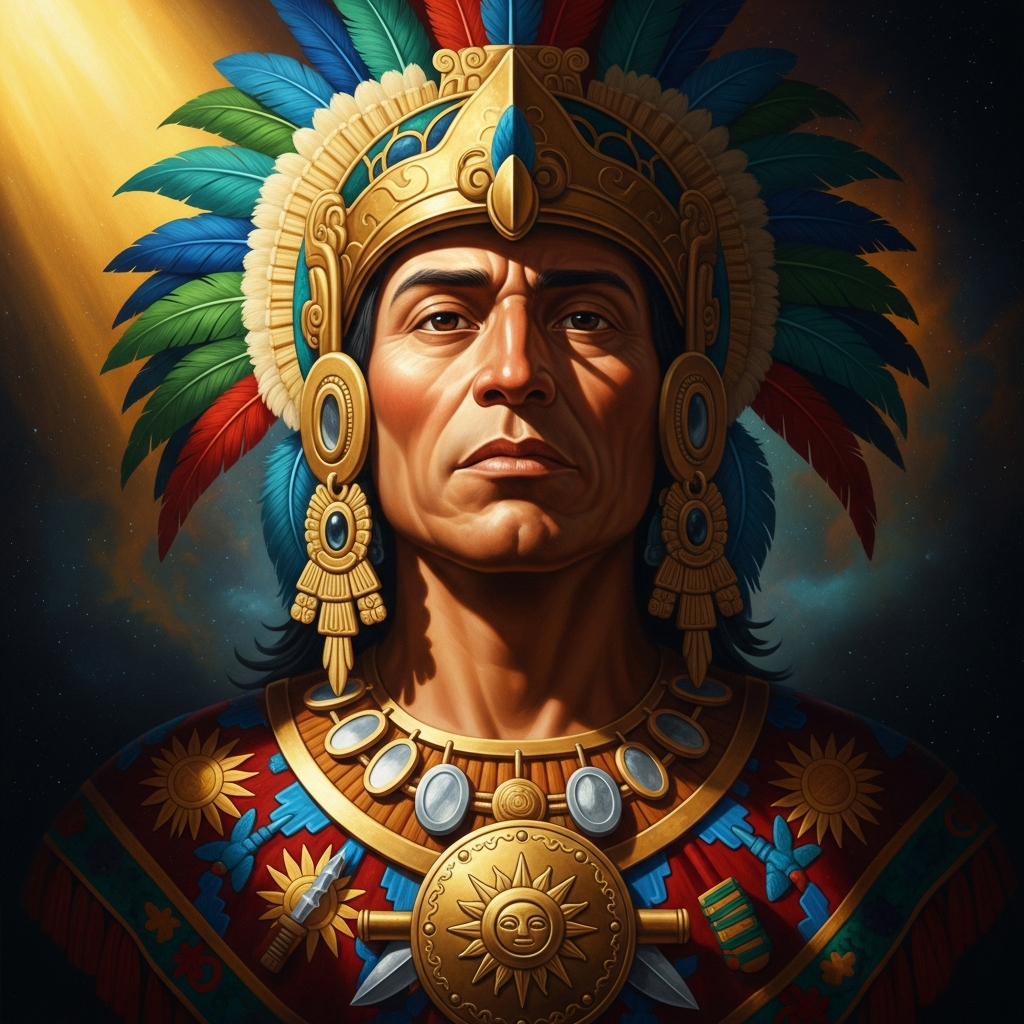
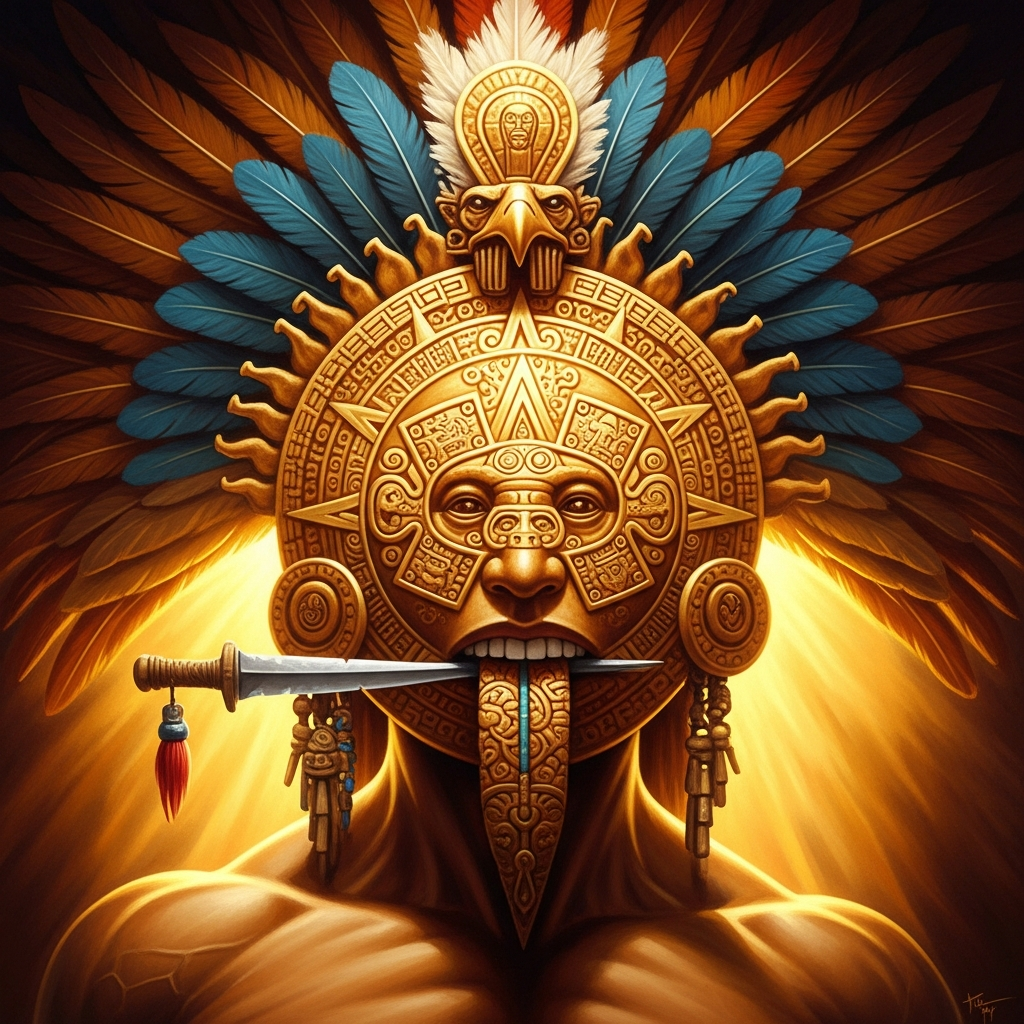
Tonatiuh (“He Who Goes Forth Shining”) is the present sun — the Fifth Sun, Nahui Ollin (“Four Movement”), the sun under whose light we now live. He is the central figure of the great Aztec Sun Stone (popularly the “Aztec Calendar”), excavated in the Zócalo in 1790, where his face stares from the center, tongue out as a sacrificial blade, surrounded by the four previous suns and the dates of their destruction. Tonatiuh is the sun who demands. Unlike the previous four suns, who rose and ran their courses with the inertia of their natures, Tonatiuh requires sustenance: the chalchiuhatl, “precious water,” the blood of human hearts, to keep him moving.
The myth: at Teotihuacan, after the fourth world ended, the gods gathered in darkness and asked who would become the new sun. The proud god Tecuciztecatl volunteered, but when the time came to leap into the sacrificial fire, he hesitated — four times he ran toward the flames and four times he turned back. The humble, scab-covered Nanahuatzin leapt without hesitation and became Tonatiuh. Shamed, Tecuciztecatl finally jumped and became the moon — but Tonatiuh struck him with a rabbit, dimming his light (the moon’s rabbit-shape, visible in its dark patches, marks the wound). At first Tonatiuh refused to move. The gods asked why. Tonatiuh demanded their blood. One by one, the gods at Teotihuacan offered themselves at the obsidian altar, and Tonatiuh began to rise. The pattern was set: the sun must be fed, or it stops.
Biblical Parallels: Tonatiuh has no clean biblical parallel — the Hebrew Bible explicitly demystifies the sun (Genesis 1:14-18 reduces the sun to a “great light” and refuses to name it as a deity), and the prophets (Deuteronomy 4:19, Ezekiel 8:16) condemn sun-worship. The closest Christian parallel is the Eucharistic theology — Christ’s blood as the substance that “sustains the world,” and the Mass as the perpetual offering that holds the cosmos in being. Some 16th-century missionaries explicitly drew this parallel to teach the Mexica the Christian sacrament. Both Tonatiuh and the Eucharist enact the principle that the world runs on someone’s blood; the difference is whose, and how often.
Cross-Tradition: Tonatiuh parallels Egyptian Ra — the sun who fights through the underworld each night and must be sustained by the prayers and offerings of the living. He parallels Vedic Surya (sun, drawn by seven horses), Greek Helios (the daily charioteer), and Inca Inti (the imperial sun who likewise demanded sacrifice). The pattern of a sun who demands sustenance is found in Mesopotamian Shamash (less violent), Norse Sol (devoured by Skoll at Ragnarok), and across many solar mythologies.
2 min read