Combat Profile
Bones from Mictlan
Quetzalcoatl descends into the underworld to retrieve the bones of the previous humanity, bleeds his own body to vivify them, and so creates the people of the Fifth Sun.
The Returning One
Quetzalcoatl's exile is never permanent; his prophesied return in the year One Reed haunts every cycle, and his Venusian rising guides every dawn.
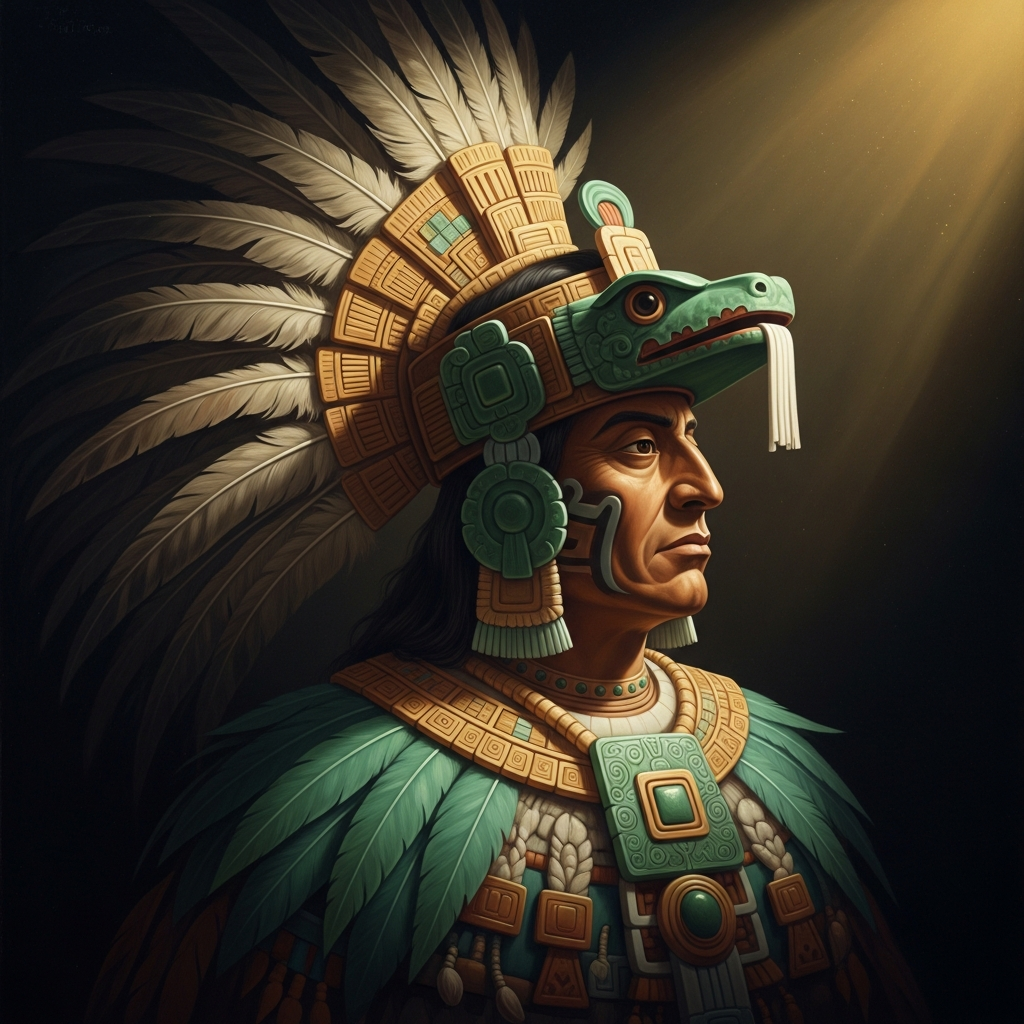
Quetzalcoatl (“Feathered Serpent” or “Precious Twin”) is the most pan-Mesoamerican of all the gods — older than the Mexica, worshipped from Olmec times through Toltec Tula to Postclassic Maya Chichen Itza (where he appears as Kukulkan). For the Mexica he is a complex figure: god of wind, of dawn, of learning and priesthood; patron of the calmecac (priestly schools); the deity who descended into Mictlan to recover the bones of the previous humanity and bled his own penis to give them life; the lawgiver who taught civilization, octli (corn-beer), the calendar, writing.
Crucially, Quetzalcoatl is also a historical figure — Topiltzin Ce Acatl Quetzalcoatl, ruler of Tula in the 10th century, who taught the Toltecs civilization and was deposed by his rival Tezcatlipoca through trickery: the smoking-mirror god gave him a magical mirror that revealed Quetzalcoatl’s own ugly face, then plied him with octli until the priest-king broke his vow of chastity by sleeping with his sister. In shame Quetzalcoatl fled east to the sea, immolated himself on a pyre, and rose as the planet Venus. He prophesied his return in the year Ce Acatl (One Reed). Cortés landed in 1519 — a One Reed year. Moctezuma II reportedly hesitated. The empire fell. Whether the Mexica truly believed Cortés was Quetzalcoatl is debated among historians, but the prophecy was real and the timing was unbearable.
Biblical Parallels: Quetzalcoatl’s descent into the underworld to retrieve the dead and bring them back to life parallels Christ’s Harrowing of Hell (1 Peter 3:18-19, the Apostles’ Creed). His bleeding to give life to dead bones echoes the blood-sacrifice salvation of Christian atonement theology, and the Ezekiel 37 vision of dead bones reclothed with flesh by divine breath/wind (Quetzalcoatl is also wind). His self-immolation and rising as the morning star parallels the resurrection and the title “bright morning star” (Revelation 22:16). His prophesied return parallels the Parousia — the second coming. The structural parallels are so close that 16th-century Franciscans (and modern fringe theorists) have argued Quetzalcoatl was a memory of Christ or of the apostle Thomas in the Americas.
Cross-Tradition: Quetzalcoatl parallels the Chinese Long (dragon) and the Hindu Naga — feathered or scaled serpents associated with wisdom, water, and royal legitimacy. His descent and return resembles Sumerian Inanna’s descent into the underworld and Egyptian Osiris’s death and resurrection. His role as bringer of civilization parallels Greek Prometheus (theft of fire), Mesopotamian Oannes (the fish-sage who taught the arts), and the Andean Viracocha.
2 min read