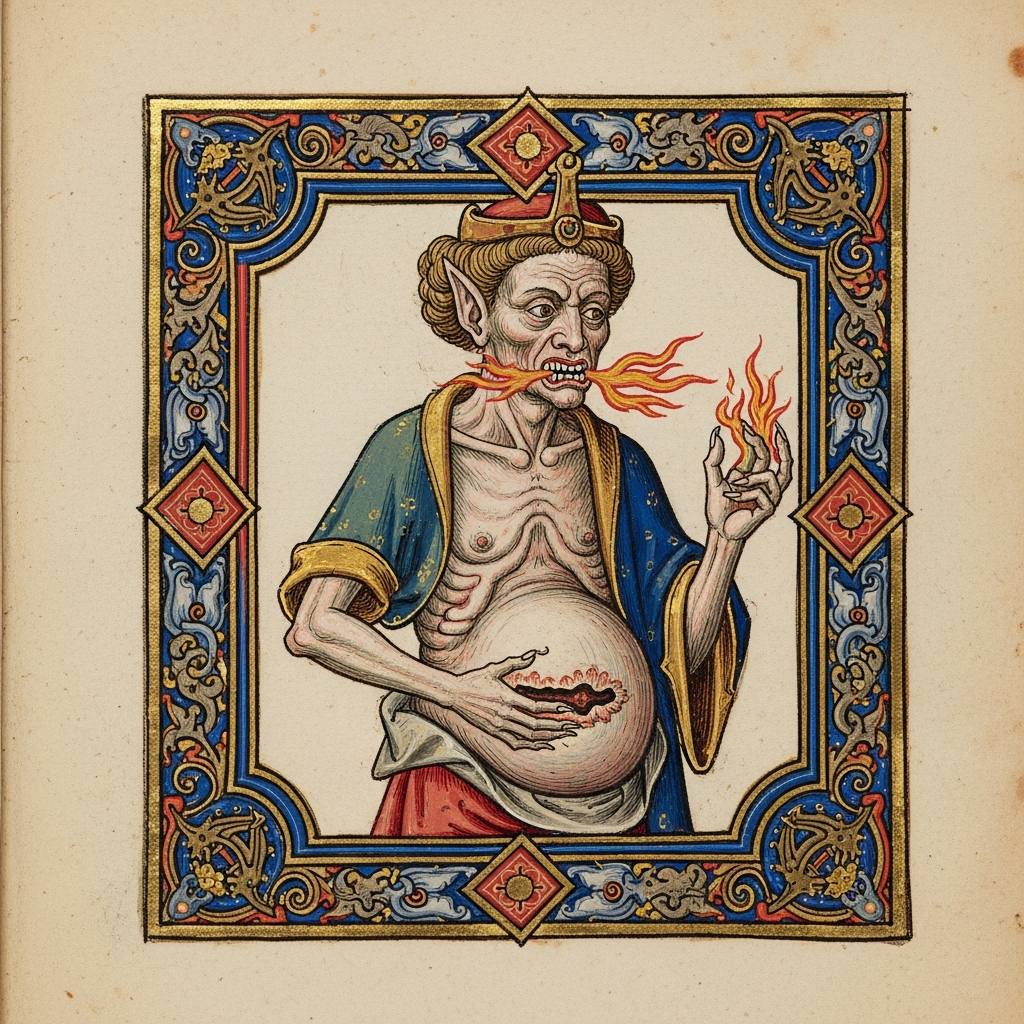
Combat Profile
Craving Manifestation
the Preta forces a target to experience overwhelming desire for their deepest attachment, temporarily incapacitating them with longing.
Eternal Hunger
the Preta constantly radiates an aura of want and dissatisfaction, sapping the resolve of nearby mortals and weakening their resistance to temptation.
Cannot satisfy any craving; food turns to fire, water turns to pus; perpetual frustration
Pretas — hungry ghosts — are one of Buddhism’s most psychologically penetrating creations. They are depicted with enormous, swollen bellies (representing insatiable desire) and tiny, needle-thin mouths and throats (representing the inability to satisfy that desire). They wander through a realm where food turns to fire when they try to eat, water turns to blood or pus when they try to drink, and shade turns to scorching sunlight when they seek relief. They can SEE what they want — it is always tantalizingly close — but they can never, ever have it.
Preta rebirth results from excessive greed, miserliness, jealousy, and attachment in a previous life — particularly the hoarding of resources while others suffered. The punishment is exquisitely karmic: those who could never get enough now exist in a state of permanent not-enough.
The parallels are vivid:
- Tantalus: The Greek king punished by standing in a pool of water beneath a fruit tree — the water recedes when he bends to drink, the branches rise when he reaches for fruit. The structural identity with pretas is complete. The English word “tantalize” preserves this image.
- The Rich Man and Lazarus (Luke 16:19-31): The rich man, in torment in Hades, begs for Lazarus to dip his finger in water and cool his tongue — a single drop of water, denied. He who feasted while Lazarus starved now experiences the mirror-image of his cruelty.
- Addiction: Modern Buddhist teachers frequently use pretas as a metaphor for addiction — the compulsive pursuit of a substance or behavior that can never satisfy, the cycle of craving and temporary relief that only deepens the craving. The preta realm is the realm of the addict, writ cosmic.
In East Asian Buddhism, the Hungry Ghost Festival (Ullambana / Zhongyuan) is a major annual observance in which offerings of food and prayers are made to relieve the suffering of pretas and honor deceased ancestors. It is one of the most widely practiced Buddhist festivals in China, Japan, Korea, and Vietnam.
“The hungry ghost stands before a feast and starves. The mouth is too small. The hunger is too large. This is what greed becomes.”
2 min read
Generosity (dana) -- the antidote to the greed that creates preta rebirth; Ksitigarbha rescues them
Petavatthu (Stories of the Departed); Abhidharmakosa; Hungry Ghost Festival traditions