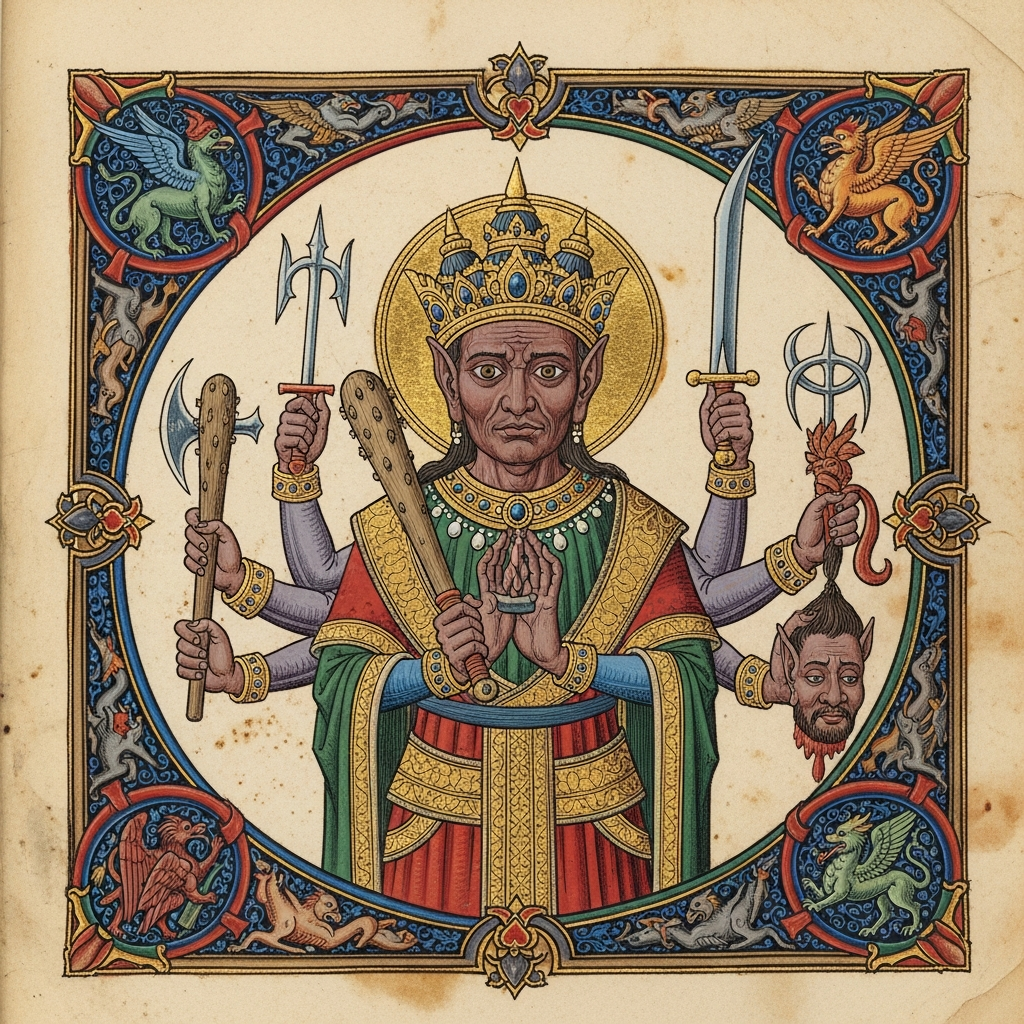
Combat Profile
Karmic Retribution
inflicts suffering proportional to the target's accumulated negative karma, growing stronger against those with violent intent
Bound to Consequence
cannot be harmed by those seeking to escape their deserved suffering, but weakens when the victim achieves genuine remorse
Total vulnerability -- naraka beings can do nothing but suffer until their karma is exhausted
Buddhist hells are elaborately detailed and cosmologically vast. The Abhidharmakosa describes multiple categories:
The Eight Hot Hells (from least to most severe):
- Samjiva (Reviving Hell) — beings kill each other, are revived, and kill each other again, endlessly
- Kalasutra (Black Thread Hell) — beings are marked with black lines and sliced along them
- Samghata (Crushing Hell) — mountains crash together, crushing beings who are then revived
- Raurava (Screaming Hell) — beings run across burning ground, screaming
- Maharaurava (Great Screaming Hell) — worse burning, worse screaming
- Tapana (Heating Hell) — beings are impaled on flaming stakes
- Pratapana (Great Heating Hell) — beings are enclosed in superheated iron chambers
- Avici (Uninterrupted Hell) — the worst: unbroken suffering without a single moment of relief, lasting an almost inconceivable duration. Reserved for those who commit the five gravest sins (killing a parent, killing an arhat, wounding a Buddha, causing a schism in the sangha, slandering the dharma)
The Eight Cold Hells: Beings trapped in frozen landscapes where the cold is so intense that their skin blisters, cracks, splits, and turns blue. Named for the sounds the suffering beings make — Arbuda (blisters), Nirarbuda (burst blisters), Atata, Hahava, Huhuva (the sounds of shivering), Utpala (blue lotus — the color of the frozen skin), Padma (lotus — the skin cracks open like a flower), Mahapadma (great lotus).
The critical difference from Christian hell: All of this is TEMPORARY. The duration is staggeringly long — the Abhidharmakosa calculates the lifespan in Avici hell as 3.3 x 10^20 years — but it is finite. When the karma is exhausted, the being is reborn, potentially in a higher realm. There is no eternal damnation, no permanent separation from the possibility of liberation. Even the being in Avici will eventually emerge and, over many lifetimes, may achieve enlightenment.
This makes Buddhist hells structurally closer to Purgatory or to the punishment visions in the Apocalypse of Peter (which describes vivid, specifically tailored punishments for specific sins, much like the naraka system) than to the Lake of Fire of Revelation 20, which is described as eternal.
The Japanese Hell Scrolls (Jigoku-zoshi, 12th century) are vivid painted depictions of the naraka realms — rolling illustrated narratives of beings boiled in cauldrons, devoured by demons, frozen in ice. They are the Buddhist equivalent of medieval European depictions of hell (e.g., the Hortus Deliciarum, or Bosch’s Garden of Earthly Delights) and serve the same devotional purpose: motivate moral behavior through the graphic depiction of consequences.
“Even in Avici, suffering ends. Even in the deepest hell, the door is not locked forever.”
2 min read
Ksitigarbha (enters the hells to teach and rescue); merit transfer from the living
Devaduta Sutta (MN 130); Abhidharmakosa; Ksitigarbha Sutra; Jigoku-zoshi (Japanese Hell Scrolls)