Combat Profile
Divine Ordinance
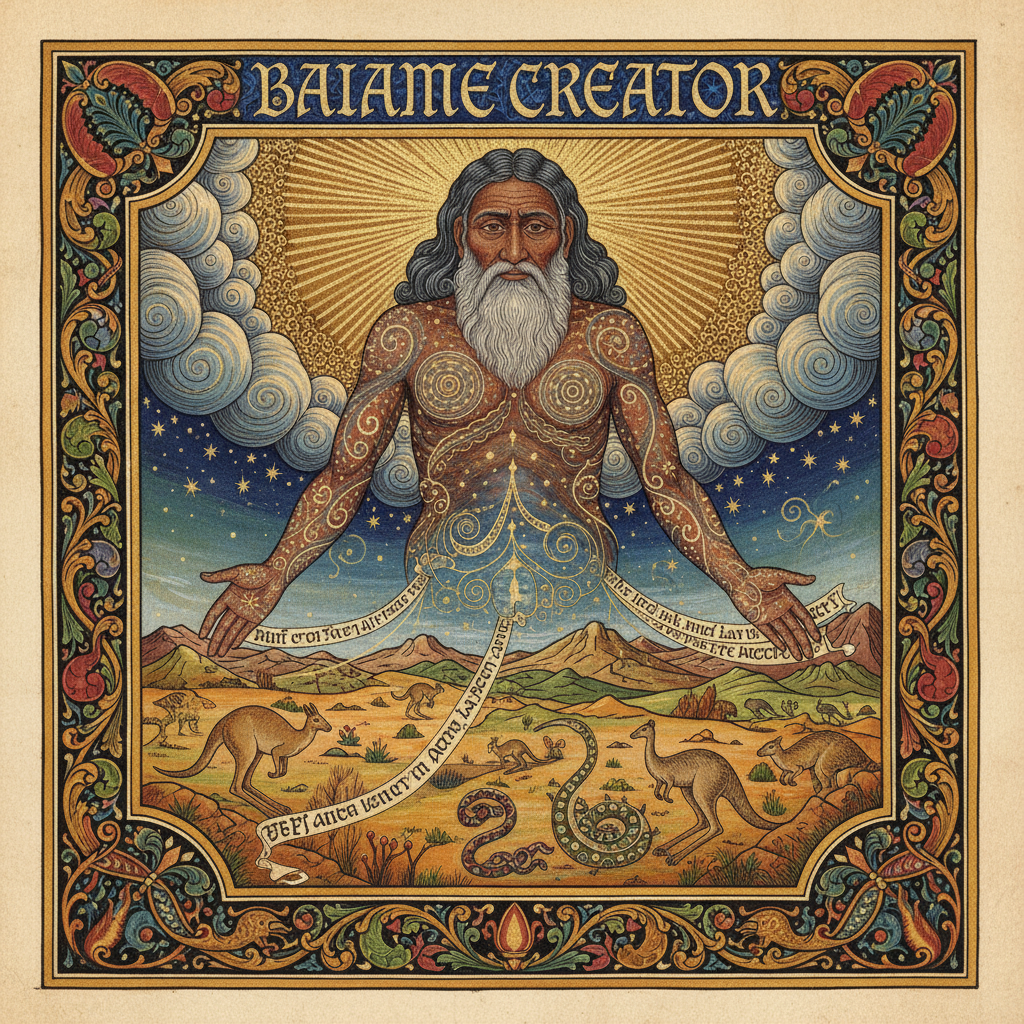
Baiame establishes immutable laws across creation, binding all beings to the moral order and punishing those who violate celestial law.
Dreamtime Authority
Baiame's presence reinforces the cosmic order; all around him are bound by the laws of creation and cannot act against the established moral code.
Distant -- like many supreme beings, Baiame created the world and its laws and then withdrew to the sky, leaving enforcement to lesser beings and to human ceremony
“Baiame made all things. He made the mountains and the plains, the rivers and the trees. He made the animals and the birds. And he made the laws.”
Lore: Baiame (also spelled Biame, Byamee, Baayami) is the supreme being of many southeastern Aboriginal nations, particularly the Kamilaroi (Gamilaraay) and Wiradjuri peoples. He is the All-Father, the creator who made the land and everything in it, who established the moral and ceremonial laws, and who then ascended to his sky-camp, Bullima, from which he watches over the world. His wife is Birrahgnooloo (sometimes Birranulu), who sends rain and fertility. His son, Dharramalan (or Daramulun), serves as intermediary between Baiame and humanity and is central to initiation ceremonies.
Baiame is a lawgiver above all else. He established the rules of kinship, marriage, ceremony, and land management. The bora ceremonies — male initiation rituals of immense significance — are attributed to his teaching. To undergo bora is to learn the law, and the law is Baiame’s. He does not intervene capriciously. He established the order and withdrew, trusting (or requiring) that humanity maintain it through proper ceremony and behavior.
The Baiame sites in New South Wales — including rock engravings at Wanaruah country (Milbrodale) and Dharawal country — are among the most significant sacred sites in southeastern Australia. The Milbrodale figure is a massive rock engraving, arms outstretched, overlooking the valley. It is not a representation of Baiame. It is Baiame’s presence in the land.
Parallel: The pattern of a supreme creator who makes the world, establishes law, and then withdraws to the sky is one of the most widespread theological structures on Earth. Scholars call it deus otiosus — the “idle god.” Olodumare (Yoruba) creates the world and withdraws to heaven. Anu (Mesopotamian) presides over the divine council but rarely acts directly. YHWH in the later biblical tradition becomes increasingly transcendent, acting through angels and prophets rather than directly. In Hindu theology, Brahman is the ultimate reality but is experienced through the active gods (Vishnu, Shiva). The Aboriginal version is distinctive in that Baiame’s withdrawal is not abandonment — it is trust. He gave the law. He gave the ceremonies. The rest is up to the people.
Early colonial missionaries, encountering Baiame, declared him evidence that Aboriginal peoples had a “primitive monotheism” compatible with Christianity. This was a profound misreading. Baiame is not the Christian God. He does not demand exclusive worship. He does not promise salvation. He does not threaten damnation. He made the law and the land, and he expects both to be maintained. The relationship is not faith-based. It is obligation-based.
2 min read
None counter Baiame directly. He is the ultimate authority. But his laws can be violated, and the consequences fall on the violators
Berndt & Berndt, *The World of the First Australians*; Elkin, *The Australian Aborigines*; Stanner, *On Aboriginal Religion*