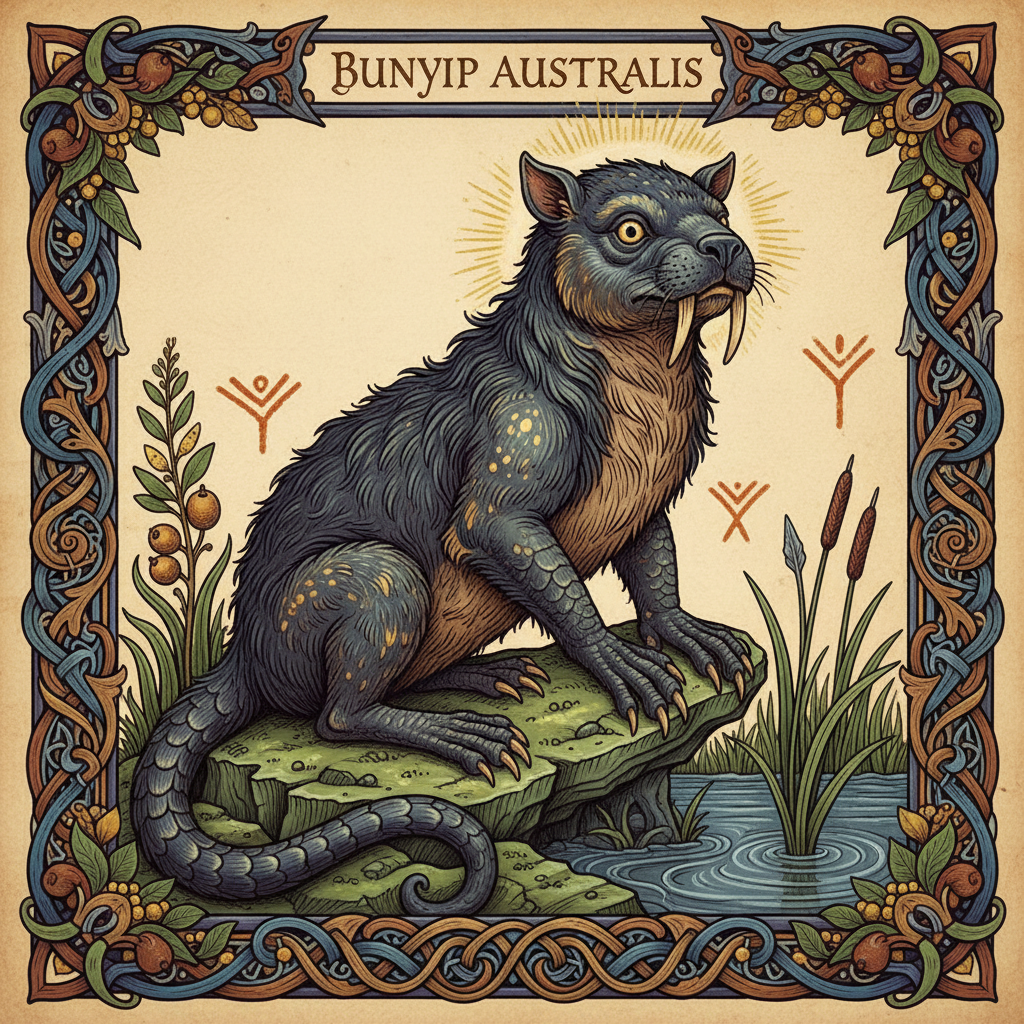
Combat Profile
Billabong Wrath
Bunyip creates a devastating whirlpool that drowns entire regions, pulling everything into the depths with irresistible force.
Dreamtime Guardian
Bunyip cannot be harmed within its sacred waterway and grows stronger as the sun sets, embodying the primal terror of untamed waters.
Largely confined to its waterhole. Does not pursue victims far from water
“Don’t go near that waterhole. Something lives in it.”
Lore: The Bunyip is among the most widely known figures of Aboriginal tradition, though also among the most distorted by colonial retelling. Descriptions vary enormously: it has been described as having a dog-like face, a long neck, flippers, a horse’s tail, tusks, or no consistent form at all. This variation is not confusion — it reflects the fact that different nations have different water beings associated with different waterholes, and the colonial practice of lumping them all under one English word (“Bunyip”) obscures a rich diversity of local traditions.
What the various accounts share is function: the Bunyip (or its local equivalent) is the danger that lives in water. It inhabits billabongs, swamps, rivers, and waterholes. It is heard roaring at night. It seizes people who venture too close. And it serves, across all its variations, as a profound piece of ecological education: water is dangerous. In a continent of drought and flood, of billabongs with invisible drop-offs and rivers with sudden currents, of saltwater crocodiles in the north and unstable banks in the south, the Bunyip encodes survival knowledge in story form. “Don’t go near the water without an elder” is harder to remember than “a monster lives in there.”
Parallel: The water monster that enforces territorial boundaries around dangerous water is a global phenomenon. The kappa (Japanese) drowns people in rivers and can only be defeated by bowing (causing it to bow back and spill the water from the dish on its head). The taniwha (Maori) guards waterways and river bends. Jenny Greenteeth (English) lurks in ponds to drown children. The vodyanoy (Slavic) drags swimmers under. Nykur/Nix (Scandinavian) appears as a beautiful horse by the water’s edge and drowns those who mount it. In every case, the function is identical: encode danger-awareness in story form. The Bunyip belongs to this global family of cautionary water spirits. The consistency of the pattern across cultures with no contact suggests that dangerous water and the stories people tell about it co-evolve wherever humans and waterways meet. In Hindu tradition as well, sacred rivers hold both blessing and danger.
2 min read
Distance from water; staying on the banks; obeying the warnings of elders
Berndt & Berndt, *The World of the First Australians*; colonial accounts compiled by Holden, *Bunyips*; various publicly shared Aboriginal accounts