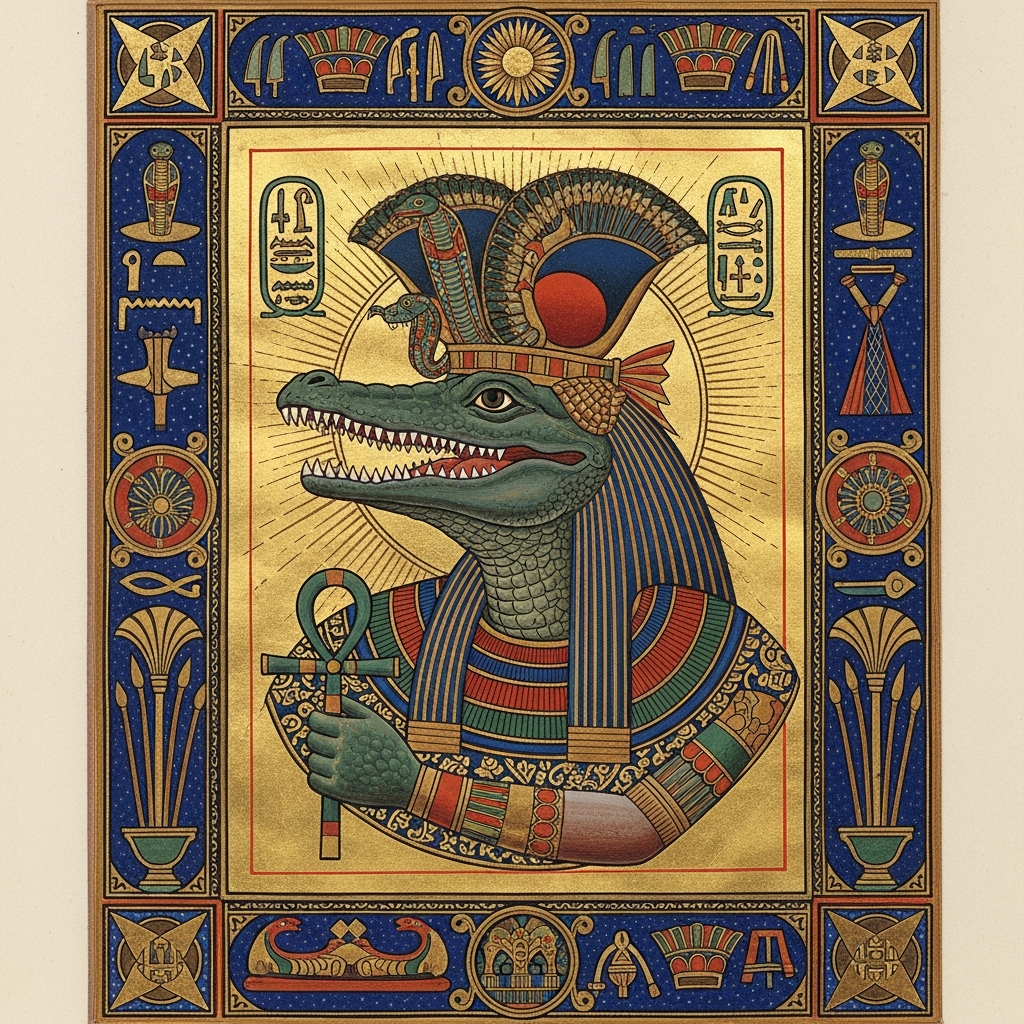
Combat Profile
Nile's Wrath
Sobek floods the battlefield with devastating torrential force, drowning enemies in the inundation's fertile but merciless power.
Crocodilian Dominion
Sobek commands fear and respect from all creatures of water and war; allies gain strength in wetlands while enemies fear his predatory presence.
“I am Sobek, who dwelleth amid his terrors. I am Sobek, lord of the bend in the river.” — Pyramid Text 317
Sobek is power without sentiment — the crocodile that is both the Nile’s protector and its lurking horror. Egyptians both feared him and venerated him. At Crocodilopolis (Greek for the city of Shedet, in the Faiyum), priests kept sacred crocodiles in pools, fed them roasted meat and honey-cakes, adorned them with golden earrings (Herodotus, Histories 2.69), and mummified them by the thousands. Some pharaohs took him as their patron precisely because his ferocity was useful: the Middle Kingdom’s military Sobek-pharaohs (Sobekhotep III, IV; Sobekneferu, the first confirmed female pharaoh) bore his name. He was also a fertility god: the Nile flood brought crocodiles, and crocodiles brought fertility — a connection most foreign cultures missed.
Cross-tradition parallels: Leviathan (Job 41 — the great water-monster YHWH alone can master, with overlapping crocodilian imagery); Tiamat (Mesopotamian primordial water-dragon); Makara (Hindu sea-monster ridden by Varuna and Ganga).
1 min read
Pyramid Texts (Spell 317); Coffin Texts; the Crocodilopolis temple at Shedet/Crocodilopolis (Faiyum); Herodotus, *Histories* 2.69