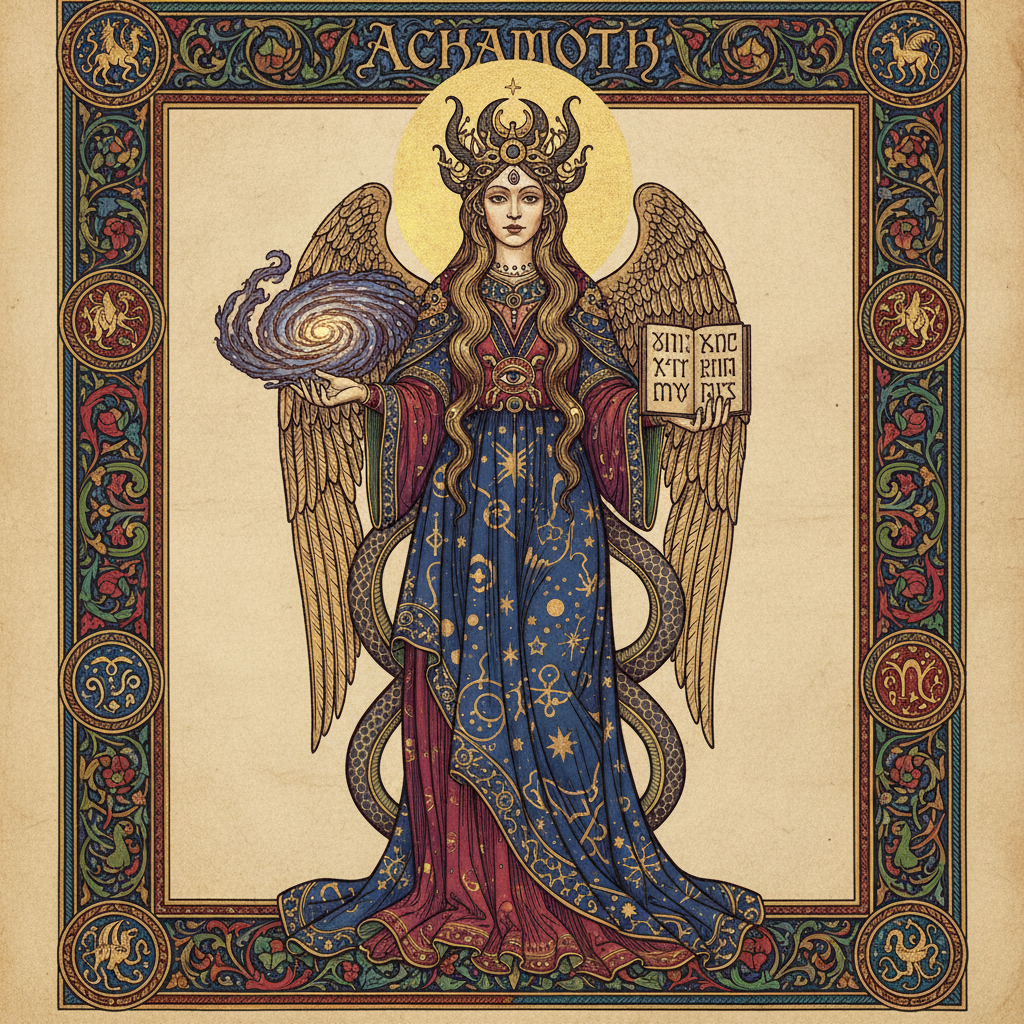
Combat Profile
Weeping Genesis
Achamoth floods reality with raw emotion and desire, summoning the material world and all its suffering into manifested form.
Sophia Fallen
All beings within Achamoth's presence experience heightened passion and grief; her sorrow is the fabric from which matter itself is woven.
Formless without Christ's intervention; her emotions are the raw substance of a broken world
“From her tears came the waters. From her laughter came light. From her grief came the elements. From her confusion came the Demiurge.”
Lore: Achamoth is the Valentinian innovation that transforms Gnostic cosmology from myth into poetry. In the Valentinian system, the higher Sophia’s unauthorized desire produced not the Demiurge directly, but a lower version of herself — Achamoth (from the Hebrew Hokhmah, “wisdom”; Irenaeus, Against Heresies 1.4-5). This lower Sophia was expelled from the Pleroma, cast out into the void, formless and desperate. And here is the Valentinian genius: Achamoth’s emotions became the raw materials of the physical world.
Her grief became water. Her fear became wind and air. Her confusion became solid earth. Her terror became fire. The entire material universe is not merely a mistake or a prison — it is crystallized suffering. Every river is a tear. Every storm is a moment of panic. Every mountain is bewilderment made solid. The Valentinians looked at the physical world and saw not creation but a woman’s anguish made material. When Christ descended from the Pleroma to give Achamoth form (shape, definition, gnosis), she experienced joy for the first time — and from that joy came the spiritual element, the divine spark hidden within the prison of matter.
Parallel: Achamoth has no precise parallel in any other tradition because no other system derives the physical elements from emotions. The closest analogues are: Tiamat (Babylonian), whose dismembered body became the sky and earth — but Tiamat was killed, not grieving. In Hinduism, Prakriti (primordial matter) emanates from Purusha, but without the emotional content. The Valentinian idea that matter is literally made of feelings is unique in the history of religion. It anticipates, by 1,800 years, the Romantic poets’ intuition that nature is a mirror of the soul — except the Valentinians meant it literally.
1 min read
The Demiurge, who was born from her confusion and then imprisoned her creation
Irenaeus, *Against Heresies* 1.4-5; *The Tripartite Tractate*; Rudolph, *Gnosis*