Combat Profile
Courtroom Dominion
Dr. Buzzard ensures legal victory through mystical influence over judges, juries, and proceedings, bending the scales of justice in favor of the righteous.
Root Doctor's Authority
His deep knowledge of hoodoo practices and ancestral spirits grants him unmatched power to protect communities and expose hidden truths in matters of law.
Mortal. Dr. Buzzard was a man, not a spirit, and he died in 1947. His power was in his reputation as much as his rootwork -- and reputation can be challenged. When a rival rootworker was hired by the opposing side in a court case, the battle became rootworker against rootworker, and the outcome was uncertain
“If you got a case coming up, you better go see Dr. Buzzard before you see your lawyer.”
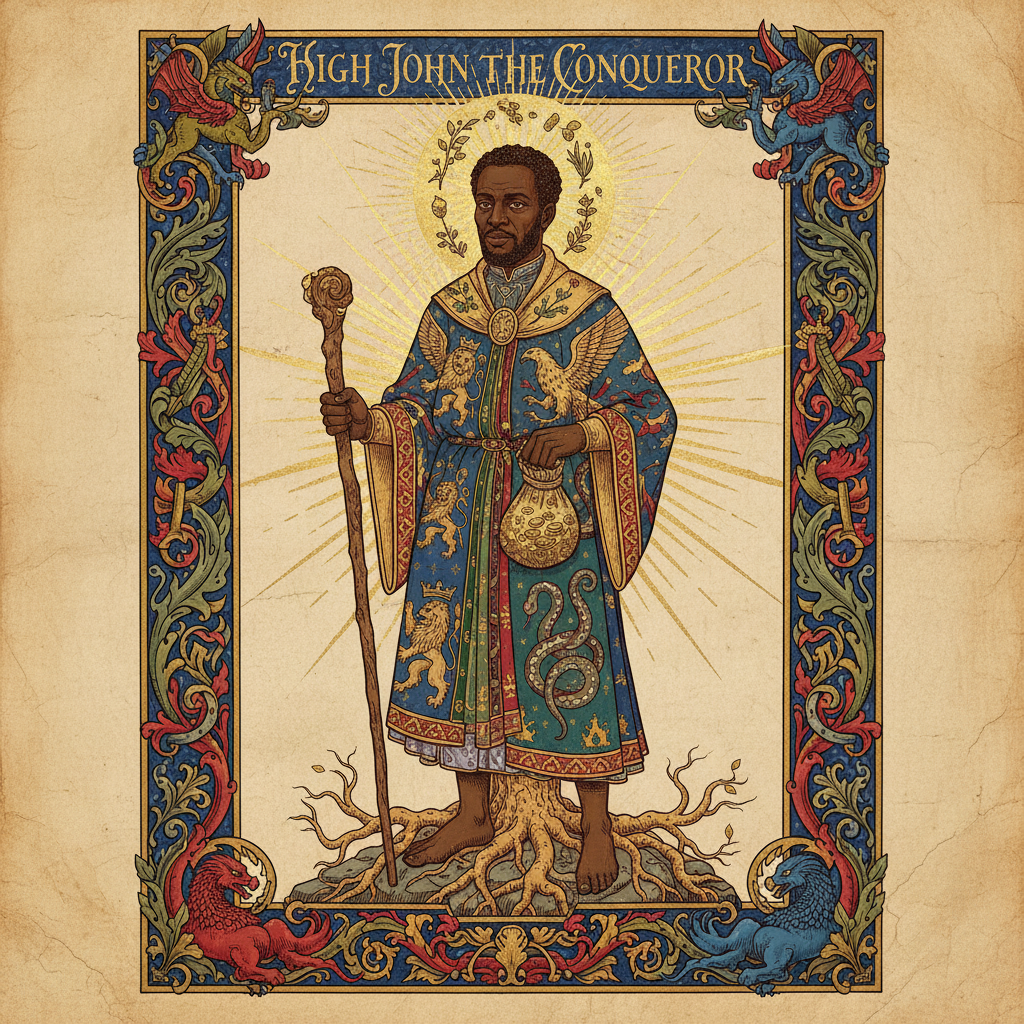
Lore: Stephany Robinson — known universally as Dr. Buzzard — was the most famous Hoodoo practitioner of the 20th century, and his story illustrates something essential about Hoodoo’s social function. Operating in the Gullah/Geechee communities of the South Carolina Sea Islands (Beaufort County) from the early 1900s until his death in 1947, Dr. Buzzard was a rootworker who specialized in court cases. In a legal system built to oppress Black people, where the law was an instrument of white supremacy and a fair trial was a fantasy, Dr. Buzzard offered an alternative justice system. He chewed calamus root or galangal (Little John to Chew) in the courtroom and spat the juice toward the jury box. He prepared mojo bags for defendants. He dressed their clothes with specific oils before trial. And his clients won. With a consistency that defied statistical probability, Dr. Buzzard’s defendants walked free.
His reputation was so powerful that it operated on both sides of the legal system. Defense attorneys sent their clients to Dr. Buzzard before trial. Prosecutors knew that if Dr. Buzzard was working the other side, the case was in trouble. Police officers consulted him. Even some judges were said to respect (or fear) his power. This was not superstition — or rather, it was superstition that worked, because in a community where everyone believed in rootwork, Dr. Buzzard’s involvement changed the psychology of the courtroom. Witnesses became nervous. Jurors became uncertain. The machinery of unjust prosecution developed hiccups and stutters that it could not explain to itself.
Parallel: Dr. Buzzard maps onto the cunning folk tradition of Europe — the village practitioners who operated at the intersection of folk magic, herbalism, and community dispute resolution. The cunning man or wise woman in English folk tradition could break curses, find stolen property, and identify witches, and was consulted by people at every social level, including magistrates. The angakkuq (Inuit shaman) served a similar social function: a specialist in spiritual technology who operated outside institutional religious authority but was consulted by the entire community, including its leaders. In Japanese tradition, the onmyoji (yin-yang masters) were court-appointed spiritual practitioners who influenced legal and political decisions. What makes Dr. Buzzard distinctly American is the racial dimension: his power existed in, and was a response to, a legal system designed to destroy Black people. His rootwork was not just magic — it was resistance.
2 min read
Stronger rootwork. In the world Dr. Buzzard operated in, the counter to one rootworker's power was another rootworker's power. Law enforcement, which consulted him rather than opposing him, was not a counter -- it was a client
Chireau, *Black Magic*; Long, *Spiritual Merchants*; Roger Pinckney, *Blue Roots: African-American Folk Magic of the Gullah People* (2003)