Combat Profile
Bondage Accretion
karma accumulates upon souls through action, intention, and passion, binding them to cycles of birth and death until austerity burns away the karmic matter
Immutable Law
karma operates as an impersonal, mechanical force that responds precisely to the moral weight of every deed, thought, and desire without judgment or mercy
Austerity (*tapas*), right conduct, right knowledge, right faith -- the Jain three jewels
“As dust clings to a freshly oiled lamp, karma clings to a soul inflamed by passion. The lamp untouched by oil — the soul without passion — gathers nothing.” — traditional Jain teaching
Lore: The Jain conception of karma is the most distinctive and philosophically radical in the history of religion: karma is not a metaphor, not a law of moral consequence, not a divine judgment system. Karma is matter. Actual, physical particles (karma-varganas) that exist throughout the universe and that are drawn to the soul when the soul experiences passion — anger, pride, deceit, or greed. The soul is an actual, non-material entity (jiva) that in its pure state is infinite in knowledge and bliss. The karmic particles that attach to it dim its knowledge (like clouds covering the sun) and drag it down into the cycle of rebirth (samsara).
This makes liberation a physical project as much as a spiritual one. You must stop generating new karma (by eliminating passion — the influx is called asrava) and you must destroy the karma already accumulated (through austerity — tapas — which literally burns the karmic particles away). The Jain monk who stands naked in the cold, fasts, endures physical discomfort without complaint, is doing something specific: generating the intense experience that burns off accumulated karmic matter. The austerity is not punitive. It is incendiary.
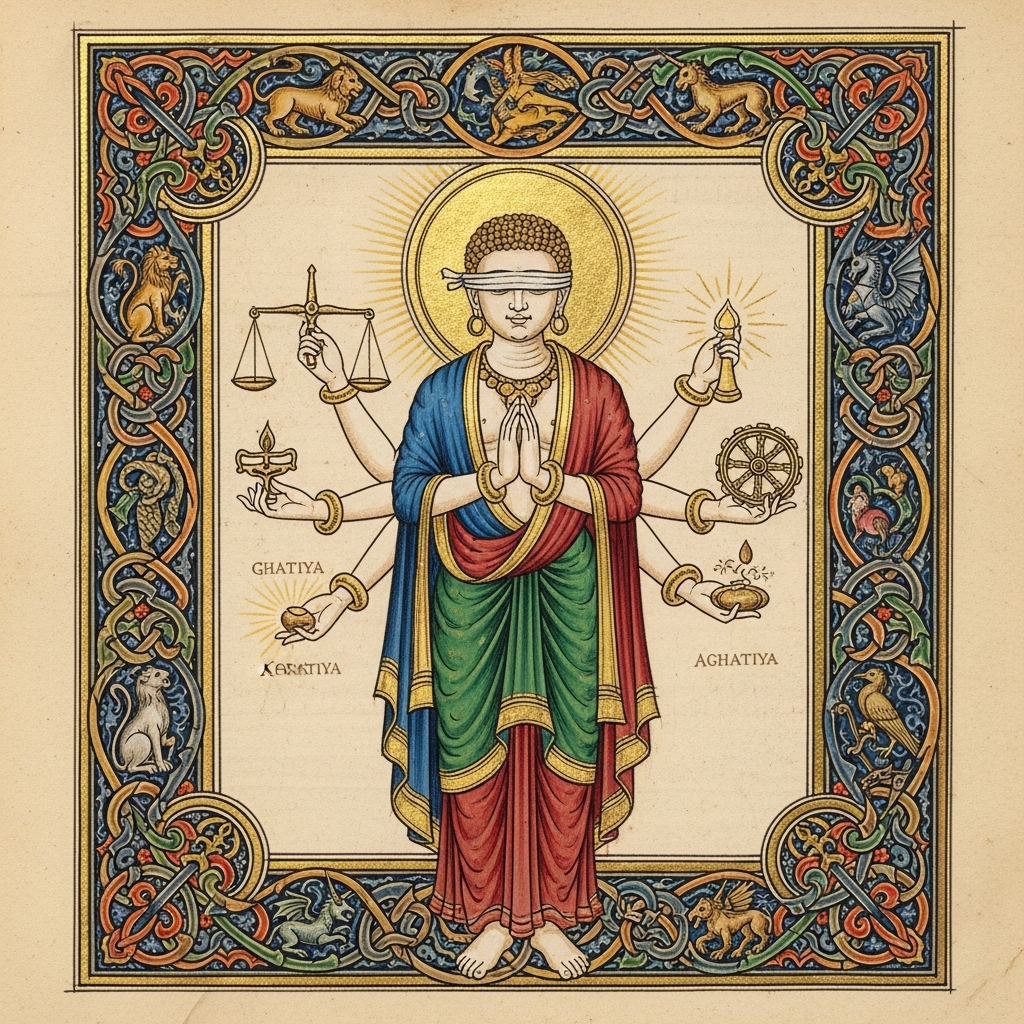
Eight types of karma govern the soul’s experience (Tattvartha Sutra 6.1-6.8). The mohaniya (deluding) karma creates the passions themselves and is the most dangerous. The jnanavaraniya (knowledge-obscuring) karma prevents omniscience. The darshanavaraniya (perception-obscuring) karma prevents pure perception. The antaraya (obstructing) karma blocks the soul’s natural energy, charity, and willpower. The four remaining types govern the name, status, lifespan, and family the soul is born into (Samayasara, Kundakunda). Liberation (moksha) requires removing every particle of every type. Not reducing them — removing them entirely.
Parallel: Hindu karma (action and its consequences — a law of moral cause and effect operating across lifetimes). Buddhist karma (intention-based — it is the intention behind an act, not the act itself, that generates karma). The Jain concept is unique in making karma physically real and making liberation a project of physical removal. It resembles, structurally, the Scientological concept of engrams — actual particles of negative experience that must be cleared. Jainism predates L. Ron Hubbard by approximately 2,500 years.
2 min read
Renunciation; the complete elimination of the four passions (*kashaya*); ultimately, *nirvana*/*moksha*
*Tattvartha Sutra* (Umasvati, chapter 6-8); *Karma-grantha*; Padmanabh Jaini, *The Jaina Path of Purification*