Combat Profile
Sparagmos
Dionysus Zagreus tears reality asunder and reforms it, dealing catastrophic damage while resurrecting fallen allies with restored vitality.
Divine Spark
Dionysus Zagreus embodies the eternal cycle of death and rebirth, granting all allies temporary invulnerability after resurrection and increasing their power proportional to sacrifice endured.
As an infant, was lured by the Titans with toys and a mirror and torn apart before he could defend himself
“Bacchus himself has set you free.” — Orphic gold tablet formula addressed to Persephone
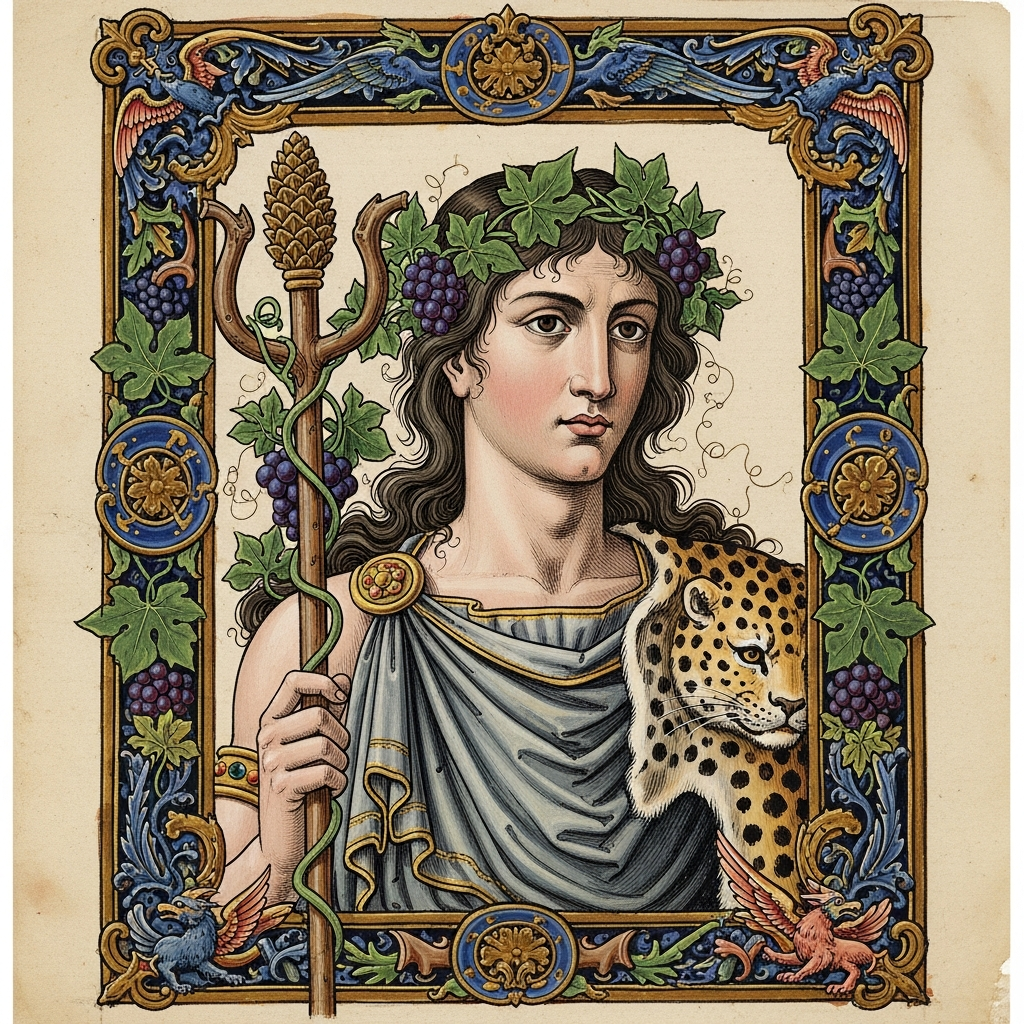
The Orphic Dionysus is not the jolly wine god of public cult. He is Zagreus — “the great hunter” or “torn in pieces” — and his story is the theological engine of the entire Orphic system. Born of Zeus and Persephone (Zeus having visited Persephone in the underworld in serpent form), the infant Zagreus was the favored child destined to inherit the world. The Titans, jealous and perhaps at Hera’s instigation, lured the infant with mirrors and toys, dismembered him, and ate him. Athena (or in some versions, Zeus himself) saved the heart. Zeus destroyed the Titans with his thunderbolts. From the heart, Dionysus was reconstituted and reborn — hence “twice-born.”
The theological payload of this myth is enormous. Humanity was created from the ashes of the destroyed Titans — but the Titans had consumed the flesh of Dionysus, so human beings carry within them BOTH the divine spark (Dionysus’s flesh, absorbed by the Titans before their destruction) AND the Titanic nature (evil, earthbound, opposed to the divine). This is the Orphic doctrine of human nature: we are not simply creatures or simply fallen beings. We are the battlefield. Every human soul contains a fragment of the dismembered god, imprisoned in a body descended from his murderers.
This is the Greek version of what Christianity calls original sin and what Gnosticism calls the divine spark trapped in matter. The parallel to Gnostic theology is nearly exact: the divine (Dionysus’s flesh) is imprisoned in the material (Titanic ash), and the goal of the religious life is to purify away the Titanic element and liberate the divine. The means differ — Orphism uses vegetarianism, ritual purity, and initiatory knowledge; Gnosticism uses gnosis — but the diagnosis is identical.
Compare: Original sin (the human dual nature — sinful clay animated by divine breath); the Gnostic divine spark (light particles from the divine realm trapped in matter by the Demiurge); Purusha (the dismembered cosmic being whose body parts became the world in the Rigveda 10.90); Osiris (dismembered and reconstituted, continuing to reign as lord of the dead).
2 min read
The Titans (who dismembered and consumed him); mortality (which is built from their ashes)
Pindar, *Dirges* fr. 133; Plato, *Laws* III.701c; *Rhapsodic Theogony* (Orphic); Proclus; Olympiodorus, *Commentary on Phaedo*; Burkert, *Ancient Mystery Cults*