Combat Profile
Descent into Hades
Orpheus traverses the boundary between life and death, temporarily resurrecting fallen allies or retrieving lost knowledge from the underworld itself.
Harmonic Ascent
Orpheus's music reverberates across all planes of existence, granting nearby allies enhanced perception and resistance to entropy.
Torn apart by Maenads for his asceticism after Eurydice's loss; could not resist looking back
“I am a child of Earth and Starry Heaven, but my race is of Heaven alone. I am parched with thirst and am dying: give me quickly the cold water flowing from the Lake of Memory.” — Orphic gold tablet (burial instruction for the afterlife)
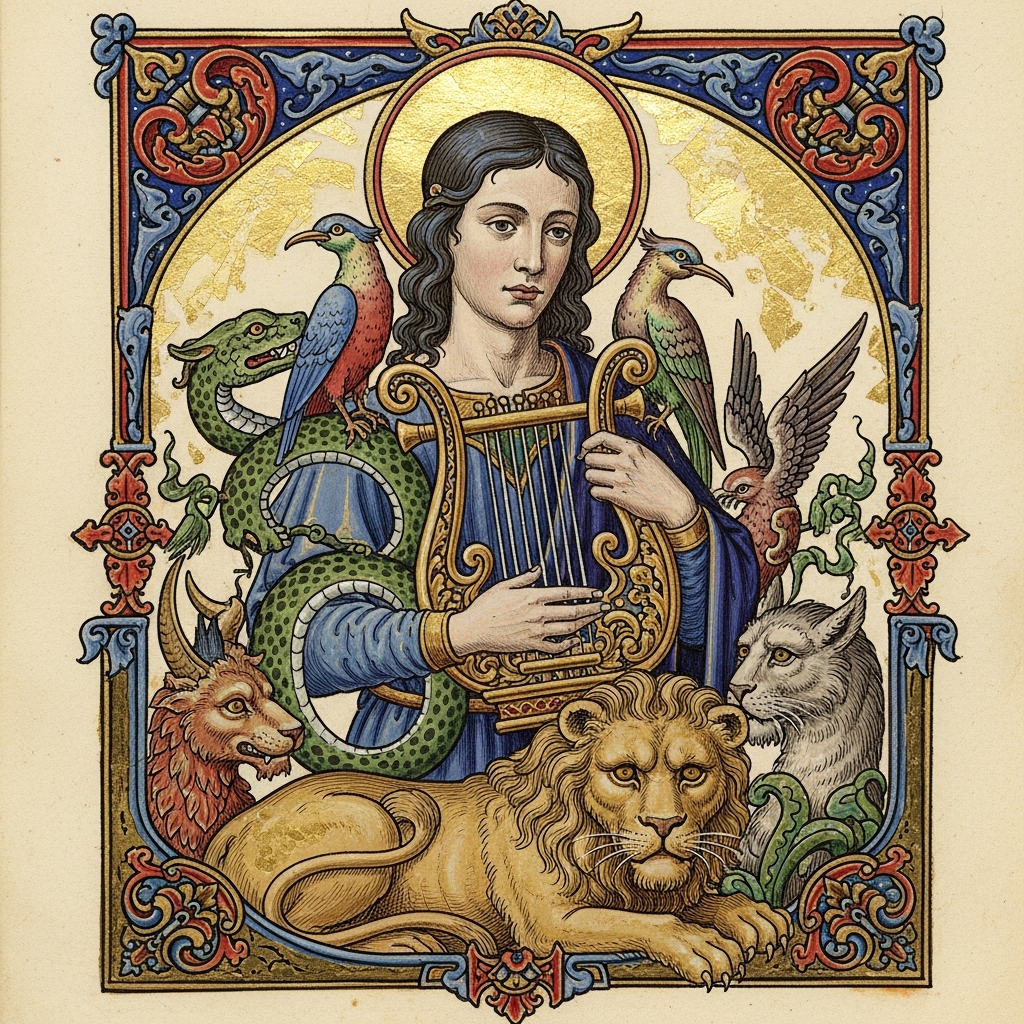
Orpheus is two figures in one, and the gap between them is the gap between public myth and mystery religion. The popular Orpheus is a musician whose love for Eurydice drove him to descend to the underworld. He charmed Hades and Persephone with his lyre, was granted Eurydice’s return on the condition he not look back, looked back, and lost her forever. He wandered inconsolable, refused all women, and was torn apart by Maenads — Dionysiac worshippers — for his rejection of them. His severed head floated down the Hebrus river still singing, and was enshrined at Lesbos, where it continued to give oracles.
The mystery tradition takes this myth and reads it as theological biography. Orpheus descended to the underworld and returned — he crossed the boundary of death and came back with knowledge. His dismemberment by the Maenads is structurally identical to the dismemberment of Dionysus Zagreus: the sacred figure is torn apart and continues to function after death. His head-that-keeps-singing anticipates the doctrine of the soul’s survival beyond the body. And the tradition he founded — the Orphic mysteries — provided initiates with something the public religion could not: instructions for navigating the afterlife successfully, written on gold tablets and buried with the dead.
In early Christian art, Orpheus is sometimes literally depicted as Christ: the Good Shepherd taming wild animals with his music, surrounded by peaceable creatures, with the lyre exchanged for the cross. The theological overlap is structural: both descend to the realm of the dead, both are violently killed, both teach that death can be transcended through knowledge and purity, and both continue to function (teaching, prophesying, offering salvation) after their deaths.
Compare: Christ (descent-death-continued teaching; the Good Shepherd parallel); Osiris (dismembered, continued authority after death); the Buddha (attained knowledge beyond death-and-rebirth, teaches the path to others); the Gnostic Revealer (secret knowledge as the mechanism of salvation).
2 min read
The Maenads (who dismembered him); his own grief (which caused his fatal backward glance)
Orphic Hymns; Orphic Gold Tablets; Virgil, *Georgics* IV; Ovid, *Metamorphoses* X-XI; Plato, *Republic* II.364e; Guthrie, *Orpheus and Greek Religion*